Government Committee Surveys Flood Damage in Taiz as Governorate Records Yemen’s Heaviest Losses
 Yemen Herald News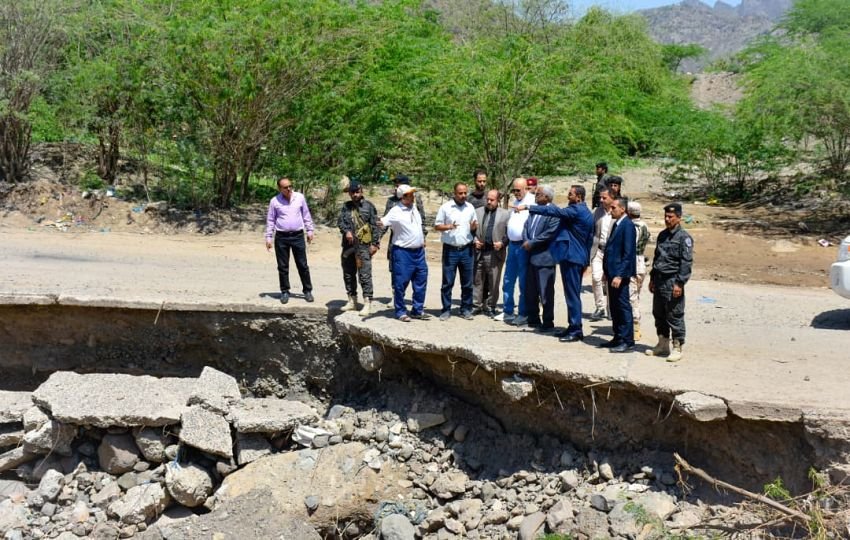
Taiz recorded the heaviest damage of any Yemeni governorate in the floods and heavy rains that swept the country from late March into the end of April 2026. Assessments compiled by local authorities and relief agencies at the time put the number of affected families in the governorate at roughly 9,790, equivalent to close to 68,000 people, and Yemeni officials reported dozens of deaths and thousands of families forced from their homes across the province.
A government committee travelled through the worst-hit districts to quantify the losses, inspecting collapsed roads, breached retaining walls, damaged water networks and farmland stripped by run-off. A wider government meeting in Taiz, chaired by the Minister of Local Administration, Badr Basalama, reviewed the district reports and the emergency committees that local authorities had formed to coordinate the response. Yemen’s prime minister separately directed government bodies to move immediately on repairs and relief for the province.
Nationally the picture was severe. United Nations reporting for the period said floods and windstorms affected more than 100,000 people across twenty governorates, killed or injured well over a hundred, damaged tens of thousands of family homes and displaced more than a thousand families in the worst-hit areas. Al Hudaydah, Hajjah and Marib were also badly affected, with Hudaydah alone reporting several thousand displaced families.
Taiz was poorly placed to absorb any of it. The city sits in mountainous terrain in Yemen’s south-west, where steep wadis channel seasonal rain into built-up areas with little warning, and it has spent much of the past decade close to active front lines. Front-line conditions have restricted road access, delayed maintenance of drainage and water infrastructure and complicated the movement of repair crews and aid convoys. Municipal budgets that were already inadequate before the war have been further eroded by currency depreciation and irregular revenue.
That combination turns a heavy rainy season into a disaster rather than a nuisance. Drainage channels that were not cleared silt up and overflow. Retaining walls that were not repaired give way. Informal settlements built on marginal ground, often by families already displaced by fighting, sit directly in the path of run-off. Aid agencies noted during the response that the households hit hardest were frequently those who had been displaced once already and had the least capacity to absorb a second loss.
The floods also stirred up a hazard specific to Yemen. Relief organisations warned during the emergency that water had shifted landmines and unexploded ordnance from known contaminated areas into farmland, riverbeds and residential districts, moving devices away from the maps that clearance teams work from. Mine action groups treat that displacement as one of the most dangerous secondary effects of flooding in the country, because it puts unmarked explosive remnants into places people consider safe.
Agriculture accounted for a large share of the losses that the committee recorded. Taiz depends heavily on rain-fed and terraced farming, and run-off that arrives too fast strips topsoil, breaks terrace walls and destroys standing crops rather than watering them. Farmers who lose a season lose both their income and the seed for the next planting, and rebuilding terracing is labour-intensive work that households rarely finance on their own. Livestock deaths compound the effect, because animals function as a store of savings for families with no access to banking.
Public health was the other immediate concern. Damage to water and sanitation systems in a country that has repeatedly faced cholera outbreaks raises the risk of waterborne disease within weeks of a flood, and clinics in affected districts were already operating with limited supplies and irregular staffing. Humanitarian agencies prioritised clean water, emergency shelter and mobile health teams alongside the distribution of food and household items.
The response ran into the constraint that has shaped every emergency in Yemen. More than twenty million people in the country were assessed as needing humanitarian assistance during 2026, and the appeal covering that caseload has for several years been funded well below requirement. Money moved to flood relief in Taiz was, in practice, money not spent elsewhere, and agencies said openly that scaling up in one governorate meant reducing activity in another.
Reconstruction is where the damage becomes durable. Roads, bridges and water systems require capital spending and functioning procurement, and a divided administration with contested revenue collection is not well equipped to deliver either at scale. Repairs after previous flood seasons in Yemen have frequently been partial, which is one reason the same districts appear in assessment reports year after year. Without investment in drainage and catchment management, the next heavy rains are likely to produce a comparable result.
There is a longer pattern behind the individual season. Yemen’s rainfall has become more erratic, with longer dry periods interrupted by intense downpours that arrive faster than the ground or the drainage can take. Terracing and catchment systems that once managed water on the country’s mountain slopes have been degraded by decades of neglect and by the war, reducing the landscape’s own capacity to slow run-off.
For the families counted in the Taiz assessment, the practical consequences outlasted the coverage. Shelter materials, restored water supply and repaired access roads determine whether a household returns home or joins the displaced population permanently. The government committee’s survey established the scale of what was lost in April 2026; what happened to those figures afterwards depended on funding and on repair work that has historically arrived slowly.
About the Author