The Strategic Implications of the USS Abraham Lincoln’s Deployment in the Arabian Sea
 Yemen Herald News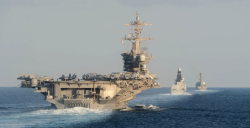
The recent deployment of the USS Abraham Lincoln in the Arabian Sea is not merely a show of military might; it represents a pivotal moment in the ongoing geopolitical chess game involving Iran, the United States, and their regional allies. The maneuver underscores the escalating tensions in the Middle East and the broader implications for global energy security and regional stability.
The Arabian Sea has long been a critical maritime route, essential for the transport of oil and gas from the Persian Gulf to global markets. The United States has maintained a significant naval presence in this region to safeguard these vital shipping lanes, particularly in light of Iran’s aggressive posturing and its attempts to exert influence over neighboring countries. The blockade operations conducted by the USS Abraham Lincoln are part of a broader U.S. strategy aimed at countering Iranian expansionism and ensuring the free flow of commerce. This strategy has intensified since the U.S. withdrawal from the Joint Comprehensive Plan of Action (JCPOA) in 2018, leading to heightened tensions and a series of confrontations at sea.
The USS Abraham Lincoln, equipped with advanced stealth capabilities and a formidable air wing, is currently conducting blockade operations aimed at intercepting Iranian oil tankers. The deployment is significant not only for its military capabilities but also for its timing, coinciding with increased Iranian threats to disrupt maritime traffic in the region. The presence of U.S. Marines and additional naval assets, such as the USS New Orleans, further amplifies the operational capacity of the U.S. forces in the area. CENTCOM’s announcement of these operations signals a clear message to Tehran: the U.S. will not tolerate any attempts to undermine maritime security or threaten its allies in the Gulf.
The implications of the USS Abraham Lincoln’s operations are profound. Politically, this deployment reinforces the U.S. commitment to its allies in the region, particularly Saudi Arabia and the United Arab Emirates, who are increasingly concerned about Iranian aggression. Economically, the blockade operations could disrupt Iranian oil exports, which are already under severe strain due to U.S. sanctions. This could lead to increased oil prices globally, affecting economies that rely heavily on stable energy prices. Security-wise, the heightened military presence raises the risk of direct confrontation between U.S. and Iranian forces, which could spiral into a broader conflict, destabilizing the entire region.
The deployment of the USS Abraham Lincoln is a calculated move within a larger framework of U.S. foreign policy aimed at containing Iran. This strategy, often referred to as the “distant blockade,” relies on a combination of naval power, aerial surveillance, and intelligence operations to monitor and intercept Iranian activities. The risks associated with this approach are significant; while it may deter Iranian aggression in the short term, it also risks provoking a military response from Tehran. Iran’s ability to retaliate asymmetrically through proxy forces in Iraq, Syria, and Yemen complicates the U.S. military calculus. The potential for miscalculation or unintended escalation remains high, particularly in a region where tensions are already fraught.
Looking ahead, several scenarios could unfold as a result of the USS Abraham Lincoln’s operations. If the blockade successfully disrupts Iranian oil exports, Tehran may escalate its military actions, potentially targeting U.S. assets or allies in the region. Conversely, if the U.S. maintains its current posture without provoking a direct confrontation, it could lead to a temporary stabilization of the situation, albeit with ongoing tensions. Another possibility is that diplomatic channels may reopen, as both sides seek to avoid a costly conflict. However, given the current trajectory of U.S.-Iran relations, this seems unlikely in the near term. The situation remains fluid, and the stakes are high for all parties involved.
The deployment of the USS Abraham Lincoln in the Arabian Sea is a critical juncture in the ongoing struggle for influence in the Middle East. It highlights the U.S. commitment to countering Iranian aggression while simultaneously raising the specter of potential conflict. As the situation evolves, the implications for regional stability, global energy markets, and U.S. foreign policy will be profound. The world watches closely as this naval operation unfolds, aware that the balance of power in the Middle East hangs in the balance.
About the Author