The Vice Foreign Affairs Minister and State Minister discussed relations with Germany.
 Yemen Herald News
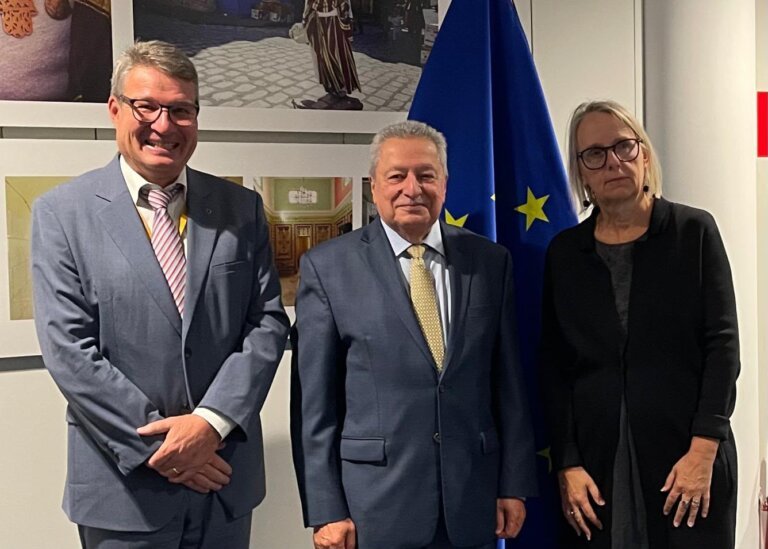
On a recent occasion in Oslo, Yemen’s Vice Minister of Foreign Affairs and Expatriates, Mustafa Noman, met with Niels Annen, Germany’s Minister of State for Foreign Affairs. This meeting was a part of the Oslo Forum for Mediation, an annual event that convenes high-level policymakers and mediators to discuss conflict resolution strategies. During their discussions, Noman and Annen focused on a broad array of issues pertinent to strengthening bilateral relations between Yemen and Germany.
The talks encompassed Germany’s ongoing support for Yemen, which spans political endorsement, development initiatives, and humanitarian aid. Both officials reaffirmed Germany’s role as a critical ally in the quest for peace and stability in Yemen. They acknowledged the pressing need for increased international involvement to bolster the Yemeni political process, highlighting how crucial it is to mitigate the long-standing crises afflicting the nation.
In focusing on development and humanitarian support, Noman and Annen stressed the importance of aligning initiatives with the Yemeni government’s plans and priorities. Such alignment is essential for ensuring that aid is effective and reaches those most in need. Their dialogue reinforced a commitment to enhancing partnerships that can facilitate recovery and rebuilding efforts across the country.
The key players in Yemen’s current scenario include various national and international stakeholders. On the local front, the Yemeni government, led by the Presidential Leadership Council, continues to represent the official authority of the country. This coalition faces the daunting task of navigating complex relationships with regional governments and military factions, including the Houthis movement, which controls significant territories in the north.
Internationally, Germany stands out as an influential advocate for Yemen’s humanitarian needs. Its involvement is part of a broader European effort to engage with the Yemeni crisis comprehensively. The German government has been active in supporting multilateral dialogues aimed at fostering peaceful resolutions and addressing the urgent humanitarian crises that have arisen due to the ongoing conflict.
Furthermore, Saudi Arabia and the United Arab Emirates are substantial stakeholders due to their military involvement and political interests in the region. Their actions impact stability in Yemen and the overall security landscape of the Arabian Peninsula. Additionally, the United Nations plays a crucial mediating role, striving to facilitate dialogue among various factions and assist in humanitarian efforts.
Other international players, including Iran, have an indirect influence through their backing of the Houthis. This has complicated the peace process, creating proxy dynamics that heighten tensions in the region and challenge efforts to achieve comprehensive agreements. The multifaceted interests of these stakeholders make the political landscape in Yemen exceptionally complex.
Yemen’s ongoing conflict has far-reaching implications beyond its borders, influencing the geopolitical stability of the entire Arabian Peninsula and the Red Sea region. The Bab al-Mandab strait, which connects the Red Sea to the Gulf of Aden, serves as a crucial maritime route for global trade, making it a strategic point for regional powers. Any instability in Yemen directly threatens safe passage through this vital waterway, impacting international shipping and trade routes.
Saudi Arabia, positioned directly across the strait, has perceived the Houthi movement, with its Iranian backing, as a significant threat to its national security. This has prompted Riyadh to engage robustly in military operations to attempt to thwart Houthi advances and restore the Yemeni government. The struggle for control over the region reflects the wider Iran-Saudi tensions, with Yemen becoming an arena for proxy conflicts that could escalate into broader regional confrontations.
Moreover, the humanitarian situation in Yemen has severe implications for regional stability and security. As the population suffers due to famine and lack of essential medical aid, there is a growing risk of instability spilling over into neighboring countries, potentially catalyzing refugee flows or exacerbating existing sectarian tensions. This humanitarian crisis draws the attention of international actors, who recognize the need for a coordinated response to prevent further deterioration.
The political dynamics in Yemen will likely continue to resonate throughout the region, influencing diplomatic relations and engagement strategies of neighboring countries and international powers. The ongoing conflict and its humanitarian toll have prompted discussions about diplomacy in a region long marked by hostility and competition for influence.
The meeting between Yemen’s Vice Foreign Minister and Germany’s Minister of State highlights the significance of diplomatic efforts in resolving the Yemen crisis. The acknowledgment of Germany’s role in facilitating humanitarian and political assistance reflects a broader understanding among the international community of the complexities involved in stabilizing Yemen. Their discussion on enhancing bilateral relations indicates an emerging strategy where stakeholders are looking to align efforts towards supporting the Yemeni government’s development agendas.
In this context, international diplomatic frameworks must adapt to the realities on the ground. The continued emphasis on humanitarian partnerships helps weave a narrative that underscores the importance of humanitarian relief as not just a stopgap measure but as an integral part of peace-building efforts. This approach recognizes that addressing immediate humanitarian needs concurrently with political negotiations is essential for any lasting peace.
Additionally, the situation underscores the challenge of creating an inclusive political dialogue that accommodates the interests of various factions within Yemen. Until there is a robust mechanism for integrating diverse political voices, including those of marginalized groups, the groundwork for a viable political solution will remain fragile. The lack of progress on this front could hinder Germany and other international partners’ effectiveness in mediating peace.
A successful path forward will require renewed commitment from the Yemeni government, the Houthis, and the wider international community to prioritize dialogue and collaboration. Historical patterns show that simply providing resources without a coherent strategy for political resolution may lead to further fragmentation and prolonged suffering for ordinary Yemenis.
In the aftermath of these diplomatic exchanges, it remains to be seen how the Yemeni political landscape will evolve. The discussions held in Oslo are a positive step, but they must be accompanied by concrete actions to foster trust and lay the groundwork for constructive negotiations. The Yemeni government must leverage this momentum to engage meaningfully with disparate factions, including the Houthis, in order to work towards a ceasefire and ultimately, a durable political solution.
International stakeholders, particularly Germany, should continue to expand their dialogue with other donor countries and organizations to mobilize greater resources for humanitarian needs. Ensuring that aid is effectively distributed requires a collaborative effort aimed at alleviating the immediate humanitarian crisis while also addressing longer-term developmental needs.
Furthermore, monitoring regional dynamics remains crucial, as any shifts could affect the existing balance of power. The international community must remain vigilant to prevent further escalation of violence, especially with the intertwined interests of Iran and Saudi Arabia complicating efforts towards regional stability.
Ultimately, the trajectory of Yemen’s future will depend on the ability of its own leaders to unite for a common cause amid the backdrop of international and regional politics. As Yemen grapples with its multifaceted crises, hope for stability hangs on collective action—an understanding that development, humanitarian relief, and political dialogue must go hand in hand to pave the way forward for a country rife with challenges.
About the Author