Flash Floods Kill Five in Oman as Vehicles Are Swept Into Wadis at Barka and Al-Maawil
 Yemen Herald News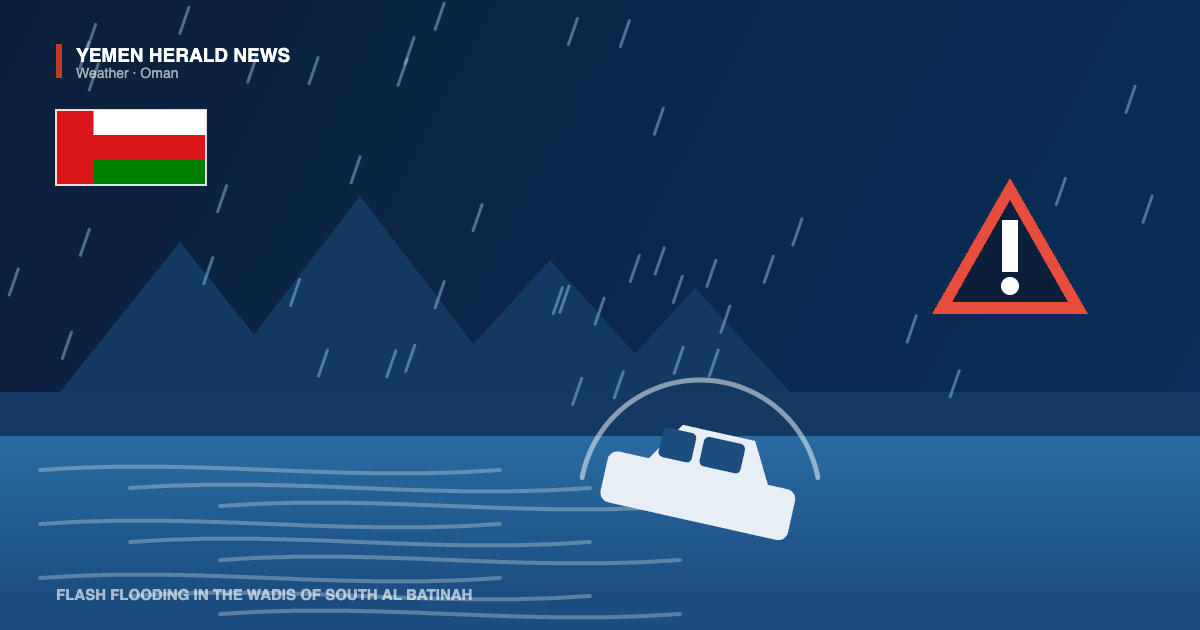
At least five people were killed in flash floods in Oman after vehicles were swept into wadis during heavy rain, the country’s National Committee for Emergency Management said. The deaths occurred in the South Al Batinah governorate, north-west of Muscat, within a single 24-hour period.
In the wilayat of Barka, a vehicle carrying ten people was swept away in a wadi. Search and rescue teams recovered seven of them alive. The bodies of the other three were retrieved from the floodwater later. In a separate incident in the wilayat of Al-Maawil, two people died after their vehicle was caught in a watercourse; their bodies were recovered shortly afterwards.
Reported tolls varied slightly as recovery work continued, with civil defence confirming five deaths and some Omani outlets subsequently reporting a sixth. The pattern in both confirmed incidents was the same: occupied vehicles caught in moving water in a valley bed that would ordinarily have been dry.
The rain had begun on 20 March, driven by a low-pressure system that brought thunderstorms and strong winds across northern Oman. Reported gusts reached as high as 155 kilometres an hour in places. Emergency alerts covered Muscat, Nakhal, Barka, South Al Batinah, Musandam and Al Dakhiliyah, and forecasters expected unstable conditions to persist until the end of the month.
A wadi is a valley or channel that stays dry for most of the year and fills rapidly when rain falls on high ground. The danger lies in the disconnect between where the rain lands and where the water arrives. A wadi crossing can be dry, and the sky overhead clear, while a torrent is already moving down from the mountains. Flow that looks shallow is often enough to lift a vehicle, because moving water exerts force in proportion to the square of its speed.
Oman’s terrain concentrates the risk. The Hajar mountains run behind a narrow coastal plain, and the population and road network are concentrated on that plain and around Muscat. Runoff from the mountains crosses inhabited ground on its way to the sea, and many roads intersect wadi beds directly.
The country has a hard record on this. In April 2024, flash floods killed 18 people in Oman, among them ten schoolchildren aged between 10 and 15 whose bus was swept away at Al-Mudaybi in Sharqiyah. The driver and four other children were rescued. Rainfall in that event reached 145 millimetres in 24 hours at Wadi Bani Khalid, and the flooding affected governorates across the north and east of the country.
The official response to each of these episodes has been consistent. The Royal Oman Police and the National Committee for Emergency Management issue repeated warnings not to cross or approach flowing wadis, publishing video of the flows to make the point, and they escalate those warnings ahead of forecast systems. The instructions are neither new nor obscure.
That they are so often disregarded reflects circumstances rather than carelessness alone. A wadi crossing is frequently the only route between a village and a main road, so waiting means being cut off. Depth and speed are difficult to judge from a driver’s seat, particularly at night. And a flow can rise substantially in the time it takes to cross, so a passage that begins safely does not always end that way.
The same weather systems routinely affect neighbouring countries, producing flooding in the United Arab Emirates and Saudi Arabia in the same periods. The Gulf’s combination of infrequent but intense rainfall, hard sun-baked ground with low infiltration capacity, and drainage sized for a drier climate makes rapid surface flooding a recurrent regional hazard rather than an Omani peculiarity.
The rain was not without benefit. Omani reporting later in March recorded substantial wadi flows recharging the aquifers that supply much of the country’s agriculture, which is the reason such systems are watched with a mixture of alarm and relief. The same water that kills people in a valley bed replenishes groundwater the country depends on.
The rescue in Barka illustrates how narrow the margins are. Seven people were pulled alive from a vehicle in which ten had been travelling. The difference between those outcomes was measured in minutes and in the position of individual passengers, not in anything the occupants could have influenced once the vehicle was moving.
Civil defence teams in Oman are equipped and trained for wadi rescues, with boats, ropes and helicopters used to reach people stranded by rising water, and the committee coordinates across the police, the armed forces and municipal authorities during declared weather emergencies. Rescues of stranded motorists typically outnumber fatalities in any given storm, though only the deaths are widely reported.
The March 2026 alerts remained in force for more than a week after the Barka and Al-Maawil deaths, covering the north from Musandam to Al Dakhiliyah in the interior. Residents were advised to avoid low-lying areas, to keep clear of wadi beds and to follow the committee’s bulletins rather than informal forecasts circulating on messaging apps.
For a country where the annual rainfall total can arrive in a handful of days, the recurring policy question is less about forecasting than about the road network. Each fatal episode renews attention on the number of crossings that pass through wadi beds without a bridge or a culvert sized for peak flow, and on whether barriers and automatic closures at known crossing points would do more than warnings alone.
About the Author