The UAE Floating Hospital at Al Arish Keeps Treating Patients Evacuated From Gaza
 Yemen Herald News
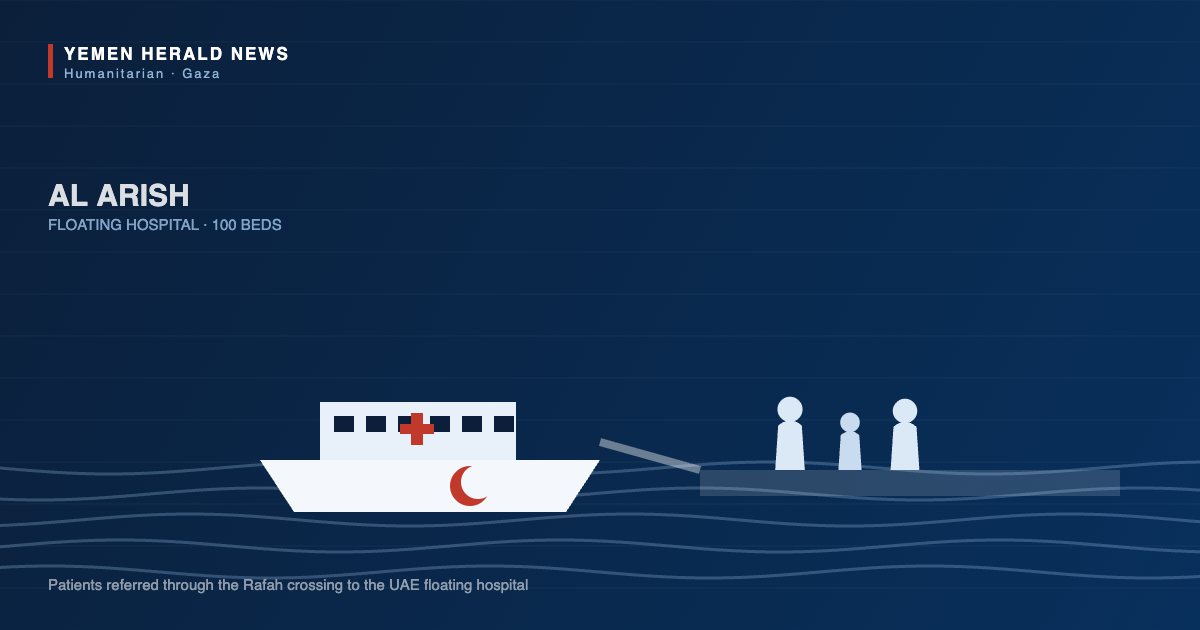
A converted vessel tied up at the Egyptian port of Al Arish, a short drive from the Rafah crossing, has become one of the more durable pieces of medical infrastructure serving patients evacuated from Gaza. The United Arab Emirates established the floating hospital there in February 2024 under the aid programme it calls Operation Chivalrous Knight 3, and it has been receiving referrals continuously since.
The ship carries roughly 100 patient beds and functions as a full hospital rather than a triage post. Emirati authorities have described its services as covering examination and diagnosis, surgery, physiotherapy and dialysis, with specialist teams brought in for cases that cannot be handled by the standing staff. By the time of reporting on its work, the facility had performed more than 5,000 surgical procedures since it opened.
Its location is the point. Al Arish sits in North Sinai within reach of Rafah, which means patients approved for medical evacuation can be moved to a properly equipped operating theatre without a long onward journey, and can be returned or transferred once stabilised. For cases requiring staged surgery and months of rehabilitation, proximity to the crossing matters as much as the equipment on board.
Access has been the binding constraint throughout. The pace of admissions has tracked the status of the Rafah crossing rather than the hospital’s own capacity, and long closures have left the ship able to treat far fewer people than its beds would allow. When the crossing reopened during 2026 the flow resumed: Emirati and Egyptian reporting recorded that more than 90 patients had been received in the period after the reopening, a figure that had risen to 95 by the middle of June 2026.
The clinical work has skewed towards the kinds of injury that emerge months or years after a blast rather than in its immediate aftermath. One case reported from the hospital in June 2026 involved a patient with a complex lower-limb deformity resulting from a femur fracture that had failed to heal correctly. The surgical team addressed it with a tendon transfer to correct foot drop and a lengthening of the right femur using an osteotomy and an external fixation device—procedures that require follow-up over many months and are difficult to deliver in a health system operating under bombardment and shortage.
In 2026 the programme added a prosthetics service under the name Step of Hope. By late July 2026 it had fitted 51 Palestinian amputees with prosthetic limbs. The workflow bridges the two sides of the crossing: teams working inside Gaza use three-dimensional scanning to map the shape of a patient’s residual limb, and the resulting data is used to produce a fitted socket, reducing the number of trips a patient must make and shortening the time between assessment and delivery.
Prosthetic provision is one of the sharper gaps in Gaza’s medical response. Amputation numbers have risen far beyond what local rehabilitation services were built to handle, and a prosthesis is not a single intervention but the start of a long relationship involving refitting, physiotherapy and repair. A programme that can produce and fit limbs at scale addresses a need that emergency surgery alone cannot.
The floating hospital is not the whole of the Emirati effort. In May 2026 the UAE sent ambulances into Gaza alongside the continuing patient transfers, part of a broader package of aid deliveries, field medical support and supply convoys run under the same operation. Similar sea- and land-based medical missions have been mounted by other governments and organisations, and the ship works alongside Egyptian hospitals in Al Arish and further west that have taken in evacuated patients since the war began.
The vessel also illustrates a wider shift in how governments deliver medical aid in this conflict. Sending patients out of a besieged territory is administratively complex and politically sensitive; building a hospital inside it is, for the moment, not possible. A ship moored on the nearest accessible coastline is a compromise between the two, and one that can be scaled up or held in reserve depending on whether the crossing is open. Its weakness is the same as its strength: the facility is only as useful as the permissions that let patients reach it.
It is worth being clear about scale. A hundred beds and five thousand operations represent a substantial sustained commitment, but they are a fraction of the need in a territory where hospitals have been damaged or put out of service and where the referral backlog runs into many thousands. Facilities of this kind relieve individual cases; they do not substitute for a functioning health system.
What the ship demonstrates is that specialist care can be delivered close to a conflict zone when the political arrangements allow patients to reach it. The hospital’s throughput has never been limited by its theatres or its staff, but by whether the crossing is open and how many people are cleared to pass through it.
For the patients who do make the journey—many of them children, many with injuries that would be life-altering even in a well-resourced system—the vessel at Al Arish has offered something the health services inside Gaza have largely been unable to provide since 2023: an operating theatre with power, supplies and a surgical team, and the months of follow-up care that make the surgery worth performing in the first place.
About the Author