Women’s Affairs Minister and UN Envoy’s Office Discuss Empowering Yemeni Women
 Yemen Herald News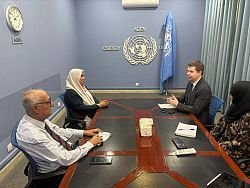
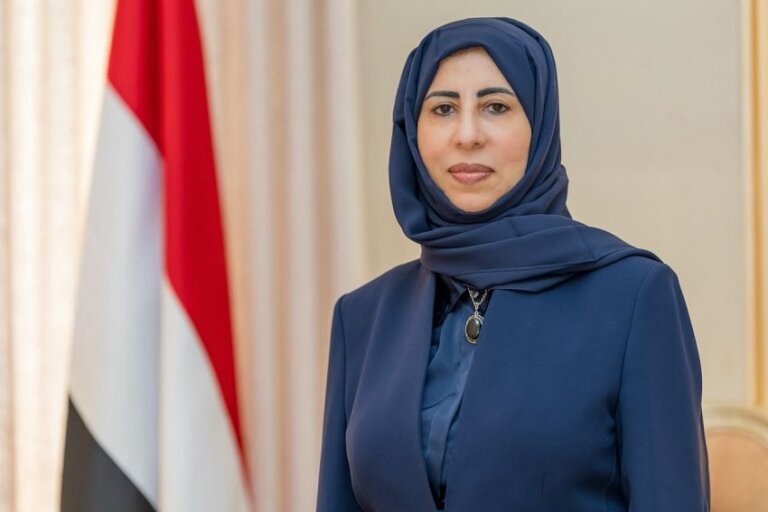
Yemen’s Minister of State for Women’s Affairs, Dr. Ahd Jaasous, has met the Director of the Office of the United Nations Special Envoy to Yemen, Bert Scott, in Aden to discuss strategies for advancing women’s empowerment. The talks focused on strengthening coordination and collaboration to address the challenges facing women, particularly in the areas of qualification, political training and economic opportunity.
During the discussions, Dr. Jaasous highlighted the significant obstacles that women encounter, especially in gaining access to education and economic resources. She emphasised the ministry’s alignment with the government’s priorities for national recovery, which include policies designed to improve the status of women and to increase their involvement in development and decision-making processes.
The minister underscored the necessity of intensifying partnerships with international organisations to bolster programmes that empower women, framing such cooperation as essential to overcoming the barriers that limit women’s participation in public and economic life. The engagement with the envoy’s office situated these efforts within the broader international framework surrounding Yemen’s political process.
The involvement of the Office of the UN Special Envoy is significant, given its central role in supporting efforts toward a political resolution of the conflict. The inclusion of women’s empowerment in discussions with the envoy’s office reflects a recognition that the participation of women is relevant not only to development but to the prospects for a durable and inclusive peace.
The specific focus on qualification and political training points to concrete dimensions of empowerment. Equipping women with skills, education and training, including in political engagement, can enhance their capacity to participate in public life and decision-making. Such preparation is essential to translating aspirations for inclusion into meaningful participation.
Political training, in particular, addresses the need to prepare women to take part in the political process and in governance. Building the skills and confidence required for political engagement can help women assume roles in decision-making bodies and contribute to shaping the policies and institutions that affect their lives and communities.
Economic opportunity, another area of focus, is fundamental to women’s empowerment and independence. Access to economic resources, employment and the means of generating income enables women to support themselves and their families and to participate more fully in economic life. In Yemen’s difficult context, expanding such opportunities is both challenging and important.
The obstacles to education highlighted by the minister reflect a critical barrier to women’s advancement. Education is foundational to opportunity, and limits on women’s access to it constrain their prospects across many domains. Addressing these barriers is essential to enabling women to develop their capacities and to participate fully in society.
The challenges facing women in Yemen have been compounded by the conflict. Displacement, economic hardship and the disruption of services have added to the difficulties women face, while the strains of war have in some cases deepened existing inequalities. Efforts to empower women must therefore contend with a context shaped by crisis and disruption.
The alignment of the ministry’s work with the government’s recovery priorities reflects an effort to integrate women’s empowerment into the broader agenda of national recovery. Positioning the advancement of women as part of the recovery effort underscores the view that inclusive development, drawing on the full participation of society, is essential to rebuilding the country.
The emphasis on women’s involvement in development and decision-making echoes an international consensus on the importance of inclusion. The participation of women is widely regarded as enhancing the effectiveness and legitimacy of both development efforts and governance, and promoting such involvement is a recurring theme in discussions of Yemen’s future.
Partnerships with international organisations, which the minister sought to intensify, can provide crucial support for empowerment initiatives. International actors can offer funding, expertise and technical assistance, helping to extend the reach and impact of programmes and to sustain efforts that might otherwise be constrained by limited domestic resources.
The coordination emphasised in the talks is essential to effective action. Aligning the efforts of the ministry, international organisations and other stakeholders can help ensure that empowerment initiatives are coherent, well-targeted and mutually reinforcing, maximising their impact in a context where resources and capacity are limited.
The existence of a dedicated ministry for women’s affairs reflects an institutional commitment to these issues. Sustained attention at the governmental level can help ensure that women’s concerns are represented in policymaking and that efforts to advance their status receive continued focus, even amid the many competing demands facing the government.
The engagement with the envoy’s office also carried an implicit message about the peace process itself. International mediators have repeatedly stressed that settlements shaped without the involvement of women tend to be less durable and less reflective of the needs of the whole population. In Yemen, women’s representation in formal negotiations and in the bodies that will shape any post-conflict order has historically been limited, and efforts such as the minister’s to build women’s political skills and to keep their participation on the agenda are aimed, in part, at ensuring they are not sidelined when decisions about the country’s future are ultimately made.
For now, the meeting between Dr. Jaasous and Scott reaffirmed a shared commitment to advancing the empowerment of women in Yemen through enhanced coordination and partnership. As the country navigates its challenges and looks toward recovery, the participation of women in development, decision-making and the political process is likely to remain an important consideration in efforts to build a more inclusive society.
About the Author