UKMTO reports no Red Sea attack since August as Bab al-Mandab traffic stays below its 2023 average
 Adel Haddad
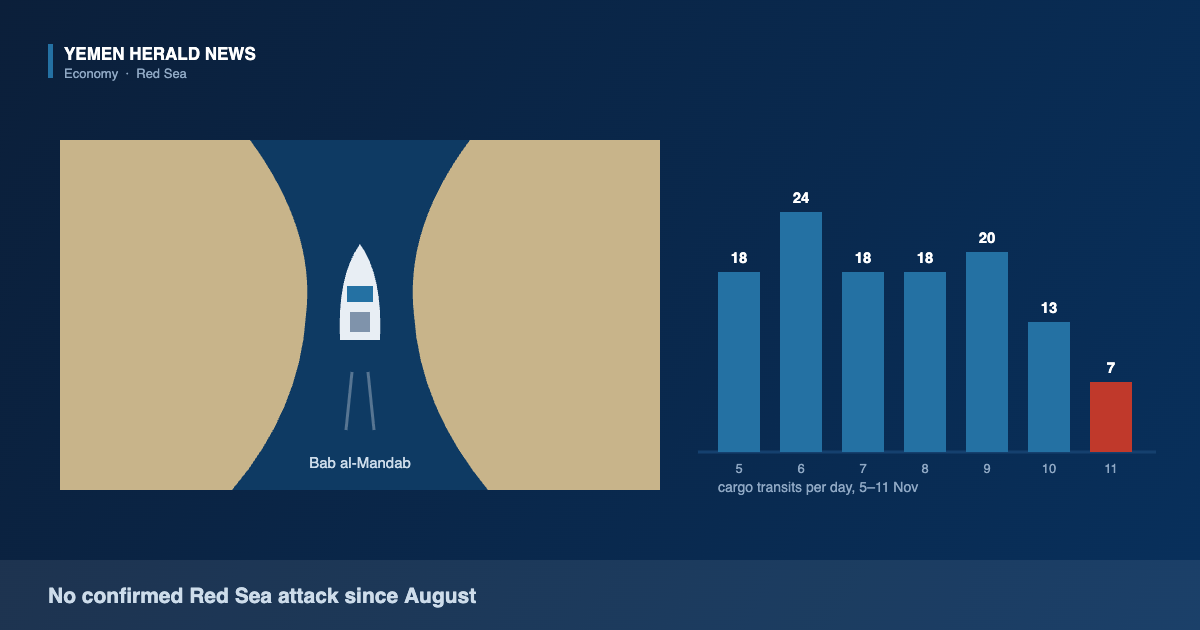
ADEN, Yemen — No confirmed attack on shipping has occurred in the Red Sea or the Bab al-Mandab Strait since Aug. 24, UK Maritime Trade Operations reported.
The finding appeared in the authority’s weekly report, which Middle East Eye reported on Saturday.
The same report recorded six vessels attacked in and around the Strait of Hormuz over the past week, according to that account.
Traffic in and around Hormuz is running about 65 percent below pre-war levels, the authority reported.
Transits through the Red Sea and Bab al-Mandab are about 22 percent below the levels recorded before July 22, when the Houthis announced a blockade, according to the same report.
A second set of figures, measured against an earlier baseline, describes a deeper fall.
The Joint Maritime Information Centre put daily Bab al-Mandab transits at about 23 for Nov. 8 to Nov. 11, in an advisory dated Nov. 12 that UK Maritime Trade Operations publishes.
That compares with about 32 a day the previous week, according to the advisory.
The centre gives the historical average for the strait as about 61 vessels a day on a 2023 baseline.
The two percentages describe the same waterway against different starting points. One is measured from July 2026, after traffic had already fallen; the other from 2023, before it did.
The transit counts in the advisory are credited to S&P Maritime and cover cargo vessels above 1,000 deadweight tonnes, according to the document.
It recorded 92 crossings in total over those four days.
The advisory’s daily table shows Bab al-Mandab cargo transits falling across the week, from 24 on Nov. 6 to seven on Nov. 11.
Tanker crossings over the same days ran from 13 on Nov. 9 to four on Nov. 11, according to the table.
No confirmed attacks or disruptions were reported in the southern Red Sea and Bab al-Mandab during that period, the advisory said.
The centre nonetheless rates the threat level for Bab al-Mandab and the southern Red Sea as substantial, and the Gulf of Aden the same, according to the document.
It rates the Strait of Hormuz as severe.
The advisory covers March 1 to Nov. 12 and counts 181 incidents over that period.
For Hormuz it gives a historical average of about 138 vessels a day on a 2025 baseline, against 135 transits facilitated by the United States over Nov. 8 to Nov. 11.
Those figures are credited to the US Navy’s co-operation with shipping office, according to the advisory. Independent tracking of Hormuz showed single to low double-digit transits a day, the document said.
United States Central Command figures issued on Nov. 11 put the number of commercial vessels redirected at nearly 150, with five merchant ships disabled, the advisory said.
About 211 vessels were tracked stationary east of Hormuz, according to the same document.
Vessels were also tracked waiting at anchorages off Fujairah and Khor Fakkan, and off Musandam and Sohar, the advisory said.
One vessel taken off Yemen remains held.
The tanker MT ASANA was hijacked on July 17 about 65 nautical miles southwest of Mukalla and is still in the hands of those who seized it, the advisory said.
The advisory refers to a Houthi selective embargo announced on July 20.
Satellite navigation interference, which has affected other parts of the region, is largely absent from the Yemeni approaches.
No significant interference was observed at sea in the Red Sea and Bab al-Mandab, the advisory said. Tracking by the firm Windward recorded 10 jammed vessels out of 1,113 transmitting on Nov. 9.
Oil volumes through the strait have moved in the opposite direction to vessel counts.
About 5.4 million barrels a day passed through Bab al-Mandab in the fourth quarter of 2025, rising to 8.1 million barrels a day in the second quarter of 2026, according to the reference site Strait Insider, which credits the United States Energy Information Administration for the second figure.
Strait Insider attributes the increase to Saudi crude rerouted through the East-West pipeline to Yanbu.
That pipeline was struck on Nov. 9, the Saudi Ministry of Energy said the following day, according to the Joint Maritime Information Centre advisory. The fire was contained and no injuries were reported.
Strait Insider describes Bab al-Mandab as open and transiting well below normal, in an assessment it dates to Nov. 9. It says its pages are reviewed rather than updated live.
The site states that the Yemeni Red Sea coast has been under Houthi control since September, and that Perim Island was taken the same month. Yemen Herald did not find those claims in the maritime advisories reviewed for this report.
Vessels avoiding the route go around the Cape of Good Hope, which Strait Insider puts at more than 20 additional days.
The Houthis have not published a response to the transit figures. Yemen Herald found no comment from the group on the November data.
The advisory lists four confirmed incidents since its previous edition, all of them in the Gulf and the approaches to Hormuz rather than in Yemeni waters.
They occurred off Lima and Khasab in Oman, in the Arabian Gulf, and northwest of Ras al Khaimah in the United Arab Emirates, between Nov. 10 and Nov. 11, according to the document.
The advisory names two of the vessels involved as the NCC FAJR and the DOMINICA PROSPERITY. No casualties were reported in either case, according to the document.
About the Author