Yemen’s Southern Transitional Council offers to defend Aden and asks for battlefield autonomy
 Adel Haddad
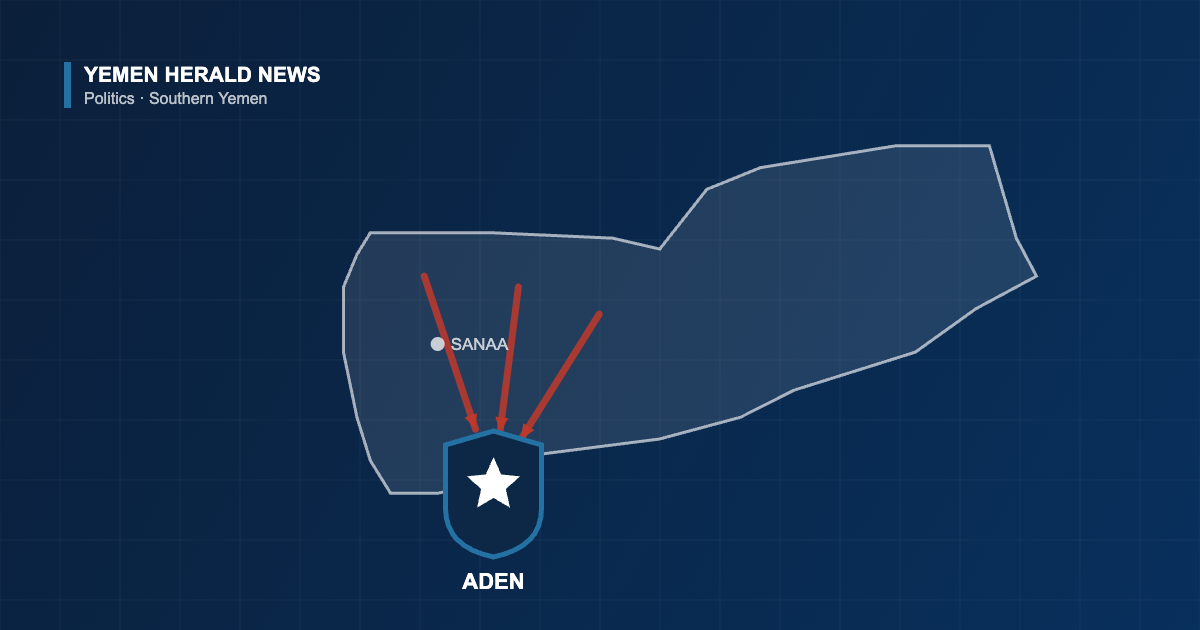
ADEN, Yemen — Yemen’s main southern separatist movement has offered to defend Aden against advancing Houthi forces, ten months after a Saudi-backed campaign dissolved it.
Amr al-Bidh, special representative for the president of the Southern Transitional Council, told Al Jazeera the movement was ready to commit everything it had to the city’s defence.
“We’re ready to put every capacity we have towards defending Aden,” he said.
Al Jazeera reported Tuesday that Houthi forces stand 60 kilometres, or 37 miles, from the city. The New Arab gave the same distance a day earlier.
Aden is the seat of Yemen’s internationally recognised government.
The offer carries a condition. Al-Bidh said the council’s units would need autonomy on the battlefield.
“No front can be held for long when the people defending it have no say in how it is defended,” he said.
“What’s missing is a political decision to let southerners lead their own defence,” he told Al Jazeera.
The council seeks an independent state in southern Yemen and is believed to be backed by the United Arab Emirates, according to Al Jazeera and The New Arab.
Its standing collapsed at the start of this year. Members of a council delegation in Riyadh announced its dissolution on Jan. 9, the Aden-based South24 Center reported.
Council institutions in the south rejected that announcement as issued under coercion, South24 said. Al Jazeera reported that other senior members declared the dissolution null and void.
The New Arab reported that Saudi Arabia moved militarily in January against the council and other Emirati-backed militias, and that Emirati forces later left Yemen.
Rashad al-Alimi, president of the Presidential Leadership Council, removed the separatist leader Aidarous al-Zubaidi from that body and referred him to prosecutors on charges including high treason, South24 reported.
Al-Zubaidi then left the country. Saudi military spokesman Turki al-Maliki said he sailed from Aden to Somaliland and flew on to Abu Dhabi, South24 reported, which could not confirm where he was.
The New Arab reported in October that he was thought to have spent nine months in Abu Dhabi.
He began rebuilding a public base before the current Houthi advance. On Oct. 13 he announced a general mobilisation in a televised address, South24 reported.
“We declare the general mobilisation to defend the south and its national liberation project,” he said, in wording reported by The New Arab.
Thousands rallied across southern Yemen the next day, The New Arab reported, in Aden, Mukalla, Seiyun and Al-Ghaydah. Some demonstrators carried Emirati flags.
That date was the 63rd anniversary of the Oct. 14 revolution against British rule, South24 said.
In the same address he asked Saudi Arabia and foreign governments to recognise a declaration the council issued on Jan. 2, South24 reported.
That document sets a two-year transitional phase, dialogue with northern parties under UN auspices, and then a referendum on self-determination, according to South24.
The council ties it to restoring a state of South Arabia inside the borders that existed before May 22, 1990, with Aden as its capital.
South24 reported the declaration gave no structure for a transitional authority and no timetable for the dialogue or the vote.
Analysts told both outlets the offer is a bid for leverage.
Andreas Krieg, a senior security studies lecturer at King’s College London, told The New Arab the intervention was primarily about political leverage.
“He is effectively presenting southern independence as the price of military cooperation,” Krieg said.
Abdy Yeganeh, policy director for Independent Diplomat, told Al Jazeera the council had kept its following.
“Events in recent weeks have shown that despite attempts of marginalising the STC, they remain a credible local entity with significant popular support,” he said, pointing to weekly marches in the south.
Others doubt it can deliver. Ali al-Dahab, a military and strategic affairs expert, told Al Jazeera the council could not repel the Houthis without the government and Saudi Arabia.
“The capabilities of the Houthis have exceeded the combined capabilities of the government,” he said, “let alone the [Southern] Transitional Council.”
Government forces on the Red Sea coast collapsed in September and pulled out of coastal positions this week, Al Jazeera reported.
Saudi Arabia replaced its coalition commander on Monday. King Salman named Gen. Fayyad al-Ruwaili, the chief of the general staff, in place of Lt. Gen. Fahd bin Hamad al-Salman, the Saudi Press Agency reported, citing a royal decree.
Al-Dahab said the appointment centralises decision-making. The New Arab reported that al-Salman had led coalition operations since August 2024.
Al-Bidh blamed the campaign against his council for both the September collapse and the gains since.
“In January, the most effective anti-Houthi force in Yemen was taken apart by decisions in Riyadh, not by the Houthis,” he told Al Jazeera.
He said a settlement imposed without southerners would not hold. “What won’t work is a deal made over the heads of southerners and signed by people who don’t represent them,” he said.
The Southern Giants Brigades, among the strongest forces tied to the council, is now aligned with Saudi Arabia, Al Jazeera reported.
Houthi forces took Sanaa in September 2014. The Saudi-led coalition has backed the Yemeni government since March 2015.
Neither the Houthis nor the Yemeni government commented on the council’s offer in Al Jazeera’s account.
Al-Zubaidi condemned Houthi attacks on Saudi Arabia in his October address, The New Arab reported.
About the Author