US Strikes Reach Iran’s Caspian Coast as Trump Threatens Tehran and the Houthis Over Red Sea Attacks
 Yemen Herald News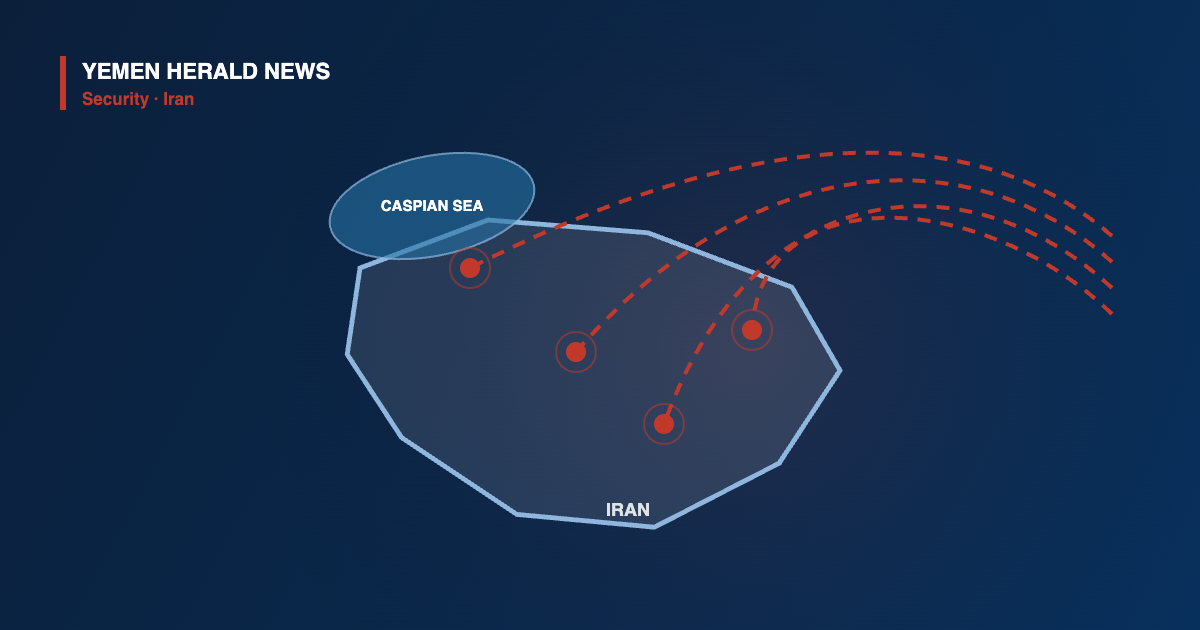
United States forces struck targets across Iran on Friday, reaching as far north as the Caspian coast, after President Donald Trump threatened what he called major military punishment for Tehran and its Houthi allies in Yemen. US Central Command said the operation completed a thirteenth consecutive night of strikes on Iranian territory, one of the deepest and most sustained American air campaigns in the region in decades.
The immediate trigger was the Red Sea. The Houthi movement claimed responsibility for missile and drone attacks on two Saudi oil tankers, the Encelia and the Layla, saying the vessels had violated a blockade the group declared on Saudi ports on 20 July. The Saudi Press Agency confirmed that the Encelia was struck while transiting the Red Sea, reported a fire at the vessel’s bow and said, citing a Transport General Authority official, that all crew were safe. Trump responded by saying Washington would hold Iran responsible for future Houthi attacks, framing the Yemeni group as an instrument of Iranian policy rather than an independent actor.
He set out an explicit formula for the other chokepoint as well, warning that each time Iran fires on a ship in the Strait of Hormuz the United States would destroy one bridge or power plant. The prospect of calibrated but escalating damage to civilian infrastructure drew immediate concern from humanitarian organisations, and Iranian officials said Tehran would answer by targeting American-linked infrastructure and energy assets across the region.
The confrontation began earlier in July, after an attack on a merchant vessel in the Strait of Hormuz prompted the first American strikes. Iran subsequently declared the strait closed and fired missile and drone salvoes at United States military facilities in several neighbouring countries, claiming operations against sites in Bahrain, Kuwait, Qatar, Oman, Iraq and Jordan. Several of the host governments said their own territory and civilian infrastructure had been damaged, including a Kuwaiti power plant.
By the time the campaign entered its second week, Central Command reported having hit around 140 Iranian military targets in a single week-long phase, and said it had used sea drones in an offensive role for the first time. The geographic spread of Friday’s strikes, from Iran’s southern coast to the Caspian in the north, indicated that Washington no longer regards any part of Iranian territory as beyond reach.
Diplomatic efforts have so far failed to interrupt the cycle. Iraqi Prime Minister Ali al-Zaidi travelled to Tehran on 23 July, meeting President Masoud Pezeshkian, parliament speaker Mohammad Bagher Ghalibaf and Foreign Minister Abbas Araghchi. Reports of the visit said he carried a renewed American ceasefire proposal and that Iran rejected it, with officials indicating that Tehran had no interest in a temporary arrangement leaving the status of Hormuz unresolved. Al-Zaidi’s office later denied that Iraq was mediating between the two governments, describing such accounts as baseless, and Araghchi publicly characterised the American approach as hegemonic.
That impasse points to the core dispute. For Washington, freedom of navigation through Hormuz is non-negotiable, since roughly a fifth of the world’s seaborne oil normally transits the strait. For Tehran, the ability to interdict traffic there is among the few forms of leverage capable of imposing costs on an adversary with overwhelming air superiority. Neither position leaves obvious room for a partial deal, which helps explain why mediation has produced so little.
The Houthi decision to open a Red Sea front compounds the problem. The group’s Humanitarian Operations Coordination Centre emailed shipping companies in late July to say vessels were barred from loading or discharging at Saudi ports and could be targeted anywhere within reach of Yemeni forces. With Hormuz disrupted and Bab al-Mandab now contested, two of the world’s most important maritime chokepoints are unsafe simultaneously, a situation with no recent precedent.
Markets have registered the strain. Brent crude climbed roughly 7 percent on 23 July as news of the tanker attacks spread, closing above 100 dollars a barrel for the first time since May, and war-risk insurance premiums for voyages through the southern Red Sea and the Gulf have risen sharply. Carriers rerouting around the Cape of Good Hope add about two weeks to voyages between Asia and Europe, tying up vessel capacity and pushing freight rates higher. Those costs eventually reach importers and consumers far from the conflict.
Saudi Arabia has answered the maritime attacks with airstrikes on Houthi-held areas, including targets in and around Hodeidah on Yemen’s Red Sea coast. Hodeidah is the main entry point for food, fuel and medicine serving the north of the country, and aid agencies warn repeatedly that damage there translates quickly into shortages for a population in which more than 18 million people already depend on some form of humanitarian assistance. The Houthis retaliated on 25 July by striking Aramco facilities at Jizan and Yanbu.
Gulf and Arab governments have condemned the attacks on shipping while urging restraint on all sides, an increasingly uncomfortable position for states that host American forces and sit within range of Iranian missiles. Kuwait, Bahrain, Qatar and the United Arab Emirates have all issued statements on the Red Sea strikes, and several have quietly pressed Washington for a de-escalation track. So far the pattern of strike and counter-strike has held, and neither side has signalled a willingness to move first.
About the Author