Houthis Hit Aramco Sites at Jizan and Yanbu as Iran Reports Its First Night Without US Strikes
 Yemen Herald News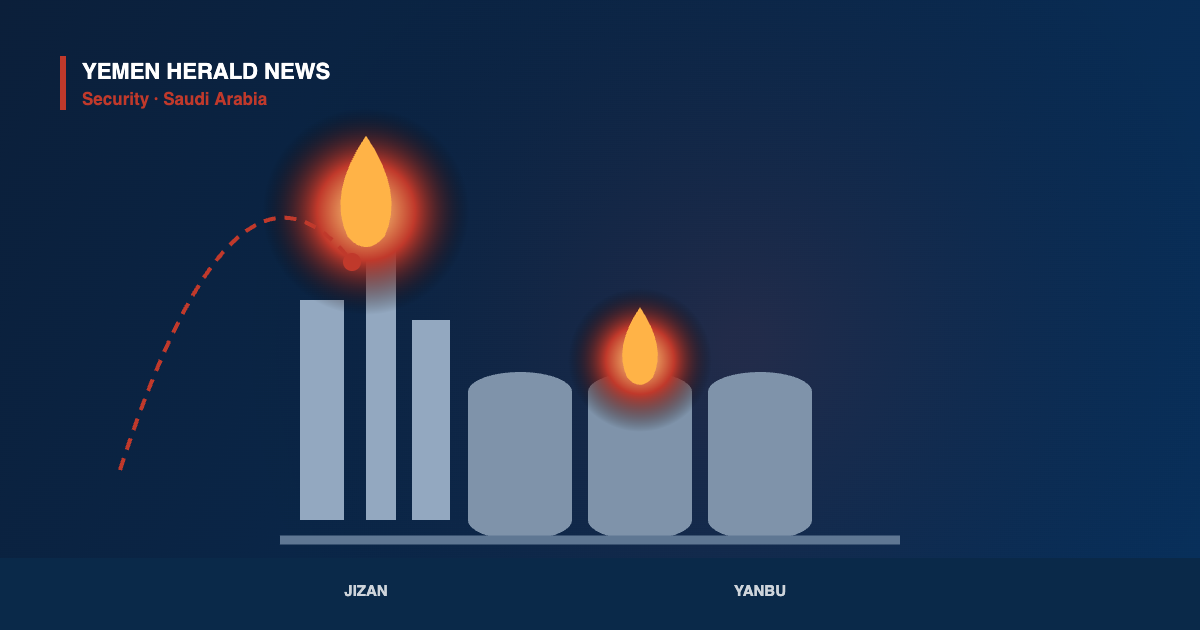
Yemen’s Houthi movement said on Saturday that it had struck Saudi Aramco facilities at Jizan and Yanbu with ballistic missiles, cruise missiles and drones, in what it called retaliation for Saudi airstrikes on Hodeidah and Kamaran Island. Fire broke out at the Jizan refinery in the early hours of 25 July 2026, and air-raid sirens sounded repeatedly across both areas, where much of Saudi Arabia’s Red Sea energy infrastructure sits. Houthi military spokesman Yahya Saree announced the operation in a recorded statement. It was the group’s first attack on Saudi oil installations in roughly four years.
The Jizan refinery, commissioned commercially in 2021, processes about 400,000 barrels of crude a day, roughly 4 percent of Aramco’s daily oil and liquids output, and houses what the company calls the world’s largest integrated gasification combined-cycle facility. Open-source researchers who reviewed satellite imagery reported expanding fires at the complex after the strikes, the first independent confirmation of damage. Neither Aramco nor the Saudi government had issued a damage assessment or casualty figure by late Saturday.
Yanbu appears to have fared better. Greek security sources said two ballistic missiles aimed at oil installations there were intercepted by a US-made Patriot battery that the Greek military operates in Saudi Arabia under an agreement with Riyadh. Saudi Civil Defence said alerts issued in the two provinces concerned a danger later lifted.
Yanbu matters more than its throughput suggests. Since Iranian naval interdiction effectively closed the Strait of Hormuz earlier this year, Saudi Arabia has leaned on its east-west pipeline to move crude across the peninsula to the Red Sea coast, where it is loaded onto tankers at Yanbu’s terminals. Tanker-tracking data show Yanbu handled the great majority of Saudi seaborne crude exports in June, making it the kingdom’s principal remaining route to buyers.
The Saudi raids that preceded the Houthi operation hit Houthi-held areas of Hodeidah on Friday. The Houthi-run broadcaster Al-Masirah said they struck telecommunications facilities and targets on Kamaran Island, and reported that a woman was injured. The Saudi Defence Ministry said its forces had targeted Houthi military sites linked to attacks on commercial shipping, and that Hodeidah port itself was not among them.
The Houthi foreign ministry said the Saudi raids opened a phase of “escalation for escalation” and held Riyadh responsible for whatever followed. The exchange has pulled Yemen’s war, in an uneasy stalemate for much of the past two years, back into an active front within a far larger confrontation.
The sequence began with the naval blockade the Houthis declared on 20 July against Saudi Arabia. The group said the measure answered Saudi attacks on Yemeni territory, including a strike on Sanaa International Airport. Two days later it claimed missile and drone attacks on two Saudi oil tankers, the Encelia and the Layla. The Saudi Press Agency confirmed the Encelia had been hit and reported a fire at its bow, citing an official who said all crew were safe. Riyadh then suspended oil shipments through the lane.
Trump said afterwards that the United States would hold Iran responsible for further Houthi attacks, extending to the Red Sea a pressure campaign that had centred on Hormuz. Washington describes the Houthis as an Iranian proxy; the group insists it acts on its own account.
Elsewhere the conflict showed a first tentative sign of a pause. Iran reported no American strikes overnight into Saturday, breaking a run that US Central Command had described a day earlier as a thirteenth consecutive night of operations. Health Ministry spokesman Hossein Kermanpour wrote on social media that the country had passed a peaceful night, and US officials said Trump had instructed the military on Friday not to strike again. Iran’s Health Ministry says more than 3,400 people have been killed since the fighting began, a figure that has not been independently verified.
The war’s centre of gravity remains Hormuz, which carried roughly a fifth of the world’s seaborne oil before traffic largely halted. Trump has warned that the United States will destroy a bridge or a power plant in Iran each time an Iranian missile or drone is fired at a ship in the strait.
Energy markets reacted sharply. Brent crude pushed above $100 a barrel for the first time since May after the tanker attacks and held above that level on Saturday, capping a steep climb over the course of July. Traders are pricing in the possibility that the Red Sea, an alternative to Hormuz for some Saudi exports, becomes equally unusable.
The Institute for the Study of War reported that at least seven vessels had altered course to avoid the Bab al-Mandab Strait after the blockade announcement, while the Houthis claimed to have turned back around ten. Sustained avoidance of the strait, the southern gateway to the Suez Canal, forces carriers onto the far longer route around southern Africa.
Diplomacy has continued without result. A Qatari-mediated round of talks took place in Tehran this week, and an Iranian delegation led by Foreign Minister Abbas Araghchi travelled to Muscat for a session on reopening Hormuz.
For Yemen itself, the fighting compounds a humanitarian emergency the United Nations has repeatedly ranked among the world’s most severe. Millions of people depend on food and fuel arriving through Red Sea ports. Whether the quiet night over Iran marks a turning point or only a pause will be settled less in Sanaa than in Washington, Tehran and Riyadh.
About the Author