WHO Says Strike on al-Daein Teaching Hospital in Darfur Killed 64, Including 13 Children
 Yemen Herald News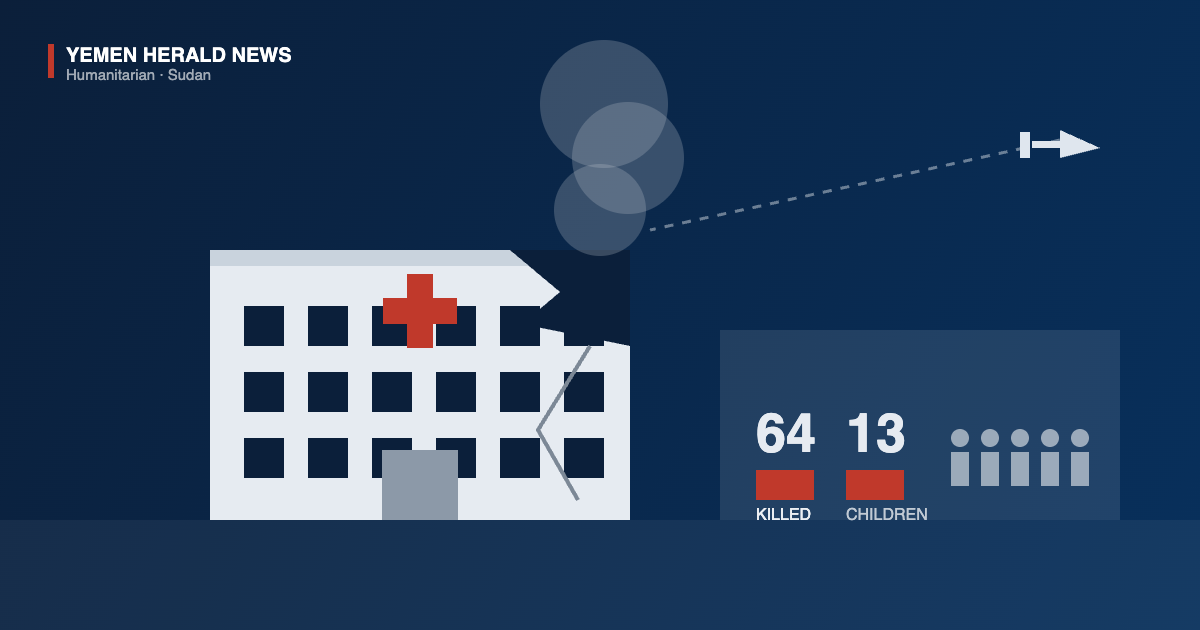
At least 64 people, among them 13 children, were killed in an attack on al-Daein Teaching Hospital in Sudan’s East Darfur state in March 2026, the head of the World Health Organization said at the time. A further 89 people were wounded, including eight members of the hospital’s own staff.
The strike hit the hospital on a Friday night, during the Eid holiday, in al-Daein, the state capital. Among the dead were patients receiving treatment, two female nurses and one male doctor. The casualty figures were released by the WHO and reported consistently across international news organisations.
The attack damaged the paediatric, maternity and emergency departments and left the facility nonfunctional. Because al-Daein Teaching Hospital was the main referral centre for the city, its closure removed emergency and obstetric care for the surrounding population rather than merely reducing capacity.
Responsibility was disputed. Sudan’s army denied carrying out the attack, while two military officials said the strike had been aimed at a police station near the hospital. The Sudanese rights group Emergency Lawyers said a military drone strike had hit the hospital itself.
The WHO placed the incident within a longer pattern. With these deaths, the total number of fatalities linked to attacks on health facilities during Sudan’s war passed 2,000, a figure the organisation has cited repeatedly in appeals for the protection of medical infrastructure.
Attacks on hospitals are prohibited under international humanitarian law. Medical facilities, personnel and transport carry protected status, and that protection is lost only in narrowly defined circumstances. The scale of documented attacks in Sudan has made the country one of the most severe contemporary cases.
Darfur has been among the worst-affected regions since fighting between the Sudanese army and the Rapid Support Forces began in April 2023. The war has displaced millions of people, collapsed much of the country’s public administration, and produced one of the largest displacement emergencies in the world.
East Darfur has absorbed people displaced from elsewhere in the region while its own services have deteriorated. Hospitals in such areas serve populations well beyond their design capacity, often with intermittent electricity, shortages of medicines and staff who have gone unpaid for extended periods.
The loss of a single referral hospital therefore propagates outwards. Patients requiring surgery, obstetric intervention or trauma care must travel to another town, along routes that may be insecure, and the facility receiving them absorbs a caseload it was not resourced to handle.
Health workers face a compounding problem. Each attack on a facility accelerates the departure of clinical staff, and Sudan’s medical workforce has been depleted by displacement, emigration and death. Replacing a paediatrician or an obstetrician in a state capital is not a matter of months but of years.
Humanitarian access has been a persistent constraint. Aid organisations working in Darfur have described difficulty obtaining permissions, moving supplies across front lines and maintaining a presence in areas where control changes. Those constraints limit the ability to restore services after a facility is destroyed.
Disease surveillance suffers alongside treatment. Hospitals are the points at which outbreaks are detected and reported, and when a referral centre stops functioning, the data that would trigger a public health response stops flowing. Cholera and measles have both spread widely in Sudan during the conflict.
Drone warfare has changed the character of the conflict. Both sides have used unmanned aircraft to strike targets far from front lines, extending the war to towns that had previously been comparatively insulated. That shift has placed fixed civilian infrastructure, including hospitals and markets, within reach.
International response to the war has been widely criticised as inadequate relative to its scale. Humanitarian appeals for Sudan have been persistently underfunded, and diplomatic efforts have not produced a durable ceasefire, leaving aid agencies operating in a conflict that has continued without meaningful pause.
The timing of the attack, during Eid al-Fitr, drew particular comment. Holiday periods typically see hospitals operating with reduced staffing while visitor numbers rise, and the WHO noted the circumstances in its statement on the incident.
No independent investigation of the al-Daein strike was reported to have been completed. The account above reflects what the World Health Organization, Sudanese rights groups and international news organisations reported in March 2026, including the army’s denial of responsibility.
Teaching hospitals carry an additional loss beyond patient care. They train the next generation of doctors and nurses, and when one is destroyed the interruption to medical education is felt years later, in a country that will need a far larger clinical workforce than it had before the war.
Aid agencies have described a pattern in which each attack on a health facility produces a fresh wave of displacement, as families who relied on it move towards larger towns in search of care. That movement in turn concentrates pressure on the remaining functioning hospitals and on the camps around them.
For the population of al-Daein, the immediate consequence was the loss of the facility itself. Restoring a damaged teaching hospital requires reconstruction, equipment and the return of clinical staff, none of which can proceed quickly in an active conflict, and the interim burden falls on smaller clinics that were already stretched.
About the Author