Yemen and Indonesia Move to Expand Higher Education and Research Ties
 Yemen Herald News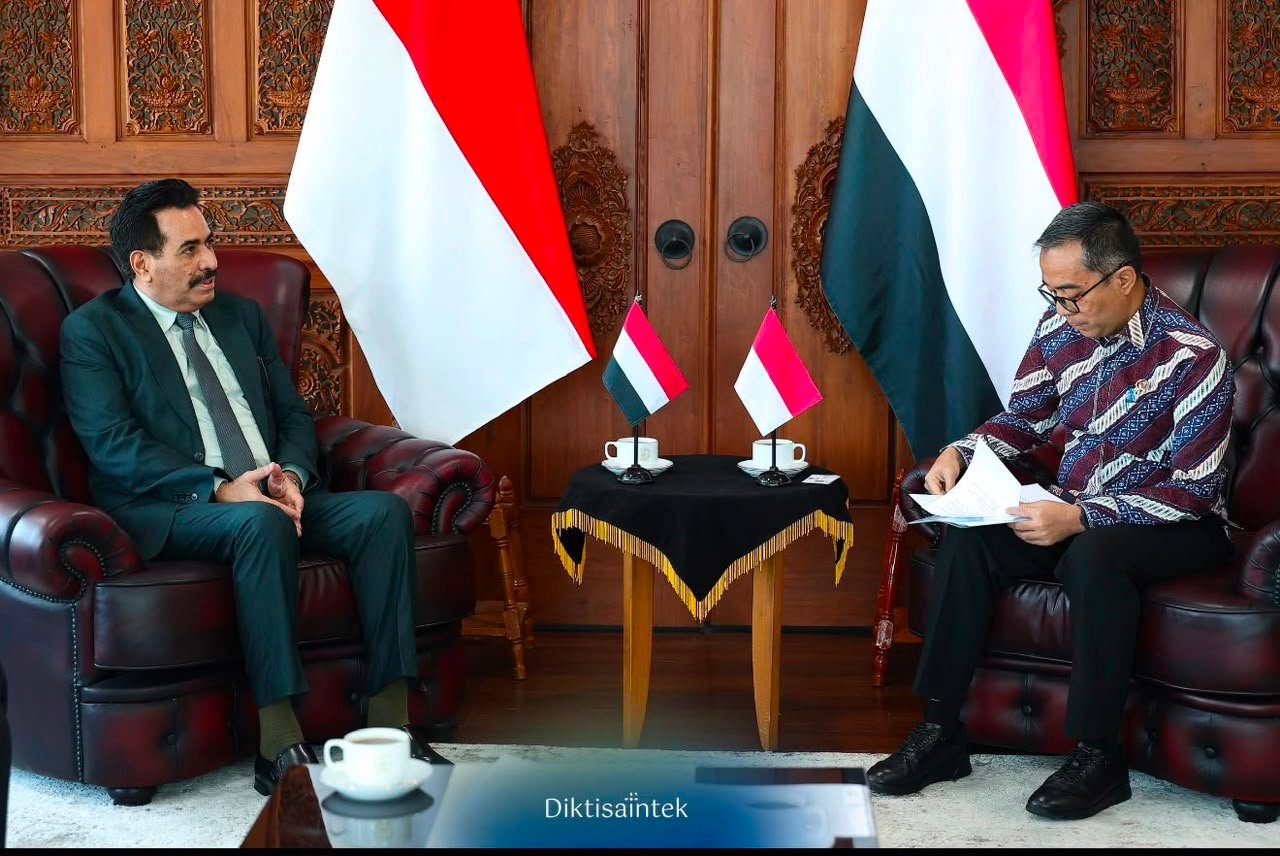
Yemen and Indonesia have taken fresh steps to deepen their academic and scientific ties, signalling a shared determination to protect education even as Yemen contends with the aftermath of years of conflict. The push took concrete form at a meeting in Jakarta on Thursday, where Yemen’s Ambassador to Indonesia, Salem Balfaqih, met Professor Brian Yuliarto, Indonesia’s Minister of Higher Education, Science, and Technology. The two officials explored ways to strengthen partnerships in higher education, scientific research and technology, with the stated aim of putting into practice a bilateral memorandum of understanding already agreed between their governments.
Much of the conversation centred on reviving and widening scholarship programmes that would allow Yemeni students to study at Indonesian universities. The Yemeni embassy proposed reactivating access to Indonesia’s Developing Countries Partnership scholarship, known by its Indonesian initials KNB, which has previously funded students from partner nations. Roughly 270 Yemeni students are already enrolled at Indonesian institutions, and Balfaqih pressed for that figure to grow. For Yemen, whose universities and schools have been battered by prolonged fighting, such openings offer a rare channel to keep training a generation whose prospects at home have narrowed sharply.
Yuliarto, for his part, encouraged more Yemeni students to come to Indonesia, particularly in science, technology, engineering and mathematics, and noted that educational links between the two countries already run deep. He observed that many Indonesian scholars have historically travelled to Yemen to study, especially at its religious institutions, gaining experience that has enriched Indonesian academic life. Framing the exchange as mutually beneficial, he positioned research collaboration, not just student mobility, as a central plank of the emerging relationship.
A well-regarded academic, Yuliarto is a professor of nanotechnology at the Bandung Institute of Technology who earned his master’s and doctoral degrees at the University of Tokyo and won Indonesia’s Habibie Prize in 2024 for his work on nanotechnology-based sensors. Appointed to lead the ministry in February 2025, he has spoken repeatedly about preparing skilled human resources to accelerate national development, and his engagement lent weight to the talks.
For Balfaqih, the meeting built on a broader diplomatic agenda in Jakarta, where Yemeni and Indonesian officials have recently worked to finalise cooperation frameworks between their foreign ministries. Anchoring the education discussion in an existing memorandum gives both governments a ready-made structure to translate goodwill into specific projects, from joint research to reciprocal academic visits. The two sides also weighed exchange programmes designed to link universities directly, easing the movement of students and faculty and encouraging the sharing of knowledge in ways that could lift teaching standards and open the door to collaborative research.
Yemen’s internationally recognised government, based in the interim capital of Aden, has signalled that it wants to use these partnerships to help rebuild an education sector hollowed out by war. The relationship draws on a long-standing friendship rooted in shared history and religious ties. Indonesia, the world’s most populous Muslim-majority nation, offers Yemeni students and researchers a large and diverse academic landscape, and exposure to Indonesian institutions and their research methods could give Yemenis new perspectives to bring to bear on problems at home, in fields ranging from public health to engineering and technology.
That potential is set against a stark humanitarian backdrop. Years of conflict have left Yemen facing one of the world’s most severe emergencies, with an estimated 18 million people thought to need some form of humanitarian assistance and more than four million displaced from their homes. In that context, education is less a luxury than a form of long-term recovery, helping to preserve the skills and institutions that will be needed once conditions improve.
Yemen’s geography adds another dimension to the diplomacy. The country sits beside the Bab al-Mandab Strait, one of the world’s busiest and most strategically sensitive shipping corridors, which has kept it firmly in the sights of regional and international powers. Deepening ties with a major Southeast Asian nation such as Indonesia points to an effort by Aden to diversify its partnerships beyond its traditional circle of allies and to draw fresh attention to investment in its people.
The focus on universities and research also reflects a deliberate attempt by Yemen’s leadership to rebuild the country’s intellectual capacity. Prioritising education can help foster resilience among young Yemenis and equip them to contribute once a measure of stability returns. Rather than treating academic ties as a peripheral concern, officials on both sides presented them as part of a wider strategy for national recovery, one that might target challenges of particular relevance to Yemen, including innovation in technology and health.
For now, the commitments remain largely aspirational, and much will depend on follow-through and funding. Yet the willingness of both capitals to keep education on the agenda, even amid competing priorities, suggests a recognition that knowledge and human capital are among the more durable foundations for cooperation. The higher education talks form part of a wider revival of Yemeni-Indonesian engagement, with the two sides having recently revisited joint cooperation mechanisms and worked towards agreements on political consultations between their foreign ministries. By investing in academic partnerships today, Yemen and Indonesia are betting that ties formed in classrooms and laboratories may outlast the immediate crises that shape their relations.
About the Author