Yemen and UN Conclude Aden Workshop to Build Social Spending Monitoring System
 Yemen Herald News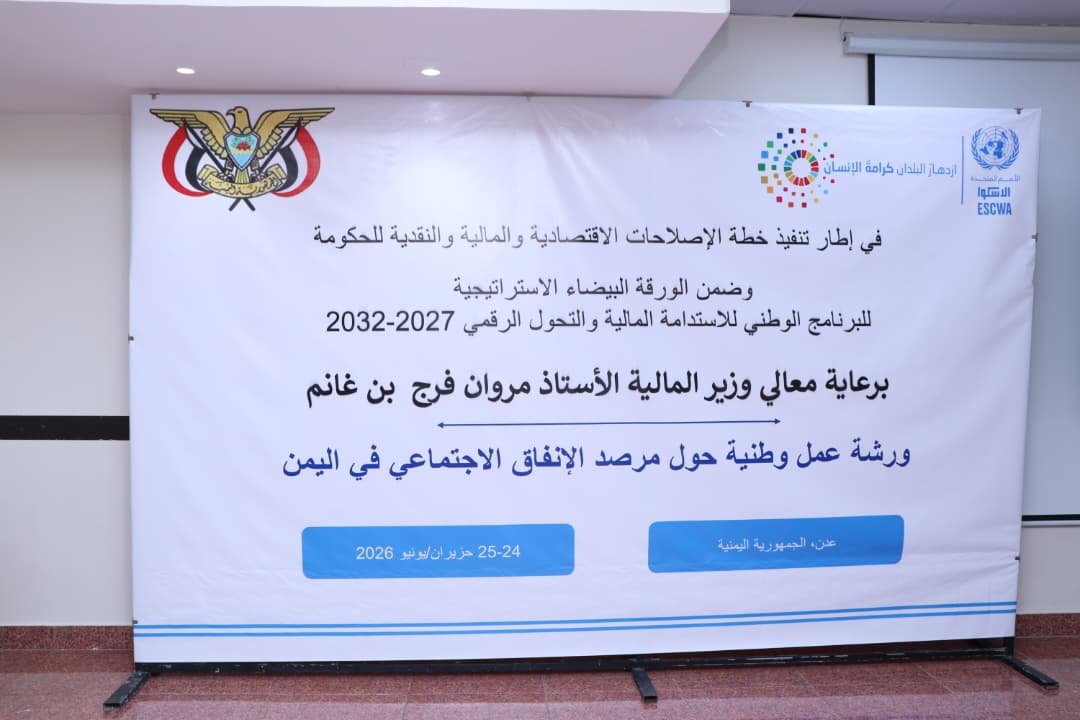
Yemen’s Ministry of Finance has concluded a workshop in Aden devoted to building a national system for tracking social spending, part of a broader push to strengthen public financial management in a country whose economy has been battered by years of conflict. The event, organised in cooperation with the United Nations Economic and Social Commission for Western Asia, known as ESCWA, brought together government bodies and international partners to advance work on what is being developed as a Social Expenditure Monitor, a tool sometimes described locally as a social expenditure observatory.
The central aim of the workshop was to strengthen national capacity by linking public budget data with indicators of social expenditure. By connecting the two, officials hope to make public spending more efficient, more equitable and more transparent, and to encourage decisions in fiscal policy that are grounded in reliable data rather than guesswork. In a setting where resources are scarce and needs are vast, the ability to see clearly where money is going has become a priority for both the government and its external backers.
According to participants, the initiative forms part of continuing efforts by the Ministry of Finance to align social spending with national priorities while improving accountability. The work was carried out in cooperation not only with ESCWA but also with the Ministry of Planning and International Cooperation and the United Nations Country Team in Yemen, reflecting an attempt to coordinate across institutions that each hold pieces of the country’s fragmented fiscal picture.
Over the course of the sessions, attendees examined a wide range of social sectors that the monitor is intended to cover. These included education, health and nutrition, social protection, subsidies, agricultural support, housing and labour markets, alongside cultural and environmental considerations. For each area, participants reviewed the data and indicators that would be needed to operate the system effectively and to keep it regularly updated, a task that depends heavily on the quality and availability of underlying records.
One notable theme of the discussions was the challenge of capturing social spending that falls outside the conventional state budget. Officials looked at how to account for money that flows through independent units, special funds and programmes financed by external partners, all of which can play a significant role in the delivery of services but which often sit outside standard budget reporting. The Social Expenditure Monitor methodology promoted by ESCWA has been applied in several countries across the Arab region as a way of giving governments a clearer and more comparable view of how much is actually spent on social development. Building a fuller picture of these flows, participants argued, is essential to understanding the true scale and direction of social expenditure in Yemen.
Ministry officials said the objectives set out at the start of the workshop had been met, and that the gathering had moved beyond theoretical discussion toward practical steps. Particular attention was paid to identifying gaps in existing data and to establishing follow-up procedures so that the work could continue in a structured way. Rather than treating the workshop as a one-off event, organisers framed it as a stage in a longer process of institution-building.
Participants also stressed the importance of technical collaboration among the various ministries and sectoral bodies that maintain relevant data, including those responsible for education, health, labour, finance, and planning. Each of these institutions controls information that the monitor will need, and bringing their records into a common framework is seen as one of the central challenges of the project. Without agreement on how data is collected, defined, and shared, the resulting picture would remain incomplete.
The effort is being coordinated through a main committee established for the Social Expenditure Monitor project under a recent government decision, a structure intended to give the initiative formal standing and to sustain cooperation between state institutions and international partners. Reaching a unified framework for exchanging data, officials said, will be key to creating an integrated national database on social spending that all relevant bodies can rely on.
That database is envisaged as a resource that would allow the authorities to monitor the flow of funds into social sectors, assess how effectively those funds are used, and help ensure that resources reach the communities and regions most in need. In a country where humanitarian needs remain immense and where international funding has come under strain, the promise of such a system lies in its potential to target limited resources more precisely and to reduce waste and duplication.
The broader context underlines why the project matters. Yemen’s public institutions have been weakened by prolonged conflict and a divided fiscal landscape, and the government in Aden has repeatedly emphasised the need for reforms that restore confidence in how public money is managed. Tools such as the Social Expenditure Monitor are unlikely to resolve the country’s deep economic difficulties on their own, but supporters argue they can lay important groundwork by improving transparency and strengthening the evidence base for policy. As Yemen continues to navigate a fragile recovery, officials hope that better data on social spending will gradually translate into more effective support for its most vulnerable citizens.
About the Author