Yemen Condemns Repeated Iranian Attacks on Kuwait, Bahrain and Jordan
 Yemen Herald News
The internationally recognized government of Yemen has strongly condemned a series of Iranian missile and drone attacks on Kuwait, Bahrain and Jordan, describing the strikes as a blatant violation of the three countries’ sovereignty and a direct threat to their security and stability. In a statement carried by the state news agency Saba on Saturday, the Foreign Ministry said the repeated attacks had struck several vital facilities in Kuwait, including power plants, water desalination plants and installations belonging to the oil sector.
The ministry affirmed the Republic of Yemen’s solidarity with Kuwait, Bahrain and Jordan and declared its support for any measures the three states may take to preserve their security, sovereignty and territorial integrity. The condemnation placed Yemen alongside Saudi Arabia and the United Arab Emirates, both of which denounced the strikes and rejected attacks on vital civilian infrastructure in the Gulf, while the Gulf Cooperation Council and the European Union issued statements of condemnation of their own.
The attacks form part of a wider confrontation between Iran and the United States that has escalated sharply this month. Iranian forces have launched successive waves of missiles and drones at military sites in countries that host American forces, in what Tehran presents as retaliation for US strikes on targets inside Iran. Air raid sirens have sounded repeatedly in Kuwait and Bahrain in recent days, and both countries say their air defenses have intercepted incoming Iranian drones on several nights.
Iran’s Islamic Revolutionary Guard Corps said its forces attacked what it described as installations and infrastructure of the US military, including Ali Al Salem Air Base in Kuwait, where it claimed to have destroyed a radar system and a satellite communications center, as well as a wharf at Kuwait’s Shuaiba Port. In Bahrain, the Guard said it targeted American facilities in the Juffair area, and Iranian media reported strikes aimed at helicopters and reconnaissance aircraft stationed at a Bahraini airbase.
Jordan’s armed forces said their air defenses intercepted and shot down four missiles that entered the kingdom’s airspace from the direction of Iranian territory, while Iranian statements claimed that fuel depots and ammunition stores at Jordanian airbases had been set ablaze. Many of the battlefield claims made by both sides have not been independently verified.
For Kuwait, the damage has extended well beyond military targets. According to Saba, a combined electricity and water desalination station was struck for the second time in two days, igniting a fire in parts of the facility and forcing several power generation units out of service. The strikes on desalination infrastructure have caused particular alarm across the Gulf, where states depend overwhelmingly on treated seawater for drinking supplies and where extreme summer heat makes any disruption to power and water potentially dangerous for ordinary residents.
Yemen’s condemnation carries a resonance of its own. The government has spent more than a decade confronting what it regards as Iranian interference in Yemen’s internal affairs through Tehran’s political and military support for the Houthi movement, which seized the capital Sanaa in late 2014 and triggered the intervention of a Saudi-led coalition the following year. For Yemeni officials, the strikes on neighboring states fit a familiar pattern of pressure on governments aligned with Riyadh and Washington.
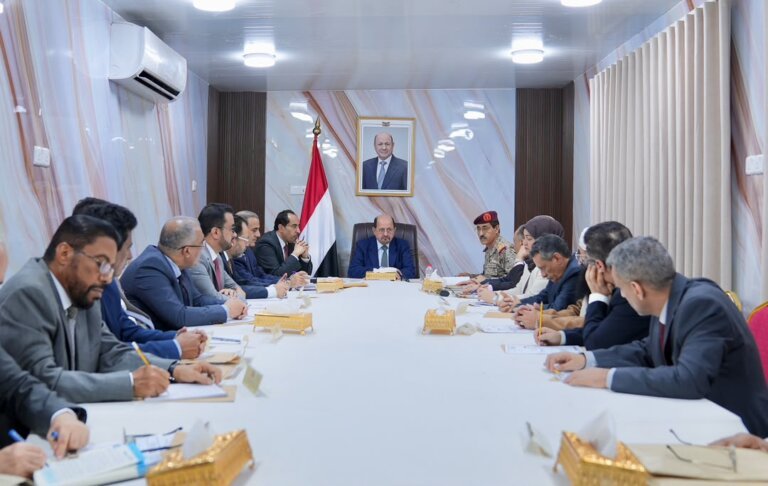
The statement also came at the end of a week of acute tension inside Yemen itself. The government briefly closed the airports under its control after the armed forces said they had struck the runway of Sanaa International Airport to prevent an Iranian aircraft carrying a senior Houthi delegation from landing there without authorization. President Rashad al-Alimi, who chairs the Presidential Leadership Council, has since insisted that the state will not permit any flights that bypass its exclusive authority over the country’s airspace.
Yemen is not a member of the Gulf Cooperation Council, but its government works closely with Gulf capitals and depends heavily on their political and financial support. The Foreign Ministry’s statement therefore signals more than routine diplomacy: it aligns the government publicly with the Gulf bloc at a moment when its members are weighing how to respond to repeated attacks on their territory. One likely consequence is renewed attention to air and missile defense cooperation between Gulf states and their Western partners in the months ahead.
Geography raises the stakes further. Yemen overlooks the Bab al-Mandab Strait, the southern gateway to the Red Sea and one of the world’s busiest shipping corridors, while the Gulf states sit astride the Strait of Hormuz, through which a large share of global oil exports passes. Any widening of the current conflict would therefore threaten two of the most important maritime chokepoints in the world, with immediate consequences for energy markets and international trade.
The humanitarian backdrop adds urgency. According to United Nations estimates, more than 18 million people in Yemen need humanitarian assistance and some 4.5 million remain internally displaced after more than a decade of war. Yemen depends heavily on imports and on remittances sent home by Yemenis working in Gulf countries, so prolonged instability in Kuwait or its neighbors would ripple quickly through an economy already under severe strain.
For now, the message from Yemen’s Foreign Ministry is one of unambiguous solidarity with its neighbors. Whether the current escalation gives way to renewed diplomacy or a broader regional confrontation will depend largely on decisions taken in Tehran and Washington, but the government has left no doubt about where it stands.
About the Author