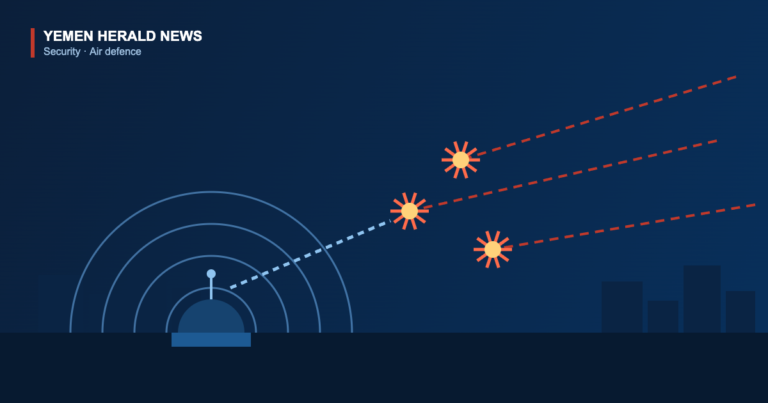
Shabwa Defence Forces say they shot down a Houthi drone over eastern Yemen front lines
 Yemen Herald News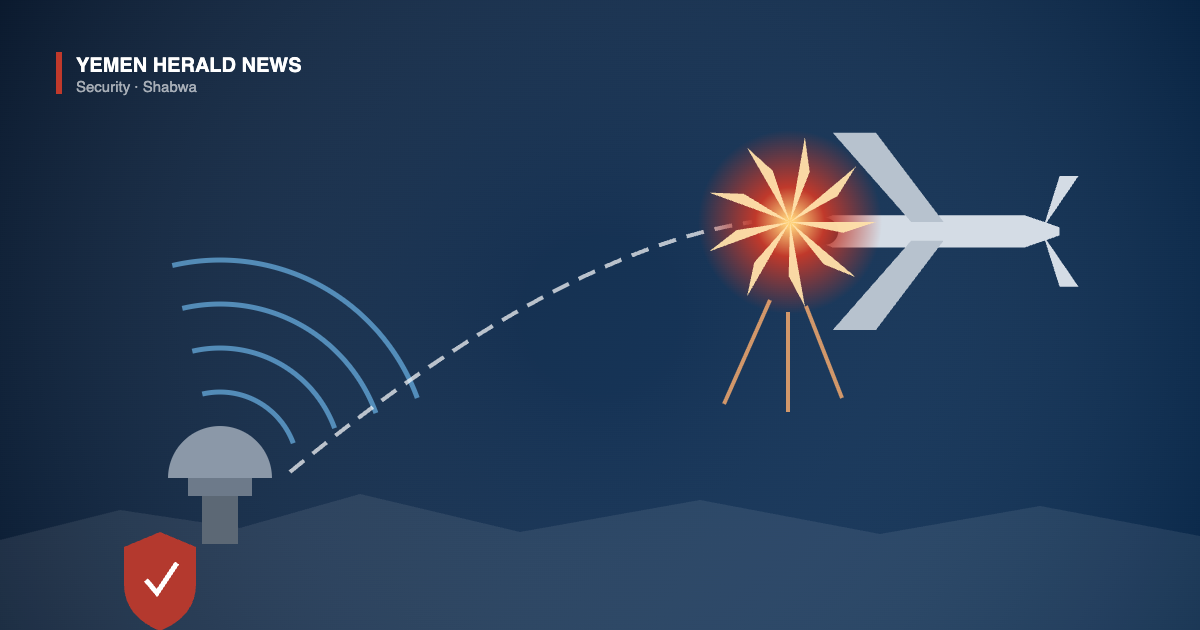
The Shabwa Defence Forces said on Monday evening that their air defence units had detected and shot down a Houthi drone flying near military positions along several front lines in eastern Yemen, including Harib, Ain, Bayhan and Upper Markha. The force said the interception caused no casualties among its personnel.
In its statement, the force said surveillance units picked up the aircraft as it approached the area and that engagement protocols were followed once it was identified. No details were given about the type of drone, the munition used to bring it down or the exact location where the wreckage fell, and the account has not been independently verified. The Houthis did not comment on the claim.
The fronts named in the statement sit along the boundary between Shabwa and Marib governorates, an arc of high ground and desert approaches that has been among the most persistently contested stretches of the country. Bayhan and Upper Markha lie in Shabwa; Harib sits just across the line in Marib. Control of these districts matters because they command the road links between the two governorates and the approaches to Marib’s oil and gas infrastructure.
The reported interception follows a period of sustained pressure on the same axis. Last week the Shabwa Defence Forces, operating alongside units from the Sabaa axis and the 26th Sector Brigade, said they had repelled Houthi attempts to infiltrate positions at Harib, Ain, Bayhan and Upper Markha, and said their own drones had flown sorties in response as part of an operation the force calls Arrows of Shabwa. Earlier in the month, a Houthi attack on the force’s positions killed two of its members and wounded several others, according to Yemeni outlets.
Drones have become a defining feature of the fighting on this front. Both sides now use them for reconnaissance and for strikes on fixed positions, and the low cost of small airframes has made them a routine instrument rather than an exceptional one. For a force holding dispersed positions across open terrain, the practical problem is less the individual aircraft than the volume: detection has to be continuous, and interception has to be cheap enough to sustain.
Independent verification of front-line claims in Yemen is limited. Access for journalists and monitors is tightly controlled on both sides, wreckage is rarely shown to outside observers, and competing statements are often issued about the same engagement. Reports of interceptions therefore tend to stand or fall on the credibility of the issuing command rather than on physical evidence, and figures announced by either side should be read with that constraint in mind.
That is why announcements of this kind carry a signalling function alongside their operational content. Government-aligned forces have an interest in demonstrating that their air defences function, both to reassure the communities behind their lines and to argue for further external support in training and equipment. The Presidential Leadership Council has spent much of the past year pressing partner states for exactly that kind of assistance, describing air and maritime defence as the weakest components of its military structure.
The Shabwa Defence Forces were formed during the reorganisation of security structures in the governorate and operate under the authority of the internationally recognised government, though the command arrangements governing the various formations in southern and eastern Yemen have long been a source of friction. Shabwa itself holds oil facilities and the terminal infrastructure associated with them, which gives its front lines an economic weight disproportionate to their population.
The broader picture has deteriorated markedly since last month, when the relative calm that had held since the 2022 truce gave way to renewed offensives. Earlier in August, Houthi forces mounted their deadliest ground assault in years, killing 58 government soldiers mainly in Marib province, according to a Yemeni military source cited in agency reporting. Fighting has also intensified along the Red Sea coast, where the Houthis declared a blockade of Saudi shipping through Bab al-Mandab on 20 July and have since struck the port of Mokha repeatedly.
Civilians have absorbed a substantial share of that escalation. The UN Human Rights Office said on Monday that at least seventeen civilian casualties from Houthi attacks had been recorded in government-held areas since 6 August, among them six people injured when a missile hit the Jaw al-Naseem camp for displaced families in Marib on 7 August. UN High Commissioner Volker Turk urged all parties to pull back before the country returns to full-scale war.
For the districts named in Monday’s statement, the immediate consequence of drone activity is displacement and disruption rather than territorial change. Front lines in this part of Yemen have moved only marginally over several years, but the areas behind them contain farming communities and displaced families who have already been moved once by earlier rounds of fighting, and who are exposed to the shortfall in aid funding that has narrowed assistance across the country.
No further engagements were reported along the Shabwa fronts in the hours after the announcement. Whether the interception reflects a genuine improvement in the force’s air defence capability or a single successful engagement is not possible to establish from the statement alone, and the force has not published a record of attempted interceptions against which any success rate could be assessed.
About the Author