Fire breaks out near Aramco facility in Riyadh as Houthis claim missile and drone strike
 Yemen Herald News
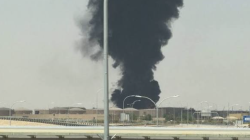
RIYADH, Saudi Arabia — A fire broke out near a Saudi Aramco facility in Riyadh on Saturday, and Yemen’s Houthi movement said its missiles and drones caused it.
A Reuters witness reported a large plume of smoke and fire near the facility in the Saudi capital. Correspondents for Agence France-Presse reported flames and heavy smoke in the same area.
Yahya Saree, the Houthi military spokesman, said the group had carried out an operation using ballistic missiles and drones against the Aramco site. He said the strikes were “precise and direct” and had started fires at the targets.
The Saudi-led coalition rejected that account. Turki al-Maliki, the coalition spokesman, said the Houthi claims were misleading. Saudi forces described the announcement as propaganda.
Neither Aramco nor Saudi government authorities confirmed the fire, any damage to the site or any effect on production.
Yemen Herald could not independently confirm what started the fire. The account of a strike rests on the Houthi military spokesman, and the opposing party disputes it.
Saree said 94 airstrikes had been carried out in Yemen on Oct. 1. The coalition said early on Sunday that its armed forces had conducted 97 “precise targeting operations”.
Al Masirah, the Houthi-run broadcaster, reported early on Sunday that Saudi Arabia had struck Sanaa. Saudi Arabia had not confirmed that strike at the time of writing.
The broadcaster said sites in Sanaa, Saada, Taiz, Hajjah, Amran and Al Bayda provinces were hit. Yemen Herald could not verify those reports.
Saudi Arabia said the previous week that it had intercepted six ballistic missiles fired toward Taif and the Yanbu area. It reported no damage to Aramco facilities in that case.
Saturday’s fire was not the first reported at a Saudi site during the current round of fighting.
A Security Council Report forecast published for October said the Houthis struck military bases and energy infrastructure on Sept. 15, and that a fire broke out at King Khalid International Airport in Riyadh that day.
Saudi forces intercepted a Houthi drone heading toward Mecca on Sept. 16, according to the same forecast.
Maj. Gen. al-Maliki said on Sept. 8 that the Houthis had attacked the cities of Abha, Khamis Mushait, Jizan and Najran. He said at least 73 people were injured.
Saudi Arabia’s Energy Ministry said those strikes started fires at several oil installations. The Jizan refinery, among the kingdom’s largest, can process 400,000 barrels of crude a day.
Saree said at the time that the group had targeted Aramco energy infrastructure with drones and ballistic missiles in retaliation for Saudi attacks. He called it “a broad operation”.
Saudi Arabia said on Aug. 9 that a fire at an Aramco facility in Jizan had been extinguished.
The forecast said Houthi grievances over the Saudi-led blockade resurfaced in July, and that reciprocal strikes began then.
Fighting resumed in July after an Iranian aircraft tried to land in Sanaa without Saudi authorisation, Al Jazeera reported. Saudi Arabia then struck Sanaa airport and the Houthis retaliated.
A UN-brokered truce had halted large-scale fighting in Yemen in 2022.
The exchanges have followed Houthi territorial gains on Yemen’s western coast. The movement seized the port city of Mokha from government-aligned forces on Sept. 10.
It captured Perim Island in the Bab al-Mandab Strait the following day and took control of Yemen’s west coast.
The coalition has carried out airstrikes in Al-Jawf, Marib, Saada and Taiz governorates. Government forces said they retook highland positions in Taiz on Sept. 21 and 22.
Hans Grundberg, the UN special envoy for Yemen, briefed an emergency meeting of the Security Council on Sept. 10.
The Council held a second emergency meeting on Sept. 15 on Houthi territorial expansion. It issued a press statement on Sept. 18 condemning Houthi attacks and the military escalation.
An earlier Council press statement on Aug. 7 urged de-escalation.
Volker Türk, the UN high commissioner for human rights, said on Sept. 24 that at least 125 civilians had been killed and wounded since early August. He said 125,000 people had been displaced in that period.
About 3,000 people have crossed the Bab al-Mandab to Djibouti, the forecast said. It said 73 UN staff members remain arbitrarily detained by the Houthis.
The UN Office for the Coordination of Humanitarian Affairs said in its March 2026 plan that more than 22 million people in Yemen required assistance.
The office said 18.3 million people were acutely food insecure. It said more than 2.2 million children under five were acutely malnourished, including 516,157 with severe acute malnutrition.
It counted 5.2 million internally displaced people. The plan sought 2.16 billion dollars to reach 12 million people.
Houthi forces killed four seafarers in an attack on the cargo ship Tihamah on Aug. 11, according to the Council forecast.
Saudi seaborne crude exports through the Bab al-Mandab between March and mid-July were eight times higher than in the same period of 2025, Al Jazeera reported.
Prince Faisal bin Farhan al Saud, the Saudi foreign minister, said in September that “the road to diplomacy is not closed”. He said the kingdom would “never hesitate to defend itself”.
The Houthis said on Sept. 8 that Saudi aircraft and cruise missiles had struck al-Jawf, al-Bayda, Marib and Taiz provinces. They also said they had shot down Saudi reconnaissance drones.
About the Author