Houthi missiles strike positions near Bab al-Mandab as Mokha port stays shut
 Yemen Herald News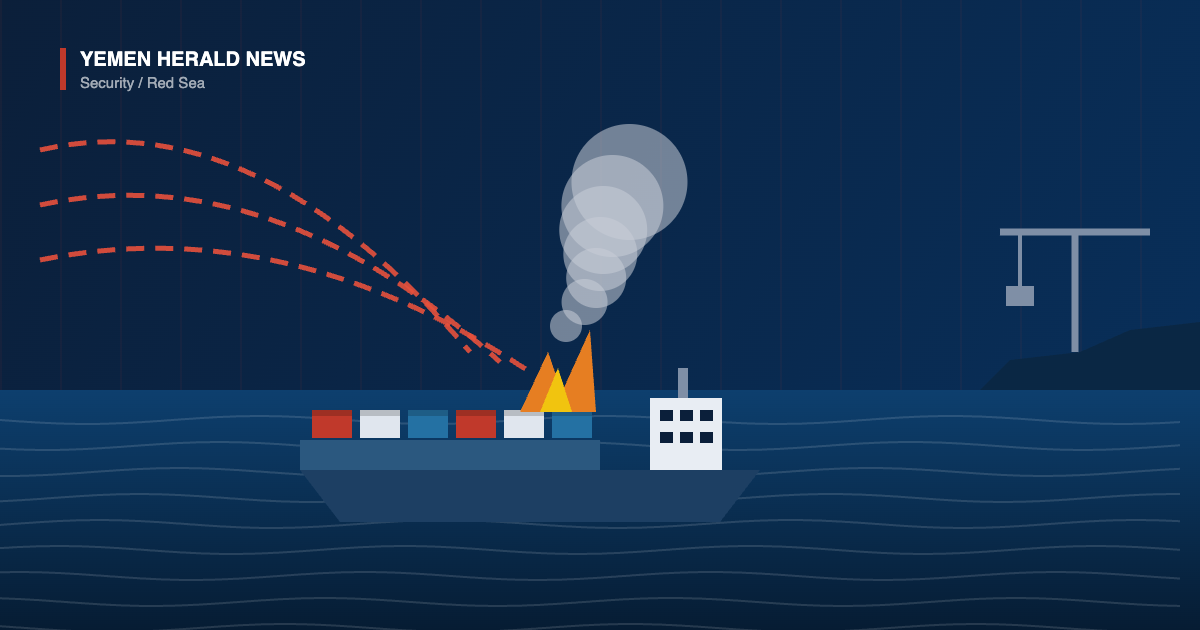
A Yemeni military source has said that Houthi forces fired ballistic missiles at government-held positions near the Bab al-Mandab Strait in the south-west of Taiz province, the latest strike in a fortnight of escalation that has reopened one of the most sensitive fronts of Yemen’s war. The source said the projectiles were aimed at military infrastructure around Dhubab, the coastal district that overlooks the strait, and formed part of a wider salvo directed at the approaches to the waterway.
That account fits a pattern documented elsewhere in recent days. Yemeni military sources said earlier this month that five ballistic missiles were launched towards positions near Bab al-Mandab, fired from the southern province of Ibb and from the al-Hawban area east of Taiz city, both of which lie under Houthi control and within range of the coastal strip. Ansar Allah, as the movement formally calls itself, has not published a target-by-target account of every launch, and the specific claim about Dhubab rests on the military source rather than on independent confirmation.
What is not in dispute is the damage further up the coast. The port of Mokha, the internationally recognised government’s main Red Sea maritime outlet in Taiz province, suspended commercial and maritime operations after being struck by more than 25 missiles since 9 August. Port officials put material losses at roughly 16 million dollars. Seven people were reported killed. Six wooden vessels and a dredger brought in for the port’s expansion were damaged, and about 1,300 workers were left without income while the facility remained closed.
Those were the first reported attacks on Mokha since the truce brokered in April 2022, which had held unevenly for more than three years. A government investigation committee has since inspected the site. The Taiz local authority described the shelling as a war crime against what it called an economic and relief lifeline, a characterisation the Houthis reject. Yemeni outlets monitoring the port reported that a later round of shelling roughly doubled the destruction there.
The escalation has not stayed inside Yemen’s borders. On 8 and 9 August the Houthis said they had struck Saudi Aramco’s refinery at Jazan, on the Red Sea coast, with a drone. Saudi authorities confirmed a fire at the facility and said it was extinguished quickly, with no injuries. The Houthi-run Saba news agency reported a second strike on 13 August, citing an unidentified military source and saying two drones had hit the refinery, the second attack on the same plant in less than a week. Jazan processes in the region of 400,000 barrels of crude oil a day.
The movement framed both operations as retaliation. In its statements it said the strikes answered what it called Saudi drone incursions into the airspace of Saada and Hajjah governorates in Yemen’s north. Riyadh has not publicly accepted that description of events. Claims of this kind, made by parties to an active conflict and rarely open to outside inspection, are difficult to verify, and each side’s version of who escalated first is contested.
Commercial shipping has also been hit. A cargo vessel was struck by ballistic missiles in the Bab al-Mandab this month, killing several foreign crew members; the casualty figures reported by different outlets have not been consistent, and the total remains unsettled. The strait links the Red Sea to the Gulf of Aden and forms part of the shortest sea route between Asia and Europe by way of the Suez Canal, which is why any exchange of fire along that coast registers well beyond Yemen.
Inland, the fighting has resumed on several fronts at once. Clashes have been reported in al-Jawf, al-Dhalea and Taiz, and missile attacks have been reported on Hadramout and Marib, including on camps belonging to the Homeland Shield Forces, the Emergency Forces and the First Military Region. Taken together, the strikes amount to the sharpest deterioration in the conflict since the 2022 truce took effect.
The strategic reasoning behind Dhubab is straightforward. The district sits on the Yemeni shoulder of the strait, a stretch of coast from which the shipping lane can be watched and, with the right weapons, threatened. Control of that ground has changed hands before during the war, and the surrounding coastal plain was among the most heavily contested terrain in the fighting of 2017 and 2018.
For Yemenis, the immediate cost is economic rather than strategic. Mokha’s closure removes a working import channel at a moment when the country depends almost entirely on seaborne food and fuel. Relief agencies have warned repeatedly that disruption at any functioning Yemeni port translates quickly into higher prices in inland markets.
Neither side has signalled a willingness to step back. The Houthis have said they will continue what they describe as firm responses to any aggression and have warned of further operations if hostilities continue. Government officials have called for international pressure on the movement. United Nations efforts to restore the truce have so far produced no publicly announced result.
The pattern of the past two weeks — coastal shelling, cross-border drone strikes and renewed ground fighting on several fronts at once — resembles the one that preceded the war’s most destructive years. Commercial traffic still moves through Bab al-Mandab, but insurers and shipping lines have treated the corridor as high-risk since 2023, and every strike near that coast makes the judgement harder to revise.
About the Author