Yemen’s Ambassador to Japan Discusses Expanding Economic Cooperation with Tokyo Trade Minister
 Yemen Herald News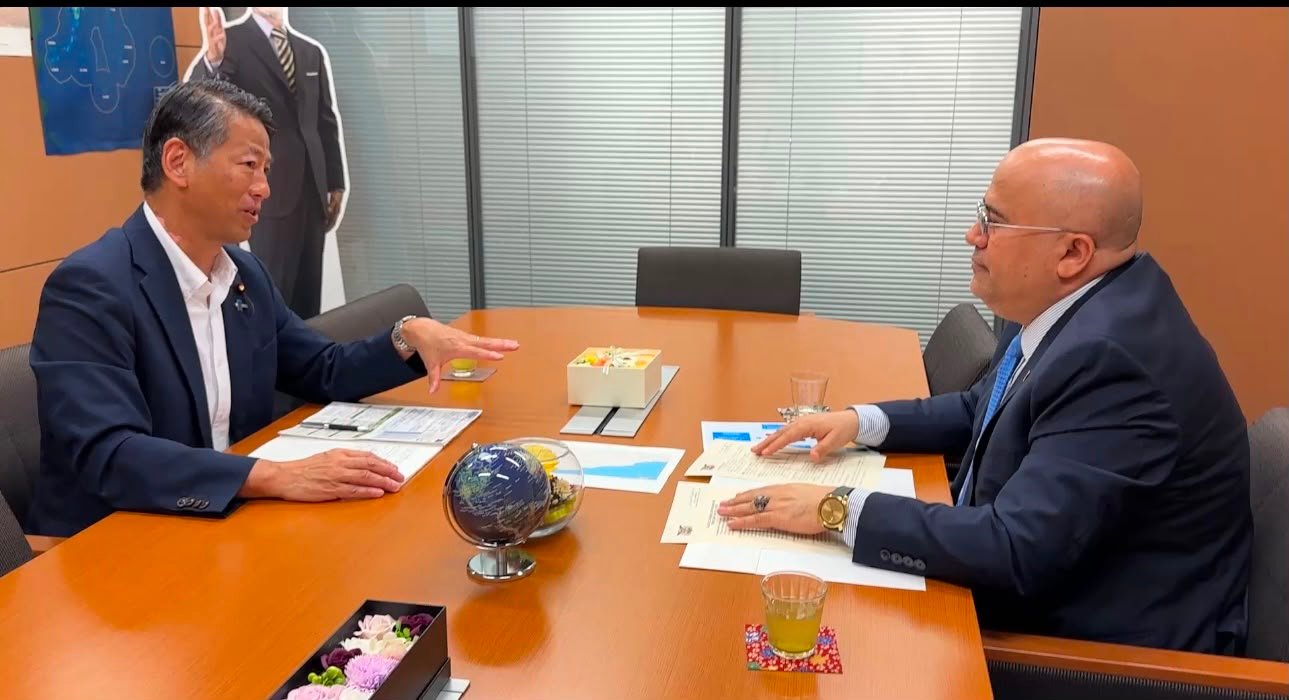
Yemen’s Ambassador to Japan, Adel al-Sunaini, has held talks in Tokyo with Japan’s State Minister of Economy, Trade and Industry, Kenji Yamada, on ways to broaden economic and trade cooperation between the two countries and to enlist Japanese expertise in support of Yemen’s recovery and development. The meeting, reported by the Yemeni news agency Saba, brought the two sides together at a moment when the Yemeni government is trying to rebuild economic institutions strained by more than a decade of conflict.
According to the account of the meeting, the two officials examined opportunities to expand the economic partnership and to draw on Japan’s industrial and technical capabilities in ways that would stimulate economic activity inside Yemen, create jobs and lay firmer foundations for sustainable development. Both sides pointed to what they described as considerable untapped potential in the relationship, and to the contribution Japanese companies, financing institutions and development agencies could make to reviving Yemeni production and trade.
Al-Sunaini briefed the Japanese minister on the latest developments in Yemen and on the effect that regional tensions and military escalation have had on the country’s economic stability and on its international trade. He drew particular attention to the risks facing maritime navigation and supply chains, a concern of direct commercial significance to Japan, whose energy imports and container traffic depend on sea lanes that pass close to Yemen’s coastline through Bab al-Mandab and the southern Red Sea.
Yemen’s economy remains acutely exposed to disruption in those waters. The country imports the overwhelming majority of its food and fuel, and shipping costs, insurance premiums and delivery times feed quickly into domestic prices. Government officials have repeatedly argued that restoring predictable commercial traffic through the Red Sea corridor is a precondition for stabilising the currency and public revenues, both of which have come under severe pressure during the conflict.
Yamada has served as State Minister of Economy, Trade and Industry since October 2025. A member of the House of Representatives for a constituency in Hyogo Prefecture, he has been returned to the lower house six times since first winning a seat in 2012. His ministry oversees Japan’s trade policy, energy security and industrial cooperation abroad, portfolios that bear directly on the questions raised in the Tokyo meeting.
Japan has been one of the more consistent international contributors to Yemen through the conflict years. Total Japanese assistance to the country since 2015 is put at roughly 497 million dollars, delivered through a combination of emergency humanitarian grants and longer-term technical cooperation administered by the Japan International Cooperation Agency, known as JICA.
That support has continued into the current year. In February 2026 the Japanese government provided about 611,000 dollars through UNICEF to address urgent emergency health needs and strengthen the response to public health emergencies. A separate grant of 1.9 million dollars was channelled through the World Food Programme in support of food security. Also in February, Japan and the United Nations Office for Project Services signed an agreement worth approximately 4.6 million dollars to improve customs functions at key Yemeni ports.
The customs project reflects a strand of cooperation that predates it. JICA has run training programmes for Yemeni customs personnel in recent years, part of a broader effort to rebuild the administrative machinery on which trade and public revenue collection depend. Earlier in August, al-Sunaini met the Director General of JICA’s Middle East and Europe Department to discuss widening technical and economic cooperation, and the agency reaffirmed its intention to continue and expand its programmes in Yemen.
For Yemen, the appeal of a deeper relationship with Tokyo lies less in aid volumes than in the transfer of technology and practical know-how. Japanese expertise in port logistics, power generation, water management and small-enterprise finance maps closely onto the bottlenecks that Yemeni planners identify as constraints on recovery. Officials have argued that capacity building of that kind offers a more durable return than emergency relief alone, though relief remains indispensable while humanitarian needs stay at their present scale.
Bilateral commerce has been limited in scale for years, and rebuilding it to any significant volume depends on conditions Yemen cannot control on its own: security in the shipping lanes, functioning ports and customs administration, and a banking sector able to handle international settlement. Each of those featured, directly or indirectly, in the case the ambassador put to his Japanese counterpart, and each is an area in which Japanese technical assistance is already engaged in some form.
The embassy in Tokyo has been notably active over the past year in cultivating contacts across the Japanese government, parliament and development establishment, and the meeting with Yamada continues that pattern. Earlier engagements have included discussions with Japanese lawmakers on expanding the bilateral partnership and with the Japan External Trade Organization on commercial ties, alongside the exchanges with JICA on development programming.
No specific new commitments were announced at the Tokyo meeting. Both sides indicated that consultations would continue and that they would look for practical areas in which Japanese economic and technical involvement could be scaled up as conditions allow. For a Yemeni government working to restore basic economic functions, the value of contacts of this kind lies partly in the substance discussed and partly in keeping the country on the agenda of a major industrial economy.
About the Author