Yemen’s EU Ambassador Discusses Cooperation and Reform in Brussels
 Yemen Herald News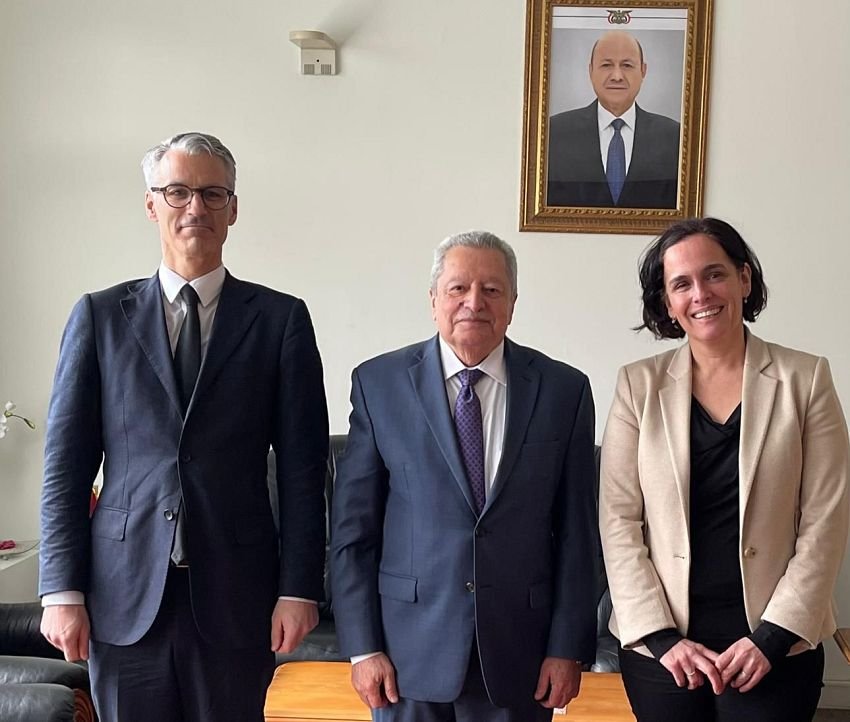
Yemen’s Ambassador to the European Union, Mohammed Taha Mustafa, has held talks in Brussels with senior EU officials aimed at strengthening the relationship between Yemen and the bloc. Among those he met were Matthew Binns, Head of the Gulf Division at the European Commission’s Directorate-General for the Middle East, North Africa and the Gulf, and Daniela Kolen, Chair of the Yemen and Red Sea Working Group, in discussions focused on future programmes and initiatives in the country.
The meeting sought to deepen cooperation between Yemen and the European Union across a range of areas, with particular attention to the development programmes and reform initiatives that have formed the backbone of the partnership. Both sides used the occasion to review the state of relations and to consider how they might be expanded in the period ahead.
During the talks, Ambassador Mustafa expressed Yemen’s solidarity with neighbouring countries that his government says have faced Iranian attacks, a statement reflecting Sanaa’s recognised leadership’s position on regional security and its alignment with allied states in the Gulf. The remark situated Yemen’s own concerns within the wider tensions that have shaped the security environment across the region.
For their part, EU officials reaffirmed their continued support for Yemen, particularly in relation to development initiatives and the government’s reform agenda. That backing underscores the European Union’s role as a significant partner in efforts to foster stability and progress in the country amid the many challenges it continues to face.
The European Union has been one of the more prominent international actors engaged with Yemen throughout the conflict, providing humanitarian assistance, supporting development programmes and backing efforts toward a political resolution. Its engagement spans both the immediate relief of suffering and longer-term initiatives aimed at strengthening institutions and laying the groundwork for recovery.
The existence of a dedicated Yemen and Red Sea Working Group within the EU’s structures reflects the importance the bloc attaches to the country and to the surrounding waters. The Red Sea, and the Bab al-Mandab strait at its southern end, constitute a vital artery of global trade, and instability there carries implications far beyond the region, giving European institutions a clear stake in Yemen’s stability.
Ambassador Mustafa’s engagement in Brussels formed part of a broader effort by Yemen’s internationally recognised government to maintain and expand its relationships with key international partners. Cultivating ties with the European Union and its institutions helps keep Yemen’s needs visible on the European agenda and supports the government’s pursuit of assistance and diplomatic backing.
The focus on future programmes points to a forward-looking dimension of the relationship. Beyond sustaining existing initiatives, both sides appear interested in identifying new areas of cooperation, an approach that reflects a recognition that Yemen’s needs are extensive and that the partnership must continue to evolve to remain relevant and effective.
Reform, a recurring theme in Yemen’s engagement with international partners, is central to the government’s agenda and to the expectations of donors. Improving governance, strengthening institutions and enhancing transparency are widely regarded as essential to attracting and sustaining support, and the EU’s emphasis on the reform agenda aligns with this broader consensus.
The reference to regional security highlighted the interconnected nature of Yemen’s situation. The country’s conflict does not exist in isolation but is bound up with wider regional dynamics, including tensions involving Iran and its role in the region. Yemen’s government has consistently framed its own struggle within this larger context, seeking to align itself with regional and international partners.
Development initiatives, singled out by EU officials, encompass a wide range of efforts to rebuild infrastructure, restore services and create economic opportunity. Such programmes are essential not only to relieving hardship but to demonstrating that progress is possible even amid conflict, and international support is often indispensable to their success.
The setting of the talks in Brussels, the heart of the European Union’s institutions, lent them added significance. Direct engagement with officials at the centre of EU policymaking allows Yemen’s representatives to advocate for the country’s interests at the source of decisions, building relationships and understanding that can shape the bloc’s approach.
Maintaining the European Union’s engagement is a priority for a government that relies heavily on external support. As competing global crises vie for attention and resources, ensuring that Yemen remains a focus of European policy requires sustained diplomatic effort, of which meetings such as this one are an important component.
Whether the discussions yield concrete new programmes will depend on subsequent steps and on the priorities of both sides. Diplomatic engagements of this nature typically lay the groundwork for cooperation rather than producing immediate results, and their value often becomes apparent only over the longer term as commitments are translated into action.
The European Union has also consistently voiced support for the United Nations-led efforts to broker a durable political settlement in Yemen, viewing a negotiated end to the conflict as the only sustainable path to stability. By pairing its development and reform assistance with backing for the wider peace process, the bloc has sought to address both the immediate needs of Yemenis and the underlying political questions that will ultimately determine the country’s future, a combined approach reflected in the Brussels discussions.
For now, the talks reaffirmed the strength of the relationship between Yemen and the European Union and the shared interest in advancing development and reform. As the country continues to navigate its complex challenges, its partnership with the bloc remains a significant element of its international strategy, offering both material support and a measure of diplomatic solidarity.
About the Author