Yemeni Ministers and FAO Open Two Fish Landing Centres in al-Mahrah
 Yemen Herald News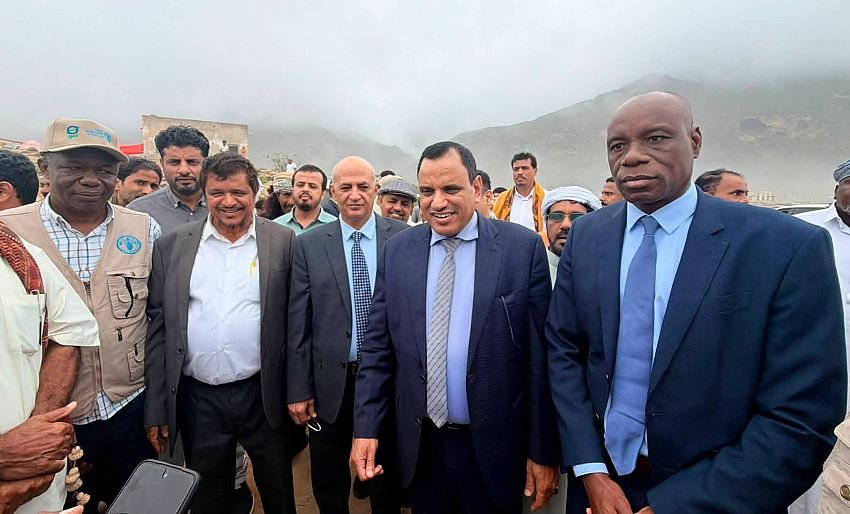
Yemen’s Minister of Agriculture, Irrigation and Fisheries, Salem al-Soqatri, and the Minister of Water and Environment, Tawfiq al-Sharjabi, opened two fish landing centres on Sunday in the Hauf district of al-Mahrah governorate, on Yemen’s far eastern coast. Adam Yao, the Food and Agriculture Organization’s representative in Yemen, joined them for the inauguration. The two facilities serve the coastal settlements of Hauf and Damqawt, and were funded by the Global Environment Facility and built by the FAO as part of a wider effort to rebuild the infrastructure that Yemen’s fishing communities depend on.
At the same event the two ministers laid the foundation stone for an ice plant at the Damqawt landing centre. The official news agency Saba reported that the factory is intended to supply local fishermen with ice to preserve their catch, cut spoilage and raise the market value of what they bring ashore. Cold storage is a persistent constraint along this stretch of coast. Without ice, fish must either be sold quickly and cheaply near the beach or risks being lost before it reaches a buyer.
Al-Mahrah sits on the Arabian Sea between Hadramawt and the Omani border, and is one of the most sparsely populated governorates in the country. It has been comparatively insulated from the front lines of the war, which has made it a practical place for aid agencies and government ministries to run reconstruction work that would be far harder to deliver elsewhere. Its long coastline and its small, scattered fishing settlements also mean that even modest improvements to landing and storage facilities can reach households with few other sources of income.
Fishing has historically been one of Yemen’s most significant sources of income outside the oil sector, and coastal communities from Hodeidah round to al-Mahrah have depended on it for both food and cash. Nearly a decade of conflict has eroded that base. Boats and engines have been damaged or lost, fuel prices have swung sharply, export routes have been disrupted, and the cold chains and processing facilities that allow fish to travel inland have deteriorated. Rebuilding them is slow, unglamorous work that rarely attracts attention, but it is what decides whether a day’s catch becomes income or waste.
Sunday’s openings form part of a broader FAO programme in the sector. Under the Emergency Livelihood Support Project for Agriculture, Livestock and Fisheries in Yemen, the organisation has worked with donors including the King Salman Humanitarian Aid and Relief Centre to rehabilitate fish landing sites in several governorates, two of them in al-Mahrah and the others in Abyan and Hodeidah. The pattern is consistent: repair the landing point, add storage, and let existing fishing crews work more productively rather than attempt to build a new industry from scratch.
The involvement of the Global Environment Facility, rather than a purely humanitarian donor, points to the environmental dimension of the work. The GEF finances projects tied to biodiversity, coastal ecosystems and sustainable resource management, and better-organised landing centres make it easier to record what is being caught and where. That, in turn, is a precondition for managing stocks. Yemen’s coastal waters have limited monitoring, and improved landing infrastructure is often the first practical step towards collecting the data that fisheries management requires.
The wider humanitarian picture in Yemen remains severe. The United Nations Office for the Coordination of Humanitarian Affairs estimated in its 2026 Humanitarian Needs and Response Plan that more than 22 million people in Yemen would require humanitarian assistance and protection over the course of the year, including 18.3 million assessed as acutely food insecure. More than two million children under five are acutely malnourished, alongside over a million pregnant and breastfeeding women. The plan sought about 2.16 billion dollars, a figure that in recent years has consistently outrun the funding actually received.
Against that backdrop, projects that raise domestic food production carry weight beyond their immediate cost. Fish is a locally available source of protein and micronutrients that does not have to be imported, financed in foreign currency or moved through congested ports. For families on the coast it is simultaneously food and a tradeable good. Aid officials have repeatedly argued that supporting local production alongside direct food distribution is the more durable of the two approaches, though it takes longer to show results and is harder to measure.
Whether the new centres deliver on that promise will depend on what happens after the ceremony. Ice plants need reliable power and maintenance, landing centres need staff and operating budgets, and fishermen need fuel at prices they can absorb. Neither the ministries nor the FAO announced a running-cost arrangement for the facilities at Sunday’s event, and the record of infrastructure handed to under-resourced local authorities in Yemen is mixed. Continued engagement with the crews who actually use the sites will be the clearest indicator of whether the investment holds.
For now, the openings at Hauf and Damqawt are a small, concrete addition to an economy that has had few of them. They will not alter the national picture. But for the crews working out of those two landing points, the difference between selling a catch at a loss and preserving it for a better price is immediate and measurable.
About the Author