Zindani Tells Aden Business Leaders the Private Sector Is Central to Yemen’s Recovery
 Yemen Herald News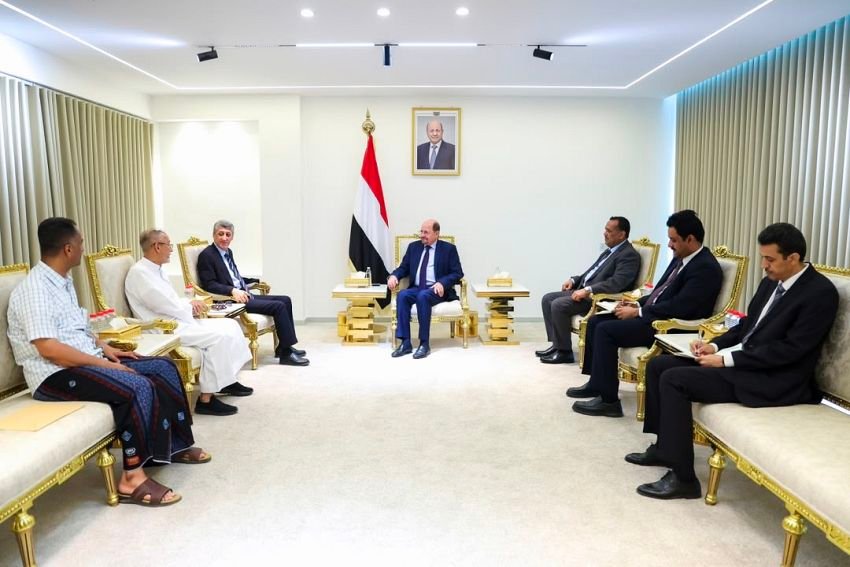
Yemen’s Prime Minister, Dr Shaya Mohsen al-Zindani, has told leading business figures that the private sector is the government’s principal partner in any economic recovery, promising a more formal framework for cooperation and a wider opening for investment. The state news agency Saba reported that he made the remarks at a meeting in Aden, the country’s interim capital, with senior representatives of the chambers of commerce and industry.
Among those present was Abu Bakr Baabid, vice-president of the General Federation of Chambers of Commerce and Industry of Yemen, who also heads the Aden Chamber of Commerce and Industry. Saba named Omar Bajarash, head of the Chamber of Commerce and Industry in Hadramawt, among the other participants. The discussion covered the obstacles businesses face after more than a decade of conflict, from damaged infrastructure and unreliable electricity to the cost and difficulty of importing goods.
Al-Zindani said the government wanted a relationship with business built on transparency, trust and a clear division of roles, and that the aim was to turn declarations of partnership into projects people can see. He has described an effective partnership with the private sector as a top priority for his cabinet, language he has used repeatedly since taking office in February 2026.
The most concrete measure to emerge from that agenda is a Public-Private Partnership Unit, created by prime ministerial decision earlier this year. According to the government, the unit has broad executive and supervisory powers covering the whole life of a project: setting priorities, commissioning economic feasibility studies, running contracting and procurement, and monitoring delivery and performance once work begins.
Officials say the body is meant to give Yemen an institutional structure capable of absorbing private capital at a time when the treasury cannot fund vital projects on its own. Years of lost oil exports, shrinking external support and heavy spending pressures have left the government searching for alternative sources of finance for electricity, water, ports and roads.
The meeting took place against a currency backdrop that has changed sharply. After the riyal fell to roughly 2,900 to the US dollar in territory held by the internationally recognised government, a series of interventions by the Aden-based Central Bank of Yemen pulled the rate back to around 1,500. The bank closed exchange houses it accused of speculation, brought internal remittances under a controlled system, and set up a committee to oversee imports and supply traders with hard currency. In February 2026 it confirmed the recovery and formally adjusted its published rates.
That stabilisation has not translated into easy conditions for business. Reporting in April 2026 described a severe shortage of physical cash across government-held areas, with banks and traders struggling to obtain banknotes even as the exchange rate held. Analysts at the Sana’a Center for Strategic Studies have cautioned that the gains will prove temporary unless the emergency measures are converted into durable policy and paired with deeper structural reform of public finances.
Yemen’s economy is estimated to have contracted by more than half since 2015, and the formal private sector that survived has done so by operating across front lines and in more than one monetary zone. Traders in government-held areas and in Sanaa work with riyal notes of different vintages that carry different values, an everyday complication no single ministry can resolve on its own.
The humanitarian backdrop remains the sharpest constraint. The conflict that began in 2015, pitting the Houthi movement against the internationally recognised government and its regional backers, has left the majority of the population dependent on assistance, with United Nations agencies putting the number needing some form of aid at more than 18 million. Aid budgets have been cut repeatedly, which is part of why the government now frames private investment and job creation as a humanitarian question as much as an economic one.
Chambers of commerce occupy an unusual position in that argument. With formal institutions weakened and split between rival authorities, the chambers have become one of the few organised channels through which businesses can put a collective case to government, and one of the few bodies with a working picture of what is actually happening in trade, employment and prices. Bringing their leadership into policy discussions gives ministries information they would otherwise struggle to collect.
Aden itself sits high on the government’s stated priorities. Al-Zindani has said the city tops his cabinet’s list, unveiling plans to improve basic services and tackle long-running institutional problems. Electricity remains the most visible test: power stations in Aden depend on gas and fuel supplies routed through Hadramawt, and disruption there feeds directly into blackouts, which in turn shut down businesses and cold storage.
Business representatives have consistently asked for a small number of practical things, among them a predictable customs and tax regime, a single point of contact inside government, and protection from arbitrary levies at checkpoints. Whether the new partnership unit can deliver any of that will depend less on its formal powers than on whether ministries and local authorities accept its authority.
For now, the cabinet-approved government programme for 2026 leans heavily on stabilising the currency, restoring service delivery in Aden and other government-held cities, and drawing investment into ports and energy. The meeting with the chambers was, in that sense, less an announcement than a signal of who the government believes it needs on side to make any of it work.
About the Author