Yemeni Rights Group Says Houthi Economic Restrictions Are Deepening Poverty
 Yemen Herald News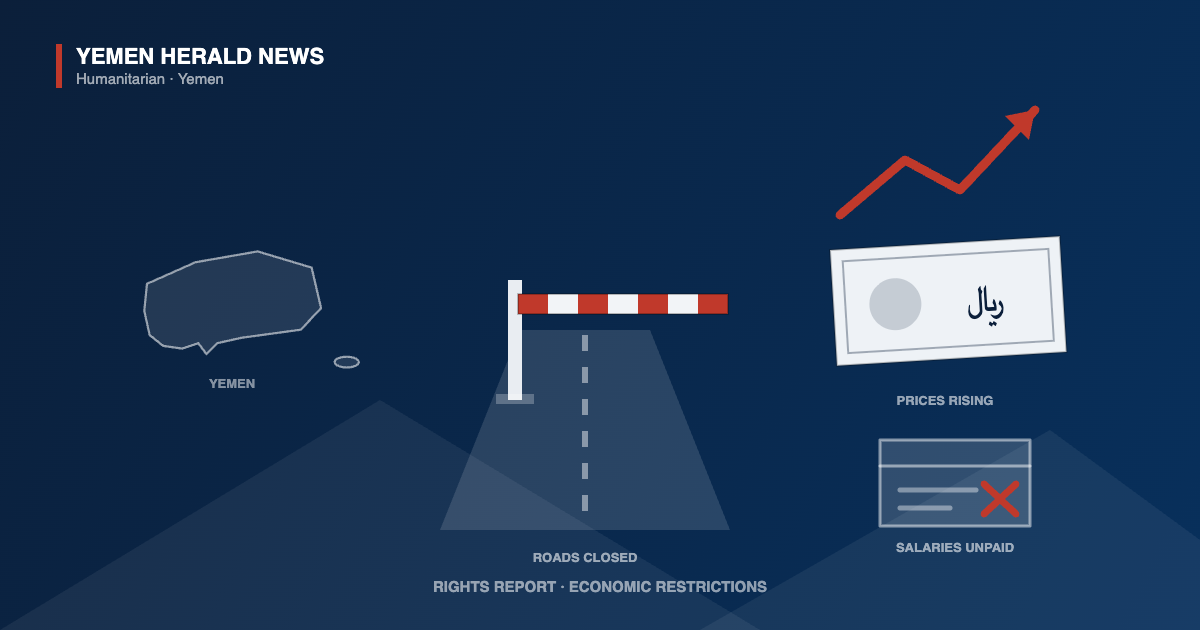
The Yemen Women’s Empowerment Foundation, a Yemeni civil society organisation, has published a report accusing the Houthi authorities of pursuing economic and administrative policies that have deepened poverty in the areas under their control. The report, issued under a title translated as “The Internal Blockade: Houthi Militia Policies to Impoverish and Subjugate Yemenis”, was carried on Sunday by the official news agency Saba and by other Yemeni outlets. Its findings represent the position of the organisation that produced it and have not been independently audited.
The foundation’s central argument is that a set of measures usually discussed separately functions cumulatively as a form of internal siege. It points to the prohibition on circulating banknotes issued by the Aden-based central bank, the suspension of salary payments to large numbers of public employees, the imposition of taxes, levies and internal customs duties, the closure of roads that restricts the movement of goods, and interference with fuel supplies. Taken together, the report says, these have pushed up the price of food and medicine and stripped households of purchasing power, leaving a growing share of them dependent on humanitarian aid.
Several of the individual measures the report describes are matters of public record. Yemen’s monetary system fractured in late 2019, when the Houthi authorities banned newly printed banknotes issued by the Central Bank of Yemen in Aden from circulating in territory they hold, producing two versions of the riyal that trade at markedly different rates. The divide has widened since. The Houthis minted a 100-riyal coin in 2024 and issued a 50-riyal coin and a new 200-riyal note in July 2025, each of which the Aden central bank rejected, describing the coin issue as a dangerous escalation and a destructive interference with monetary stability.
Public sector pay is the second long-running grievance. Salaries for civil servants in Houthi-held governorates have been paid irregularly or not at all for years, a situation that dates to the relocation of the central bank from Sanaa to Aden in 2016 and the collapse of the arrangements that had funded the national payroll. The two sides blame each other. The internationally recognised government argues that the Houthi administration collects substantial revenue and chooses not to spend it on salaries, while the Houthi authorities point to the removal of the central bank and to restrictions on oil exports and imports as the cause.
Movement restrictions and internal levies have also been documented repeatedly by aid organisations and monitoring groups working across Yemen’s front lines. Road closures around contested cities, checkpoints that charge fees on commercial traffic, and duties levied on goods crossing between areas of control all add cost to a supply chain that is already expensive, and those costs are passed to consumers. The foundation’s contribution is less the discovery of new practices than the framing of them as a single deliberate policy, a political judgement rather than a documented fact.
On fuel, the report says interference with supplies has driven up transport costs and, with them, the price of basic goods and medicines. Fuel imports through Hodeidah have been a recurring point of dispute throughout the conflict, with shipments delayed, inspected or held for extended periods, and each interruption has produced sharp local price movements. For households already spending most of their income on food, even short disruptions translate quickly into reduced consumption.
The scale of need in Yemen is not in dispute, though the precise figures cited vary between sources. In its 2026 Humanitarian Needs and Response Plan, the United Nations Office for the Coordination of Humanitarian Affairs estimated that more than 22 million people in the country would require humanitarian assistance and protection during the year, including 18.3 million assessed as acutely food insecure. More than two million children under five are acutely malnourished, and the plan sought roughly 2.16 billion dollars, an appeal that in recent years has been only partly funded.
The organisation behind the report works primarily on women’s rights, and its account gives particular weight to the effect of economic restrictions on women and on the households they support. That emphasis overlaps with findings from international bodies. Human Rights Watch has documented restrictions imposed by warring parties on women’s freedom of movement in Yemen, including requirements that women travel with a male guardian, which limit access to work, aid distribution points and health services. Where household income has collapsed, those constraints compound the difficulty of replacing it.
The Houthi authorities did not comment on the report. They have previously rejected characterisations of this kind, attributing the deterioration of Yemen’s economy to the military intervention that began in 2015, to restrictions on the port of Hodeidah and on Sanaa airport, and to the transfer of central bank functions to Aden. Independent verification of competing claims remains difficult, because access for researchers and journalists is constrained on both sides of the divide.
What the report does illustrate is how far Yemen’s economic fragmentation has become a driver of humanitarian need in its own right, distinct from active fighting. Two currencies, an unpaid public payroll, internal customs borders and contested fuel imports together produce a country in which the cost of living can differ sharply between governorates and in which aid substitutes for wages. Reversing that would require agreements on monetary policy, revenue sharing and salary payments that have so far eluded successive rounds of negotiation.
About the Author