Yemen’s Ambassador al-Wuhayshi Reviews Yemen Developments with Russian Foreign Ministry Official
 Yemen Herald News
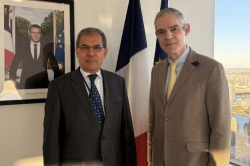
Yemen’s Ambassador to Russia, Dr. Ahmed al-Wuhayshi, held talks in Moscow with Sergey Gdanov, whom the Yemeni embassy identified as deputy director of the Department of International Organizations at the Russian Foreign Ministry. The two discussed bilateral relations between the two countries and reviewed recent political and security developments inside Yemen.
Al-Wuhayshi told the meeting that the Yemeni government is committed to protecting national sovereignty and to securing maritime routes against what he described as threats from the Houthi movement. The government in Aden has consistently characterised Houthi operations in the Red Sea and the Bab al-Mandab strait as acts of aggression that endanger regional stability and international shipping. The Houthi leadership has framed the same operations as pressure connected to the war in Gaza and has rejected the government’s characterisation.
According to the embassy’s account, Gdanov underlined the importance of Yemen’s sovereignty and territorial integrity, a formulation Russia has used consistently throughout the conflict, and reiterated Moscow’s support for United Nations efforts to bring the parties to a negotiated settlement. Russia has not recognised the Houthi authorities in Sanaa and has maintained diplomatic relations with the internationally recognised government while keeping channels open to other Yemeni actors.
Moscow’s position carries weight beyond the bilateral relationship because Russia holds a permanent seat on the United Nations Security Council, the body through which the Yemen file is managed internationally. Security Council resolutions on Yemen, including those governing the arms embargo and the mandate of the United Nations Mission to Support the Hudaydah Agreement, require Russian assent or at least abstention to pass. Russia has periodically abstained on Yemen texts it regarded as unbalanced, and that voting behaviour gives meetings of this kind more substance than their protocol level suggests.
The maritime dimension the ambassador raised has been among the most internationally consequential aspects of the conflict. Attacks on commercial shipping in the Red Sea and the Bab al-Mandab strait since late 2023 have pushed a substantial share of traffic away from the Suez Canal and around the Cape of Good Hope, lengthening voyages between Asia and Europe by roughly ten days and raising insurance and freight costs. Several vessels have been struck and seafarers have been killed. The rerouting has affected Egypt’s canal revenues and global supply chains well beyond the region.
Russia has an interest in that corridor as a route for its own seaborne trade, particularly energy exports redirected toward Asian markets, and Russian officials have publicly opposed unilateral military action against Houthi targets while calling for the underlying causes of the escalation to be addressed. That combination — support for freedom of navigation alongside opposition to Western strikes — has left Moscow positioned somewhat apart from the United States and its partners on the maritime question.
Inside Yemen, the political process has remained stalled. A roadmap brokered with Saudi and Omani involvement, which envisaged salary payments, the reopening of roads and airports and the start of an inclusive political process, has not been signed, and periodic front-line fighting has continued in Marib, Taiz, al-Dhale and along the Red Sea coast. The economic split between the Aden and Sanaa authorities has deepened, with the two areas operating separate currencies whose exchange rates differ by close to a factor of three.
The humanitarian consequences remain severe. The United Nations Office for the Coordination of Humanitarian Affairs estimates that 22.3 million people in Yemen require humanitarian assistance and protection in 2026, more than two thirds of the population, including 5.2 million internally displaced people. Some 18.3 million people are acutely food insecure and more than 2.2 million children under five are acutely malnourished. The United Nations and its partners have appealed for 2.16 billion dollars to reach 12 million people this year, and Yemen’s appeals have been chronically underfunded in recent cycles.
Al-Wuhayshi has represented Yemen in Moscow since 2017, when he became the first sitting Yemeni ambassador to Russia in six years, and previously served as the Arab League’s ambassador to India. His posting has involved a steady schedule of meetings with Russian foreign ministry departments and with Mikhail Bogdanov, the Russian president’s special representative for the Middle East and Africa, at which he has briefed Russian officials on developments in Yemen, on the government’s economic reform programme and on measures to comply with international standards on combating money laundering and terrorist financing.
Trade between the two countries is modest, and the relationship rests more on diplomatic than commercial foundations. Russia was a significant partner of the former People’s Democratic Republic of Yemen and later of the unified state, and a generation of Yemeni professionals and military officers trained in Soviet and Russian institutions. Those links have given Moscow a durable, if limited, standing with several Yemeni constituencies.
No agreements, initiatives or joint statements were announced following the meeting, which the embassy described as a review of bilateral relations and of developments in Yemen. Consultations of this kind are routine between the embassy and the Russian foreign ministry, and their significance lies less in any single outcome than in the maintenance of a channel through which the government in Aden can put its case to a permanent member of the Security Council.
About the Author