Al-Alimi Tells UK Ambassador Yemen Has Entered a New Phase of State-Building
 Yemen Herald News
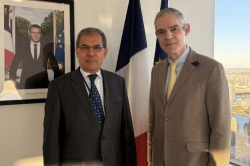
President Rashad Muhammad al-Alimi, chairman of Yemen’s Presidential Leadership Council, told the British ambassador to Yemen on Tuesday that the country has entered a new phase of taking the lead and rebuilding the state. The state news agency Saba reported that the president received Ambassador Abda Sharif in Aden for talks covering bilateral relations, developments in the national and regional arenas, and joint efforts to strengthen regional security and stability.
Al-Alimi praised what he called the historic relationship between Yemen and the United Kingdom and said he appreciated British support for the internationally recognised Yemeni government, for regional security and for the protection of maritime routes. He added that he was looking forward to advancing the partnership further, particularly in supporting state institutions, driving economic recovery and building a sustainable peace.
The president argued that Yemen is entering a new stage because the balance of power has shifted over recent years. He pointed to the rebuilding of the state’s civil, military and security institutions and to what he described as their strengthened ability to carry out national responsibilities. That process, he said, has produced a clearer vision, greater institutional cohesion and a more united political will behind the restoration of state authority.
Al-Alimi also highlighted what he termed an unprecedented degree of harmony among state institutions on national commitments, describing it as unity of vision and purpose in preparation for the next stage. His remarks came on the same day the Presidential Leadership Council held an extraordinary session in Aden under his chairmanship. Saba reported that all members attended, among them Sultan al-Aradah, Tariq Saleh, Abdulrahman al-Muharrami, Abdullah al-Alimi, Othman Mujalli, Mahmoud al-Subaihi and Salem al-Khanbashi, and that the session reviewed national and regional developments.
On the humanitarian file, the president rejected the accusation that his government has blockaded civilians living in areas held by the Houthi movement. The government has never imposed a blockade on citizens in those areas, he said, adding that it has worked to keep ports open, maintain imports and ensure the flow of food, medicine and essential goods. The real cause of the humanitarian disaster, in his account, is the continued seizure of state institutions and the use of their resources to serve what he called the coup project.
“Ending the humanitarian suffering starts with addressing its root causes and restoring the State and its sovereignty over all its territory,” he said.
Responsibility for the humanitarian emergency remains sharply contested. The Houthi authorities in Sanaa attribute shortages to government restrictions and the wider economic war, while United Nations agencies have generally described the crisis as the product of years of conflict, currency collapse, unpaid salaries and access constraints imposed by multiple parties.
The president framed Yemen’s request to its partners in limited terms. Yemen is not asking friends to fight its battle, he said; what it seeks is a consistent international position that supports the Yemeni state and its institutions and rejects the use of Iranian-aligned militias as leverage.
Turning to the sea, the president said Yemen’s stability represents a shared regional and international interest, and that protecting the Red Sea, Bab al-Mandab and freedom of international navigation begins with a strong state on Yemeni soil. Supporting the Yemeni state, he argued, is a direct investment in the security of global trade, in regional stability and in the protection of international law.
The meeting took place against a backdrop of continued attacks on commercial shipping off Yemen’s coast. On Tuesday an India-flagged mechanised sailing vessel, the Faize Noore Oliya, sank in the Red Sea after being struck near the Bab al-Mandab Strait, roughly 13 nautical miles south of the Houthi-controlled port of Hodeidah. All 14 crew, 13 of them Indian nationals, were rescued by the Yemeni coast guard and taken to Mokha. Yemen’s government blamed Houthi forces, saying a remotely operated explosive-laden boat was used; no group had claimed responsibility at the time. India’s shipping minister, Sarbananda Sonowal, said the vessel was hit by a projectile near Yemeni waters and that India strongly condemned the attack.
Al-Alimi reiterated Yemen’s welcome for the multinational maritime coalition formed to protect international navigation, and praised Saudi Arabia’s leading role in strengthening security in the Red Sea and Bab al-Mandab. Saudi Arabia, Yemen and a dozen other regional stakeholders and Red Sea littoral states announced the creation of a Multinational Maritime Defence Alliance on 30 July, a defensive grouping whose stated purpose is protecting freedom of navigation through Bab al-Mandab, the Red Sea and the Gulf of Aden.
The president devoted particular attention to Britain’s institutional role, praising the United Kingdom as penholder on the Yemen file at the United Nations Security Council. The penholder drafts resolutions and statements on a file, giving London significant influence over how the Council handles Yemen. Al-Alimi said he appreciated British efforts to support international legitimacy decisions, to rally backing for a political process based on agreed references, and to reinforce the security and stability of Yemen and the wider region. In July the Council adopted resolution 2826, extending for six months the requirement that the Secretary-General report on Houthi attacks in the Red Sea.
For her part, Ambassador Sharif reiterated the United Kingdom’s support for the Presidential Leadership Council and the Yemeni government, for their efforts to restore security and stability and to reach a comprehensive peace, and for deepening the partnership between the two countries across a range of fields.
About the Author