Yemen’s ambassador to Cuba discusses Houthi escalation and Taiz siege with Communist Party official
 Yemen Herald News
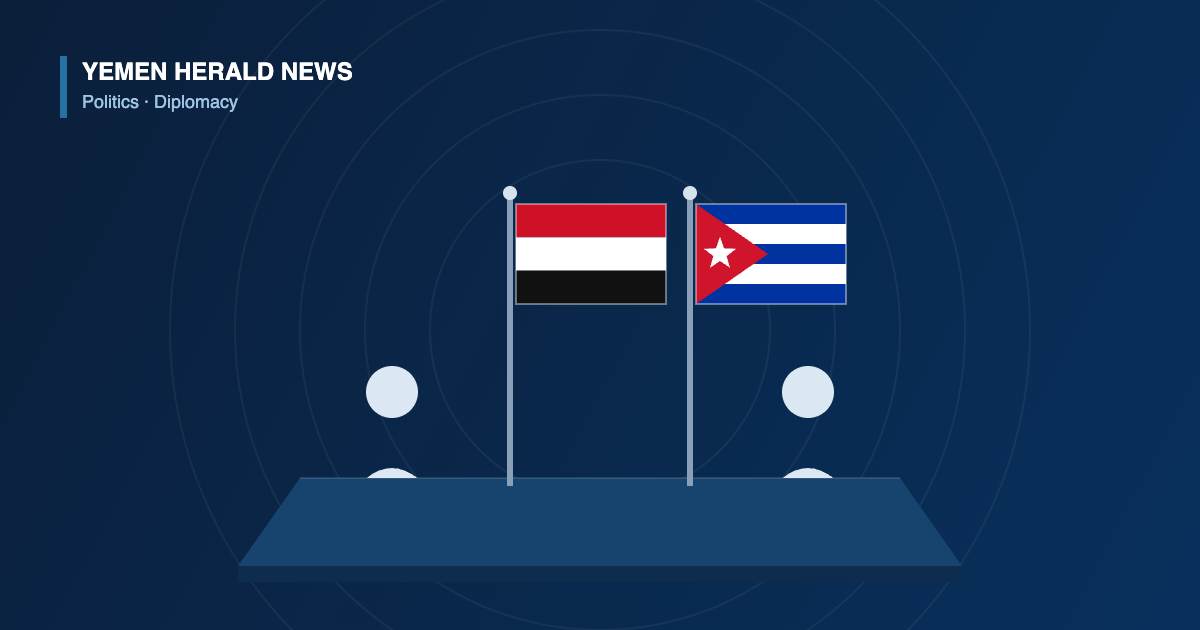
HAVANA, Cuba — Yemen’s ambassador to Cuba briefed a senior Cuban Communist Party official on the war in Yemen on Wednesday, Yemen’s state news agency said.
Mohammed Nasher met Emilio Lozada García, head of the International Relations Department of the Central Committee of the Cuban Communist Party, the agency Saba reported.
The two discussed political, security and military developments in Yemen, according to Saba.
The account of the meeting rests on Saba, which is run by the internationally recognised government. Yemen Herald found no independent confirmation of it. The Cuban Communist Party did not publish its own account of the talks.
Nasher set out the government’s efforts to restore state institutions and to end what it calls the Houthi coup, Saba said.
He raised Houthi escalation and threats to international shipping in the Red Sea and the Bab al-Mandab Strait, according to the agency.
He also raised the humanitarian and economic consequences of the fighting, including the siege of Taiz, Saba said.
Nasher described the government’s position on Operation Yemen Dawn and its objectives, the agency reported. He referred to ground developments announced by official authorities.
He said Yemen was committed to a just and sustainable peace that protects its security, sovereignty and stability, according to Saba.
Lozada reaffirmed Cuba’s support for Yemen’s sovereignty and stability, the agency said. He said a political settlement was needed to bring peace and security to Yemenis.
Saba did not say whether the two discussed any specific agreement.
The Houthis dispute government accounts of the war. They did not comment on the Havana meeting.
The government announced Operation Yemen Dawn on Oct. 6. Rashad al-Alimi, chairman of the Presidential Leadership Council, announced it.
Al-Alimi said the operations aimed at recovering the remaining territories held by the Houthis. In a post on X, he cited restoring state institutions, liberating Sanaa and ending the Houthi coup.
The offensive is backed by air cover from the Saudi-led coalition. Major General Turki al-Malki, the coalition spokesman, pledged full operational support.
Al-Malki said 100 fighter jets supported government forces. He said the coalition had secured air protection of the strait and destroyed hundreds of Houthi targets. Those figures are the coalition’s.
Officials said government-aligned forces retook Dhubab, north of the Bab al-Mandab Strait, and captured Bab and Hadeid. Witnesses reported seeing government tanks enter the towns.
Dhubab sits on a route linking the Red Sea and the Gulf of Aden. About 12% of global trade passes through Bab al-Mandab.
The Houthis seized Mokha and several Red Sea islands in early September.
They captured Turbah, a town on the road linking Taiz to Aden, on Oct. 4, and seized villages on the outskirts of Taiz.
The Institute for the Study of War said losing Turbah would likely hamper government reinforcement and resupply.
Yahya Saree, the Houthi military spokesman, claimed missile and drone attacks on King Khalid International Airport in Riyadh, an oil refinery in Rabigh, Abha airport and military sites in Khamis Mushait, Najran and Jizan.
Hans Grundberg, the UN special envoy for Yemen, told the Security Council on Oct. 9 that the country had slid back into full-scale war.
He said fighting continued around Taiz and in Lahj, Marib, al-Jawf and Hajjah.
Grundberg said the humanitarian situation in Taiz, Yemen’s most populous governorate, was deteriorating rapidly.
He said war and diplomacy were not mutually exclusive, but that battlefield gains could not replace the negotiations needed to settle the conflict.
A settlement must be Yemeni-owned and based on Security Council resolutions and earlier negotiations, Grundberg said.
He said threats against Saudi-linked commercial ships undermined freedom of navigation for every country.
Grundberg said 72 UN staff remained detained. He called for their unconditional release and said many had serious health problems.
He welcomed the release of one detained UN staff member as a positive step.
Grundberg told the Council that 40 million Yemenis had endured more than a decade of conflict.
He said obligations under international humanitarian law were not optional, including the protection of medical facilities and humanitarian staff.
He said the International Monetary Fund ranked Yemen as the world’s poorest country.
In Taiz, the Houthis hold the city under siege. Residents face shortages of fuel and other essentials.
Yemen’s Ministry of Public Health and Population said medicines, supplies and fuel at health facilities in the city were nearing depletion.
The Houthis have seized most of the city’s entrances, forcing residents onto steep and sometimes unpaved roads.
The International Organization for Migration said 217,303 people, in 36,216 families, were displaced across Yemen between Aug. 1 and Oct. 12.
Taiz governorate accounted for 55% of that displacement, the agency said. Fighting restricted access to most displacement sites there.
More than 3,000 people fled to Djibouti, according to the agency.
The World Health Organization has recorded at least 959 people killed and more than 4,200 wounded.
The United Nations humanitarian plan for Yemen, published in March, said more than 22 million people needed assistance. It put the number of acutely food insecure at 18.3 million.
More than 2.2 million children under five are acutely malnourished, according to the plan. It recorded 516,157 of those cases as severe.
The plan counted 5.2 million people already displaced. It sought $2.16 billion to reach 12 million people.
Saba published its report on the Havana meeting on Wednesday.
About the Author