Yemen’s deputy foreign minister Mustafa Noman meets Djibouti’s interior minister in Geneva
 Yemen Herald News
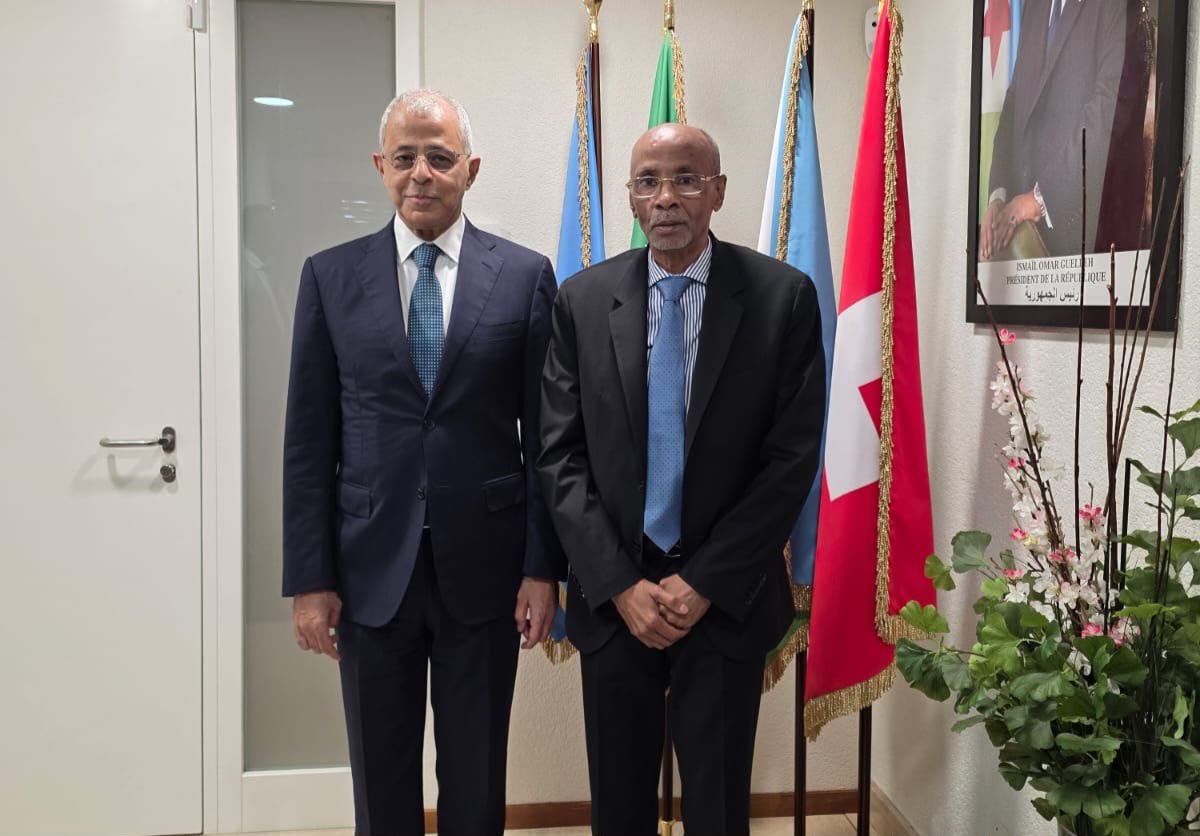
GENEVA, Switzerland — Yemen’s deputy foreign minister met Djibouti’s interior minister on the sidelines of the UN refugee agency’s annual governing session, Yemen’s state news agency said.
Mustafa Noman and Omar Abdi Said discussed cooperation on migration and refugee affairs, the agency, Saba, reported.
The two met during the 77th session of the Executive Committee of the United Nations High Commissioner for Refugees.
The session opened at the Palais des Nations in Geneva, Yemen’s state broadcaster reported on Oct. 12.
Saba said the talks covered the continued movement of migrants and displaced people across the Red Sea.
Noman raised the economic and humanitarian consequences of the war and its effect on regional security, according to the agency.
He called for closer coordination between the Yemeni and Djiboutian governments on humanitarian needs and pressure on basic services, Saba said.
He thanked Djibouti for hosting Yemenis who have fled their homes, the agency reported.
Noman attributed that displacement to Houthi military escalation and worsening humanitarian conditions.
The Houthis dispute that characterisation of the fighting.
He praised Djibouti’s leadership, government and people, according to Saba.
The account of the meeting rests on the Yemeni state news agency. No independent confirmation of it has been published.
Djibouti’s interior minister said in September that more than 2,500 Yemenis had arrived in the country within about a week, Al Jazeera reported.
Omar Abdi Said said at the time that he expected the number of displaced people to rise to about 10,000 in the following weeks, according to the same report.
He called on the United Nations and international partners to mobilise financial resources matching the scale of the crisis.
He said the influx had already exceeded Djibouti’s national capacity as international funding declined, Al Jazeera reported.
The International Organization for Migration’s response coordinator for Djibouti, Safiya Ibrahim, said the agency was counting on additional financial support to continue its operations there.
Yemen’s delegation to the Geneva session is led by Noman, the deputy minister of foreign affairs and expatriates.
Ambassador Muthana al-Amri and Yahya al-Rafiq, first secretary of Yemen’s permanent mission in Geneva, are also taking part, the state broadcaster said.
Noman told the session that Yemen has hosted and protected refugees for decades despite limited resources.
He said the government plans to improve refugees’ access to education, health care, social protection, livelihoods, civil documentation and financial inclusion.
None of those commitments has received international funding so far, he said.
Noman asked the refugee agency to help align Yemen’s commitments with those of donors, and called for a shift from annual aid to longer-term solutions.
He said the recent escalation had displaced tens of thousands of Yemenis.
He attributed that escalation to Houthi forces, which he said are backed by Iran.
The Houthis deny that they act on Iran’s behalf.
Barham Salih, the United Nations High Commissioner for Refugees, said recent escalations in Yemen had displaced hundreds of thousands of people.
Salih said attacks on airports in Riyadh had killed 12 people and injured more than 300.
Noman met Salih separately on Monday during the same session, Saba reported.
Yemen’s government says it does not want the international community to replace the state, but seeks a partnership to protect citizens and refugees.
The United Nations moved its main Yemen offices to Aden in September 2025.
The Houthis declared a naval blockade of Saudi Arabia on July 20 and later an air blockade, according to a House of Commons Library briefing.
The briefing said Houthi drone and missile attacks on Saudi territory this year were the first since 2023, and Saudi air strikes on Yemen the first since 2022.
The Houthis have taken several areas along the Red Sea coast, and control of the Bab al-Mandab Strait is disputed.
Djibouti lies across the Bab al-Mandab Strait from Yemen, at the southern entrance to the Red Sea.
The strait is one of the world’s main shipping lanes.
The Houthis announced a new phase in their campaign against Saudi Arabia in June, centred on the blockade of their air and sea ports, the briefing said.
A planned prisoner exchange stalled in July as tensions rose, according to the briefing.
The Presidential Leadership Council has governed the internationally recognised side of the conflict since it replaced former president Abd Rabbu Mansour Hadi in 2022.
The United Arab Emirates announced in January that it would withdraw its remaining forces from Yemen, the briefing said.
Britain announced defensive support for Saudi Arabia in September, including one Royal Air Force Voyager refuelling aircraft.
The Saudi-led coalition struck energy sites in Sanaa on Tuesday after warning residents to leave the area.
The Associated Press, citing witnesses, reported several explosions in the capital.
The United Nations humanitarian response plan for Yemen, issued in March, said more than 22 million people needed assistance.
The plan said 18.3 million people were acutely food insecure.
It recorded more than 2.2 million children under five as acutely malnourished, including 516,157 with severe acute malnutrition.
The plan counted 5.2 million internally displaced people and sought 2.16 billion dollars to reach 12 million of them.
Saba did not say how long the Geneva meeting lasted.
It did not report any agreement between the two governments.
About the Author