Zelenskyy Urges Allies to Tighten Russia Sanctions as Ukraine and US Meet in Florida
 Yemen Herald News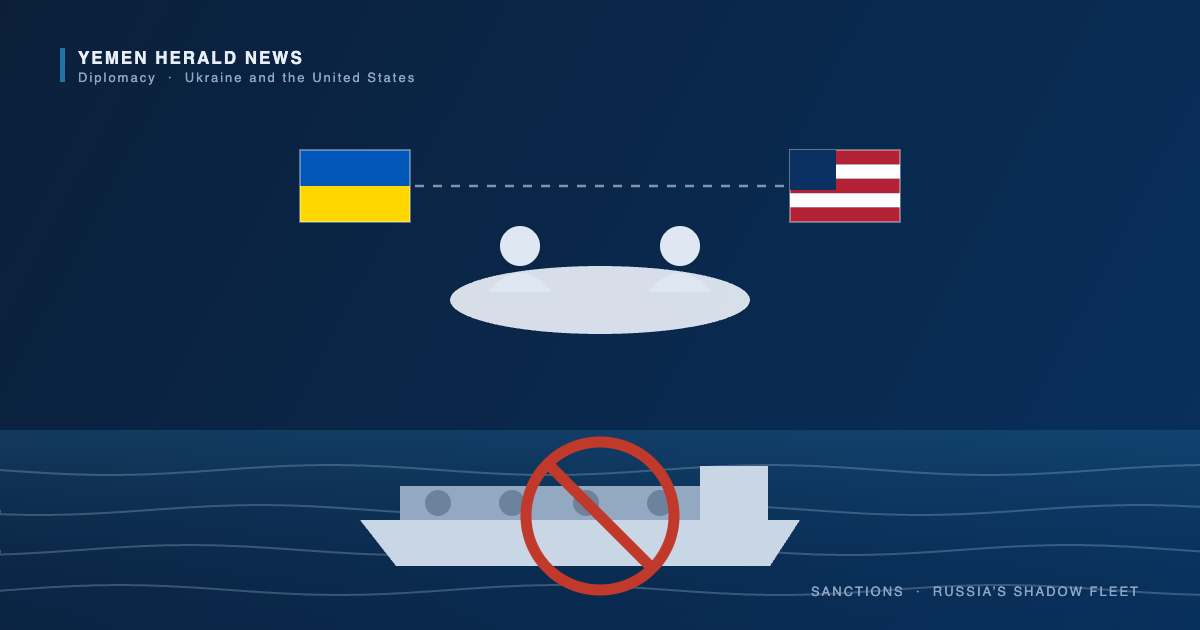
Ukrainian President Volodymyr Zelenskyy urged the country’s allies to hold and tighten sanctions on Russia’s economy as Ukrainian and American delegations met in Florida in late March 2026 to discuss ways of ending a war then in its fifth year. The talks opened on Saturday 21 March and continued through the following day, with Zelenskyy confirming on 22 March that the two teams had concluded their discussions and that a fresh exchange of prisoners of war was among the outcomes under consideration.
The American delegation was led by special envoy Steve Witkoff and by Jared Kushner, son-in-law of President Donald Trump. Russian representatives did not attend. The round had originally been planned for Abu Dhabi with Russian negotiators present, but the United Arab Emirates venue was set aside after United States and Israeli military action against Iran escalated across the Gulf, and the meeting was moved to the United States. Kremlin spokesman Dmitry Peskov confirmed that Russia would not take part in the Florida sessions, leaving the round to proceed as a bilateral encounter between Washington and Kyiv.
That absence shaped what the meeting could achieve. Without a Russian delegation in the room, the discussions functioned less as a negotiation than as an alignment exercise between Ukraine and its principal backer — an attempt to agree a common position before any wider format could be reconvened. Earlier attempts at a three-way process had already slipped: talks scheduled for the UAE in early March were postponed as the confrontation with Iran widened, and the diplomatic track had been effectively on hold for several weeks before the Florida round.
Sanctions were the point Zelenskyy pressed hardest in public. He focused on Russia’s so-called shadow fleet — the loosely registered, often ageing tankers used to move crude outside the reach of Western price caps and insurance rules — arguing that revenue from those cargoes goes directly into the Russian war budget. “Russia’s shadow fleet must not feel safe in European waters or anywhere else,” he said. “Tankers that serve the war budget can and must be stopped and blocked, not just let go.”
The Ukrainian position, as set out at the time, was that any relaxation of restrictions had allowed Moscow to lift crude sales and therefore to sustain military operations that sanctions were meant to constrain. Kyiv has pushed allies to move from designating individual vessels towards enforcement at sea — port bans, insurance checks and detentions in the straits and coastal waters through which the tankers pass. European states have taken steps in that direction, though enforcement has remained uneven, and the legal basis for stopping ships in international waters continues to be contested.
The shadow fleet has drawn attention well beyond Europe. The same category of vessel — older tonnage, opaque ownership, frequently changing flags and patchy insurance — has been linked to safety and pollution risks in the Baltic, the Mediterranean and the approaches to the Red Sea, waters that carry a large share of global seaborne trade. For states along those routes, the concern is less the politics of the sanctions regime than the prospect of an uninsured tanker suffering a casualty in a crowded shipping lane.
The Florida round also touched on prisoner exchanges, one of the few areas where the two sides have continued to reach agreement even when broader diplomacy stalled. Zelenskyy indicated that a further exchange was possible, though he gave no figures and no timetable. Successive swaps since 2022 have been mediated at various points by third countries, and they have tended to proceed on their own track, largely insulated from the fortunes of the wider peace process.
The wider context in March 2026 was a war that had settled into attritional fighting along a long front line, with both Russia and Ukraine claiming incremental gains through the early part of the month and neither able to force a decision. That stalemate is what has given the diplomatic track its urgency, and also what has made it so difficult: each side has reason to believe that time, weaponry and economic pressure might still improve its position, which narrows the space for the compromises any settlement would require. It also explains why successive rounds have produced procedural announcements rather than substantive terms.
For Ukraine, the strategic argument put to allies was that economic pressure and battlefield endurance are the same instrument. Constraining Russian oil revenue, in Kyiv’s account, shortens the period over which Moscow can sustain the war and therefore brings a negotiated end closer. Critics of that approach have pointed out that sanctions have repeatedly proved easier to announce than to enforce, and that Russian exporters have adapted quickly to each successive restriction.
The Florida talks did not produce a public framework agreement, and no date was announced for a round that would include Russian negotiators. What they did establish was that the American administration intended to keep a channel open through its own envoys, and that Ukraine would continue to press its allies to close the maritime gaps in the sanctions regime while that channel remained the main avenue available to it. Whether that pressure could be converted into enforcement at sea remained, at the time, the open question.
About the Author