Yemen’s Prime Minister Tours the Saudi-Funded Prince Mohammed bin Salman Hospital in Aden
 Yemen Herald News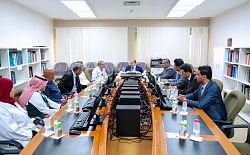
Yemen’s Prime Minister and Minister of Foreign Affairs and Expatriates, Shaya Zindani, visited the Prince Mohammed bin Salman Hospital in Aden on 23 July to inspect its operations and to acknowledge the Saudi funding behind it. The hospital is one of the larger pieces of Saudi civilian assistance in Yemen and treats patients drawn from well beyond the interim capital.
Zindani toured several departments, among them the computed tomography imaging unit, the cardiac catheterisation centre and the intensive care wards. Those units matter in a country where specialist treatment is scarce. Patients needing cardiac intervention or advanced imaging have often had to travel abroad, at a cost most households cannot meet, or go without treatment altogether.
The hospital’s director and members of the medical staff briefed the prime minister on the range of services offered and on the rising number of patients using them. They said care is provided free of charge to people from across Yemen and described the installed equipment as meeting recognised international standards, an account the government has repeated in its own summary of the visit.
Zindani spoke with inpatients during the tour, asking about their conditions and the treatment they had received, and praised the staff for what he called dedicated medical and humanitarian work. He described the hospital as a model of the development partnership between Yemen and Saudi Arabia and as evidence of the direct effect of Saudi support on services that people actually use.
That framing is deliberate. Yemen’s internationally recognised government relies heavily on Riyadh for budget support, fuel deposits and reconstruction financing, and visits of this kind make the relationship visible in a place where public confidence in the state has been eroded by unpaid salaries and unreliable services. Aden, the seat of government since 2015, has struggled with electricity shortages, water supply failures and periodic unrest.
The wider health picture explains why a single functioning hospital carries such weight. More than a decade of war has left much of Yemen’s health infrastructure damaged, understaffed or closed. Facilities that remain open frequently lack medicines, fuel for generators and salaried personnel, and many operate on support from international organisations rather than from the health ministry’s budget.
United Nations planning figures for 2026 put the number of Yemenis requiring humanitarian assistance and protection at more than 22 million, including about 5.2 million people displaced inside the country. Some 18.3 million are classed as acutely food insecure. More than 2.2 million children under five are acutely malnourished, of whom roughly 516,000 have severe acute malnutrition, the form most likely to be fatal without treatment.
Outbreaks of cholera and measles recur, driven by damaged water networks and interrupted vaccination coverage, and they place sudden demands on hospitals with little capacity to absorb them. Aid agencies have appealed for 2.16 billion dollars to fund this year’s response in Yemen, and shortfalls in recent years have already forced reductions in nutrition and health programmes.
Saudi Arabia’s involvement in Yemen is contested and cannot be separated from its military role. The kingdom has led the coalition fighting the Houthi movement since March 2015, and its air campaign has drawn sustained criticism over civilian casualties. Its aid programmes, delivered largely through the Saudi Development and Reconstruction Program for Yemen, are presented in Riyadh as a parallel commitment to reconstruction. Critics argue that assistance from a party to the war cannot be assessed in isolation from the war itself.
The regional context has sharpened in recent weeks. The Houthis declared a maritime embargo on Saudi Arabia in July and claimed attacks on shipping in the Red Sea, prompting Saudi strikes on targets around Hodeidah and condemnation from several Arab governments. The Bab al-Mandab strait, through which most of Yemen’s imported food, fuel and medicine passes, is contested again. Disruption there reaches hospitals quickly, because pharmaceutical supply chains depend on the same shipping lanes.
For the government, facilities such as the Prince Mohammed bin Salman Hospital serve a purpose beyond clinical care. They demonstrate that authorities in Aden can deliver something tangible, and they offer a template for cooperation that officials hope will extend to electricity, water and education. Whether that template scales is another matter, since one well-resourced hospital does not address the salary arrears, fuel costs and administrative gaps that constrain the rest of the system.
Officials have also linked recovery to the resumption of oil exports, halted since Houthi attacks on export terminals in late 2022. Without that revenue the government depends on external transfers to meet basic obligations, and health spending competes with salaries and security costs for a shrinking pool of funds.
Zindani’s visit is unlikely to change any of that on its own. It does indicate where the government intends to direct attention as fighting escalates: toward institutions that function, and toward the partnerships that keep them running. Aid organisations have long argued that Yemen’s recovery depends less on flagship projects than on paying health workers regularly and keeping smaller clinics stocked. The measure of the hospital’s contribution will be whether patients from outside Aden can still reach it as the roads and sea lanes around them grow less secure, and whether comparable capacity can be built in provinces that currently have none.
About the Author