Missile strikes on cargo ship Tihamah kill six in Bab al-Mandab
 Yemen Herald News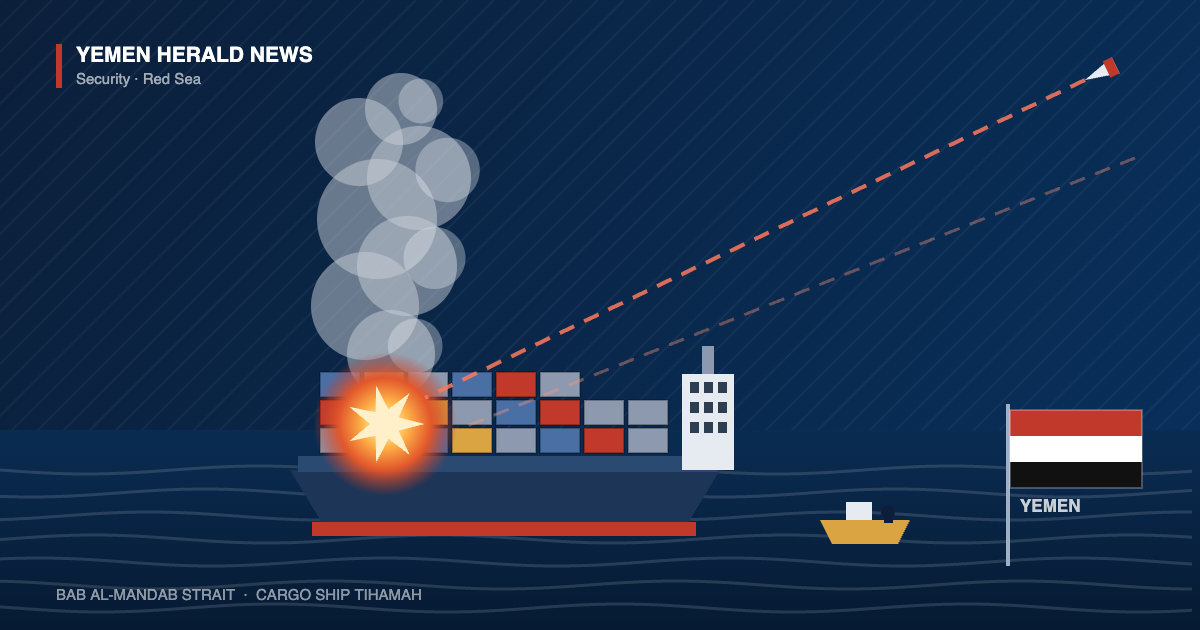
Editorial illustration: the cargo ship Tihamah struck by missiles in the Bab al-Mandab Strait
At least six people were killed on Tuesday when missiles struck the cargo ship Tihamah as it passed through the Bab al-Mandab Strait, in an attack that Yemen’s internationally recognised government has blamed on the Houthi movement. A second missile was fired at the vessel while rescuers were still working alongside it, and the deaths that followed made this the most lethal assault on merchant shipping in the waterway since the current phase of regional escalation began.
Yemen’s Ministry of Transport said the Tihamah was hit by three successive ballistic missiles while transiting the strait, the narrow channel that separates the Arabian Peninsula from the Horn of Africa. The ministry said the vessel, a small general cargo ship carrying food supplies, caught fire after the first impact. Four of its crew were killed: three Pakistani nationals and one Indonesian sailor.
The Tihamah sails under the flag of Tanzania and is owned by Thubab for Marine Services, an Egyptian company. It belongs to the class of modest, regionally operated ships that carry much of the foodstuffs and consumer goods still reaching Yemeni ports, rather than to the large container lines that suspended Red Sea transits during earlier phases of the crisis.
The second missile landed while a search-and-rescue operation was under way. Yemen’s Coast Guard later confirmed that two rescue workers were killed in that strike, and some accounts identify them as members of the Yemeni navy’s Second Naval Brigade. Reported injury figures vary, with several outlets putting the number of wounded at about ten. An initial strike followed by a second aimed at responders is the pattern maritime security analysts describe as a double-tap attack.
The Ministry of Transport condemned the attack as a grave threat to maritime safety and to global commerce, and placed full responsibility for the deaths and the damage on the Houthis. It called on the international community and on maritime organisations to act to protect commercial vessels and their crews. The Houthi leadership had not publicly claimed the strike at the time the ministry issued its statement.
If confirmed as a Houthi operation, the attack would be the first to kill crew aboard a merchant ship since the escalation that followed United States and Israeli strikes on Iran at the end of February. Houthi forces had continued to threaten shipping through that period, but the incidents reported in the intervening months produced damage and near-misses rather than deaths.
The strait is one of the world’s most important maritime chokepoints. Vessels moving between the Mediterranean and the Indian Ocean by way of the Suez Canal and the Red Sea must pass through it, and at its narrowest point the channel is only about eighteen miles across. That geography leaves ships almost no room to route around a threat originating on the Yemeni coast, which is why attacks in the area register immediately on marine insurance markets and on freight rates far beyond the region.
Traffic through the strait has already thinned markedly. Major container operators diverted around the Cape of Good Hope during earlier phases of the crisis, adding roughly ten days and substantial fuel cost to voyages between Asia and Europe, and many have not fully returned. The result is a smaller and more exposed population of ships — regional feeders, tankers and general cargo vessels of the Tihamah’s size — carrying the residual risk.
The consequences fall hardest on Yemen itself. The country imports the overwhelming majority of the food it consumes, and the transport ministry noted that strikes on ships, ports and transport infrastructure jeopardise the supply of essential commodities to millions of Yemenis. The United Nations has for several years described Yemen as one of the world’s largest humanitarian emergencies, with millions of people displaced inside the country and a majority of the population dependent on some form of assistance.
Aid operations are affected directly. Much of the humanitarian cargo entering Yemen arrives by sea, and shipping lines that withdraw from the route or impose war-risk surcharges make relief pipelines more expensive and less predictable at a time when funding appeals for the country have repeatedly fallen short of their targets.
Attacks on port infrastructure have compounded the difficulty. Government officials have protested strikes on facilities including the Red Sea port of al-Mokha, arguing that damage to berths and cranes slows the discharge of cargo that has already survived the voyage. Higher premiums and crew hazard pay work their way into the price of flour, fuel and cooking oil in Yemeni markets.
The nationalities of the dead show how widely the costs of this conflict travel. Pakistani and Indonesian seafarers crew a substantial share of the world’s merchant fleet, and states that supply maritime labour have pressed for years for stronger protection for their nationals working the Red Sea corridor. Small, lightly protected ships of the Tihamah’s type fall outside the naval escort arrangements organised for larger convoys.
The immediate questions now are operational. Investigators will need to establish the Tihamah’s condition and whether the hull can be salvaged, and the Coast Guard’s account of the second strike will bear on how rescue operations in the strait are conducted in future. The government’s appeal for international escorts and monitoring repeats requests it has made after earlier incidents, so far without producing a durable security arrangement in the southern Red Sea.
About the Author