Al-Alimi Tells Yemen’s Top Judges the Courts Are Central to Restoring State Authority
 Yemen Herald News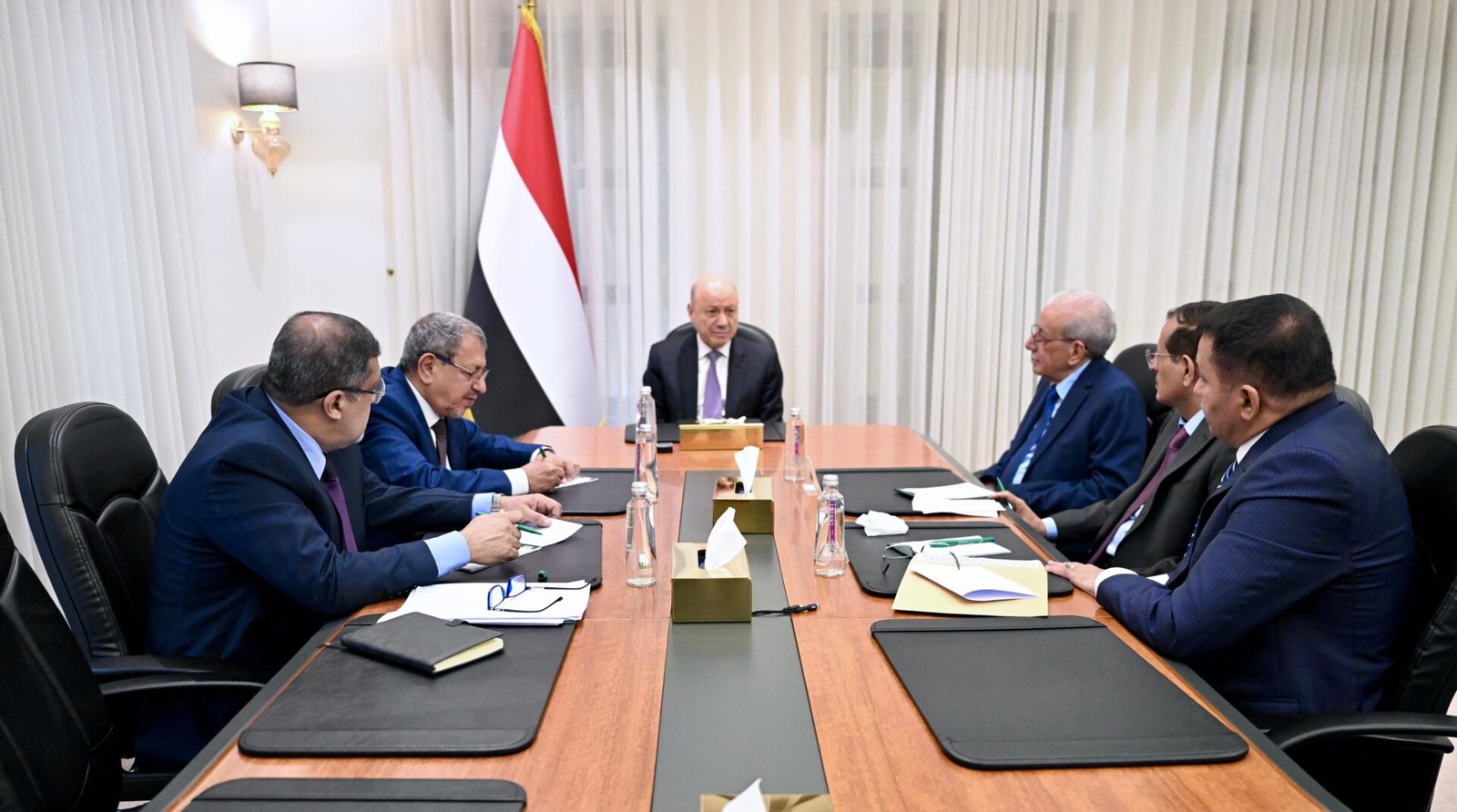
On Tuesday, Rashad Mohammed al-Alimi, chairman of Yemen’s Presidential Leadership Council, met the country’s most senior judicial officials in Riyadh and told them that the campaign to restore state institutions is as much a legal contest as a military one. The meeting brought together Mohsen Yahya Talib, chief justice and chairman of the Supreme Judicial Council; Ali al-Awash, chief justice of the Supreme Court; Justice Minister Badr al-Aridah; and Prosecutor General Qaher Mustafa. The official Saba news agency reported that the session reviewed the judiciary’s performance over recent months, examined the caseload before the courts, and considered the part the courts are expected to play in reasserting state authority and the rule of law after more than a decade of conflict.
Al-Alimi opened the meeting by acknowledging the work of judges and prosecutors who have continued to hear cases despite displacement, damaged courthouses, irregular salaries and the security risks that come with ruling on politically charged matters. He credited the Supreme Judicial Council with holding the court system together and with protecting rights and freedoms during a period in which many other state functions have been disrupted. A judiciary that still issues rulings under those conditions, he said, is itself a form of victory, because it demonstrates that the state continues to operate as a state rather than as a collection of armed factions.
The president framed the war in terms that went beyond front lines. Yemen’s struggle today, he argued, is not only a military and security confrontation but a contest over justice, law and the credibility of public institutions. That framing has become a recurring theme of his public remarks, and it carries a practical implication: the government’s claim to legitimacy rests in part on whether citizens in areas under its control can obtain a hearing, enforce a contract or challenge an official decision through a functioning court.
Much of the discussion focused on how the courts should handle cases arising from attacks on civilians and infrastructure. Al-Alimi said the Houthi movement represents a threat that extends beyond military targets to public utilities, displacement camps and ordinary civilians, and he pressed for those incidents to be pursued as fully documented criminal cases rather than answered only with statements of condemnation or military retaliation. He has made similar appeals before, urging that alleged violations be recorded in a form that would stand up in legal proceedings. The Houthi authorities in Sanaa reject the government’s characterisation of their conduct and have levelled their own accusations against forces aligned with the Presidential Leadership Council.
The meeting also addressed the financial side of armed activity. Participants discussed smuggling and money-laundering networks and the need to pursue those who finance or supply armed groups, rather than limiting prosecutions to the individuals who carry out attacks. Al-Alimi called for investigations and trials in serious terrorism cases to move more quickly, while insisting that fair-trial standards be observed, a balance he presented as necessary if verdicts are to command the confidence of the public and of victims’ families.
The officials in the room carry that mandate in practice. Badr al-Aridah was appointed justice minister under Republican Decree No. 3 of 2026, which set out the current cabinet, while Qaher Mustafa has taken an assertive line as prosecutor general. In June he ordered a precautionary freeze on funds and accounts held by the Southern Transitional Council at banks, exchange houses and other financial institutions, a decision that underlined how far prosecutorial authority now reaches into disputes among nominally allied parties.
The Presidential Leadership Council was formed in April 2022, when Abd Rabbuh Mansour Hadi transferred his powers to an eight-member body chaired by al-Alimi. The council’s stated purpose was to unify the anti-Houthi camp and rebuild the institutions of a government fragmented by war since 2015. Progress has been uneven. The internationally recognised government administers Aden and much of the south and east, while the Houthis control Sanaa and the densely populated highlands, leaving the country with parallel administrations, parallel central banks and, in effect, parallel court systems.
That division is what gives the judicial question its weight. Courts operating under the recognised government are among the few institutions capable of demonstrating a functional alternative to administration by decree, and their rulings carry implications for property, commerce and the eventual terms of any settlement. Legal officials have argued that carefully documented case files also preserve evidence that could be used in future accountability processes, whether domestic or international.
The setting of the meeting was itself telling. Much of the council’s senior leadership has operated from Riyadh rather than from Aden, an arrangement that critics inside Yemen have cited as evidence of the government’s distance from the territory it administers. Convening the heads of the judicial bodies abroad underlines both the security constraints the leadership continues to work under and the logistical difficulty of coordinating institutions split between the temporary capital and exile.
No timetable was announced for the measures discussed, and Saba’s account did not specify how many cases are currently pending or what resources would be allocated to speed them up. What the session produced was a statement of direction: that the government intends to route its response to attacks through the courts, to pursue financiers alongside fighters, and to treat the survival of a working judiciary as a measure of whether the state is being restored at all.
About the Author