Press Freedom Under Strain as the Iran War Widens into Lebanon and the Gulf
 Yemen Herald News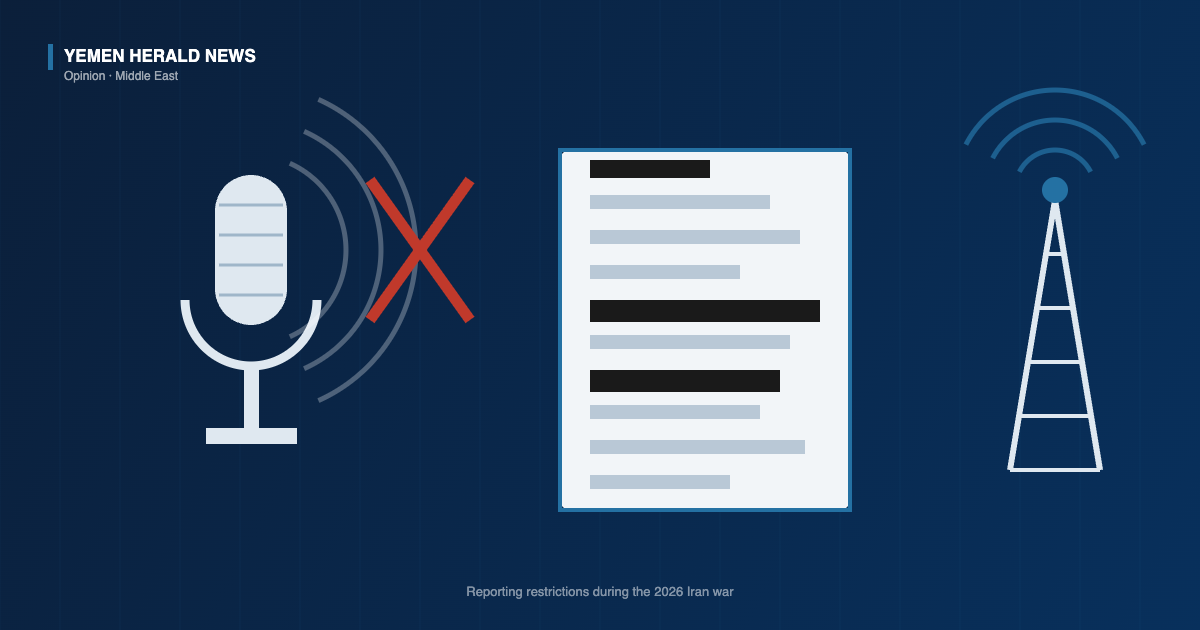
As the war that began with Israeli and American strikes on Iran at the end of February 2026 widened into Lebanon and out into the Gulf shipping lanes, a second and quieter contest was under way over what the public in the countries involved would be told about it. Journalists working in Iran, Israel and the United States all described operating under tightening constraints during March, though the constraints were of very different kinds and carried very different risks.
The military picture by late March was stark. Israel and the United States began strikes on 28 February aimed at Iran’s nuclear and ballistic missile programmes and at its leadership, and Iran’s supreme leader, Ali Khamenei, was killed that day. Iranian forces declared the Strait of Hormuz closed from 4 March and attacked vessels attempting to transit it; the United Kingdom Maritime Trade Operations centre had logged around ten attacks on shipping by 8 March, with five crew members killed aboard two vessels. Strikes on energy infrastructure followed, and the International Energy Agency warned that the disruption to oil and gas flows was more severe than the shocks of the 1970s.
The killings of senior officials continued into the middle of the month. On 17 March the Israeli military said it had killed three more senior Iranian figures in Tehran: Ali Larijani, secretary of the Supreme National Security Council; Gholamreza Soleimani, head of the Revolutionary Guard’s Basij militia; and Esmaeil Khatib, the intelligence minister. Earlier in March Israel said it had killed Daoud Alizadeh, described as the commander of the Quds Force’s Lebanon branch, also in Tehran. In most of these cases the claim originated with the Israeli military and was not independently verified at the time it was reported.
Coverage of those killings tended to converge on a single frame: the technical sophistication of the operations, the depth of Israeli penetration into Iranian security structures, and the question of who might be targeted next. Comparatively little space went to the legal questions the strikes raise. Targeted killings of serving state officials sit in genuinely contested territory in international law, and the line between a combatant and a civilian official is not self-evident when those killed are ministers and council secretaries rather than field commanders. Whatever conclusion a reader reaches, the argument was largely absent from the reporting.
Conditions for independent journalism inside Iran, already among the most restrictive in the world by the assessment of international press-freedom organisations, deteriorated further under wartime conditions. Internet disruption, the physical danger of moving around a country under bombardment and the risk carried by anyone who speaks to a foreign outlet all narrowed what could be gathered and confirmed from the ground. The practical effect was that much of what the outside world learned about the strikes came from the governments carrying them out rather than from the places where they landed.
Lebanon has been the clearest illustration of the imbalance. Israel authorised a ground operation there in early March, with the stated aim of establishing what officials called a security layer against Hezbollah along the northern border, and troops of the 91st Division were operating in the south by the middle of the month. The humanitarian consequences for Lebanese civilians drew markedly less attention than the campaign against Iran, even as displacement and damage to infrastructure mounted. Israeli officials were quoted in terms that regional governments cited as evidence of an intent to reduce parts of Lebanon to the condition of Gaza; the Israeli government has consistently framed the operation in narrower, defensive terms.
The underlying difficulty is structural rather than conspiratorial. A conflict fought across closed borders, contested airspace and blockaded sea lanes leaves reporters dependent on a small number of official sources: military spokesmen on one side, state media on the other, and anonymous briefings distributed to a handful of favoured outlets. When verification is impossible, editors face a choice between publishing an unconfirmed claim with attribution or publishing nothing, and the incentives of a fast news cycle push consistently towards the former. Attribution then does less work than it appears to, because a claim repeated often enough begins to read as established fact.
For readers in Yemen and the wider region the stakes are not abstract. The closure of the Strait of Hormuz and the attacks on shipping bear directly on the cost and availability of fuel and food across the Arabian Peninsula, and the same maritime corridors have been contested in the Red Sea for years. Accurate reporting on where vessels are being struck, by whom and under what conditions is the difference between informed preparation and rumour, and it is precisely the kind of reporting that becomes hardest to do when access closes.
None of this argues for treating any single account as definitive. It argues for the opposite: for reporting that states plainly what is known, what is claimed and by whom, and what remains unverified, and that gives the legal and humanitarian consequences of a widening war the same attention it gives to the operational detail. As the conflict continued into April, that standard remained the most useful measure a reader could apply to any account of it.
About the Author