
African Union Condemns Houthi Attacks on Red Sea Shipping and Warns of Risks to African Trade
 Yemen Herald News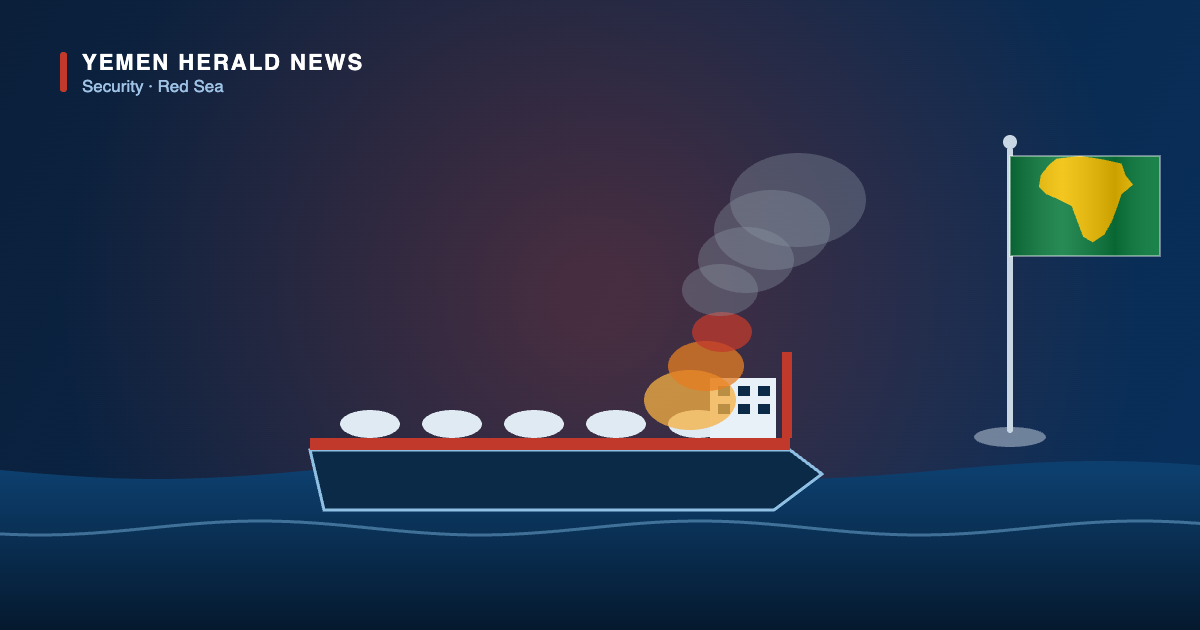
The African Union has condemned the attacks claimed by Yemen’s Houthi movement against commercial oil tankers in the Red Sea, warning that they amount to a dangerous escalation with serious implications for regional peace and security. In a statement issued on 23 July, the chairperson of the AU Commission, Mahmoud Ali Youssouf, said attacks on commercial vessels and any attempt to obstruct the free movement of maritime traffic constitute a grave threat to international maritime security and to the stability of one of the world’s most strategic waterways.
Youssouf expressed the African Union’s full solidarity with Saudi Arabia and reaffirmed what he described as unwavering support for the kingdom’s security, sovereignty and stability. He called on the Houthis to cease all attacks against commercial shipping immediately, to refrain from actions that could escalate tensions further, and to respect international law governing maritime navigation. The union also restated its backing for regional and international efforts to de-escalate the conflict, safeguard maritime security and advance a negotiated settlement in Yemen.
The statement followed a sharp deterioration in the southern Red Sea. On 20 July the Houthis declared a maritime blockade of Saudi Arabia, informing shipping companies that vessels were banned from loading or unloading at Saudi ports. Two days later the group’s military spokesman, Yahya Saree, said its forces had struck two Saudi oil tankers, the Encelia and the Layla, using ballistic and cruise missiles and drones. Saudi authorities confirmed that the Encelia caught fire after being hit and that all crew members were safe.
The United Kingdom Maritime Trade Operations agency placed the strike roughly 70 nautical miles southwest of the Saudi coastal city of Al Shuqaiq. No casualties or pollution were reported, but at least seven vessels changed course to avoid the Bab al-Mandab Strait in the hours that followed, and war-risk insurance rates for the corridor rose again.
For African states the concern is not abstract. The Red Sea and the Suez Canal together form the shortest maritime route between Asia and Europe, and the corridor is estimated to carry around 12 per cent of world commerce. Egypt depends directly on transit revenues, and the earlier Houthi campaign against shipping demonstrated how quickly those earnings can evaporate. Suez Canal revenue fell to about 4 billion dollars in 2024 from a record 10.3 billion dollars in 2023, with 13,213 ships transiting the waterway compared with more than 26,000 the year before.
Egyptian officials have said cumulative losses since the attacks began exceed 8 billion dollars, a sum equivalent to a significant share of the country’s foreign currency earnings at a time when its economy is already under strain. Traffic has recovered only partially even during long pauses in the attacks, because shipping lines schedule vessels months in advance.
Other African economies feel the disruption through their ports rather than their treasuries. Djibouti handles the overwhelming majority of landlocked Ethiopia’s external trade, and its container terminals and bunkering business depend on vessels choosing the Red Sea over the route around the Cape of Good Hope. Sudan, Eritrea and Somalia sit along the same corridor, as do the shipping links that supply the Horn of Africa with fuel, wheat and fertiliser. When carriers divert, the cost of those imports rises for consumers with very little margin to absorb it.
The diversion itself is straightforward arithmetic. Routing a vessel from Asia to Europe around southern Africa adds between ten days and two weeks to the voyage, along with fuel, crew and charter costs and higher emissions. Those expenses reach African importers in the form of higher freight rates and longer lead times,.
The African Union’s intervention also reflects its own institutional interest in the waterway. The union has spent years building maritime security cooperation among coastal states, including through its integrated maritime strategy and counter-piracy efforts off the Somali coast, and a persistent threat at the northern end of that corridor complicates all of it. Several AU members border the Red Sea or the Gulf of Aden, and instability there has historically spilled into their own politics.
Yemen’s war remains the source of the problem. The Houthis seized the capital, Sanaa, in late 2014, and a Saudi-led coalition intervened in March 2015 in support of the internationally recognised government. More than a decade later the country is divided between rival administrations, and the United Nations 2026 Humanitarian Needs and Response Plan estimates that more than 22 million Yemenis require humanitarian assistance and protection this year, including 5.2 million internally displaced people.
The group presented the blockade as retaliation for what it described as Saudi restrictions on Yemeni ports and for an airstrike on Sanaa International Airport that it attributed to the kingdom, accusations Riyadh rejects. Saudi Arabia has called the declared blockade a dangerous escalation, and governments from the Gulf, Europe and now Africa have issued condemnations in similar terms over recent days.
What follows depends largely on whether the Houthis attempt to enforce the embargo against further vessels and how Saudi Arabia and its partners respond. Youssouf’s call for de-escalation aligns the African Union with a widening consensus that the corridor cannot be secured by naval deployments alone, and that any durable improvement will require progress on the Yemeni conflict that has produced the threat in the first place.
About the Author




