France Condemns Houthi Strikes on Saudi Tankers and Reaffirms Its Commitment to Red Sea Navigation
 Yemen Herald News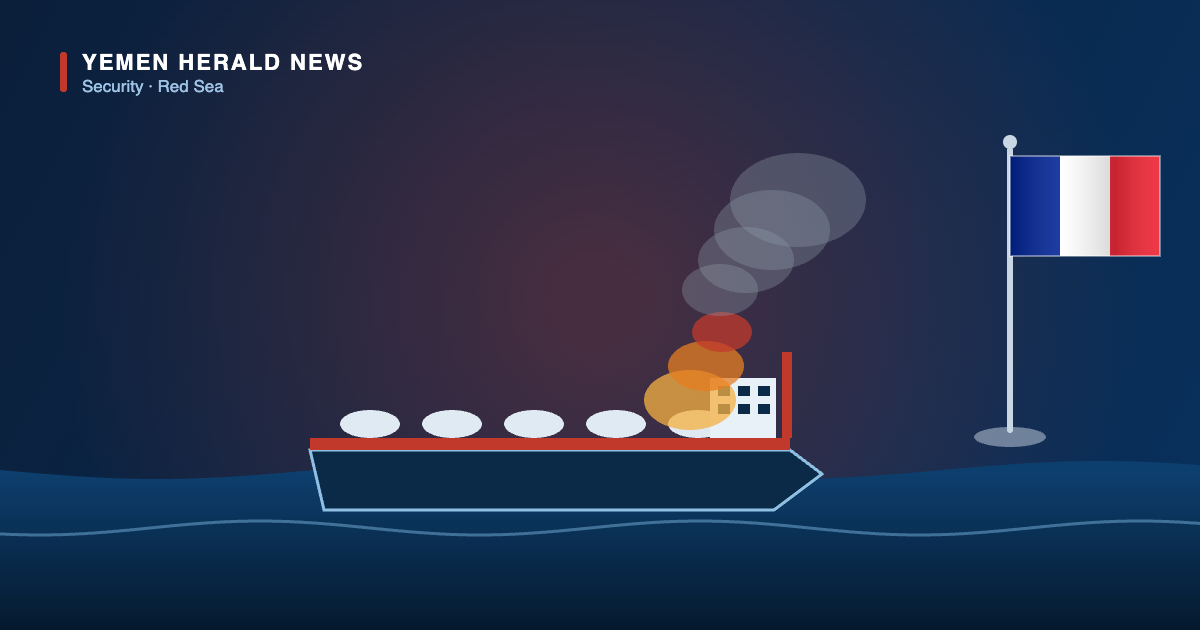
France has condemned the Houthi strikes on Saudi vessels in the Red Sea, describing the attacks as irresponsible and a serious escalation. A spokesperson for the French Ministry for Europe and Foreign Affairs told a press briefing on 23 July that the Iran-aligned movement should halt its offensive operations and stop targeting commercial shipping, and Paris reaffirmed its commitment to the security of navigation and freedom of maritime movement in the corridor.
The condemnation followed a fast-moving sequence off Yemen’s west coast. On 20 July the Houthis declared a maritime blockade of Saudi Arabia, notifying shipping companies by email that vessels were banned from loading or unloading at Saudi ports. Two days later the group’s military spokesman, Yahya Saree, said its forces had struck two Saudi oil tankers, the Encelia and the Layla, using ballistic and cruise missiles and drones because the ships had violated that decision.
Saudi authorities confirmed that the Encelia, a products tanker that had sailed from Yanbu, caught fire after being hit and said all crew members were safe. The United Kingdom Maritime Trade Operations agency placed the strike roughly 70 nautical miles southwest of the Saudi coastal city of Al Shuqaiq. No casualties or pollution were reported, but at least seven vessels altered course to avoid the Bab al-Mandab Strait in the hours that followed.
The Houthis presented the embargo as retaliation for what they described as Saudi restrictions on Yemeni ports and for an airstrike on Sanaa International Airport days earlier that they attributed to the kingdom, accusations Riyadh rejects. Saudi Arabia has called the declared blockade a dangerous escalation. France issued its statement alongside a series of condemnations from Qatar, Bahrain, Kuwait, Lebanon, the European Union and the African Union.
French concern about the Red Sea is longstanding and grounded in a physical presence. The French Navy has contributed frigates to Operation Aspides, the European Union mission launched in February 2024 to escort merchant vessels and intercept drones and missiles aimed at them, and France maintains a permanent military base in Djibouti at the southern end of the corridor. That combination gives Paris both a stake in the waterway and the means to observe what happens in it at first hand.
Aspides operates under a defensive mandate. Its warships protect shipping and provide situational awareness to owners and masters, but they do not strike targets ashore, a limitation that distinguishes the European effort from the American and British strikes on Houthi positions during the earlier phase of the campaign. The mission has also been constrained throughout by the small number of vessels member states have been prepared to commit relative to the distances involved.
The economic logic behind the European position is straightforward. The Red Sea and Suez route is the shortest link between Asian manufacturing and European ports, and it carries an estimated 12 per cent of world commerce. Diverting a vessel around the Cape of Good Hope adds between ten days and two weeks to each voyage, with corresponding fuel, crew and charter costs, while war-risk insurance premiums climb for anyone still willing to transit the southern Red Sea. Those costs eventually appear in freight rates and consumer prices.
The current escalation differs from the 2023 and 2024 campaign in an important respect. That earlier wave of attacks was framed as pressure over the war in Gaza and struck vessels of widely varied ownership. The present blockade is directed at Saudi Arabia specifically and at the export routes on which the kingdom depends, which has drawn Gulf governments into treating the maritime threat as a national security question rather than an international shipping problem.
Iran’s part in it remains disputed. The United States, European governments and United Nations experts have documented Iranian support for the Houthis’ drone and missile programmes, assistance Tehran denies providing. What is not in doubt is that the group can now hit moving vessels at considerable distance, and that capability is what makes a declared embargo credible enough to reroute traffic and reprice risk.
The human cost inside Yemen continues to mount. According to the United Nations 2026 Humanitarian Needs and Response Plan, more than 22 million people require humanitarian assistance and protection this year, including 5.2 million internally displaced people. Some 18.3 million Yemenis are acutely food insecure and more than 2.2 million children under five are acutely malnourished. Aid agencies appealed in March for 2.16 billion dollars to reach 12 million of the most vulnerable, and funding has fallen well short.
Because Yemen imports most of its food, fuel and medicine, disruption at sea passes quickly into local markets. Higher freight and insurance costs raise import prices in a country where the rial has lost much of its pre-war value and public salaries are paid irregularly, and insecurity in the shipping lanes complicates the logistics on which aid agencies rely to move supplies into Aden, Mukalla and al-Hudaydah.
Paris gave no indication that it plans to change the scale of its naval contribution. For now the French position amounts to condemnation, continued participation in a defensive European mission, and support for a negotiated end to a war that has entered its second decade. Whether that is enough will depend on how far the Houthis go in enforcing the blockade they have announced, and how Saudi Arabia chooses to respond.
About the Author