Bahrain Condemns Houthi Strike on Saudi-Operated Tanker Encelia in the Red Sea
 Yemen Herald News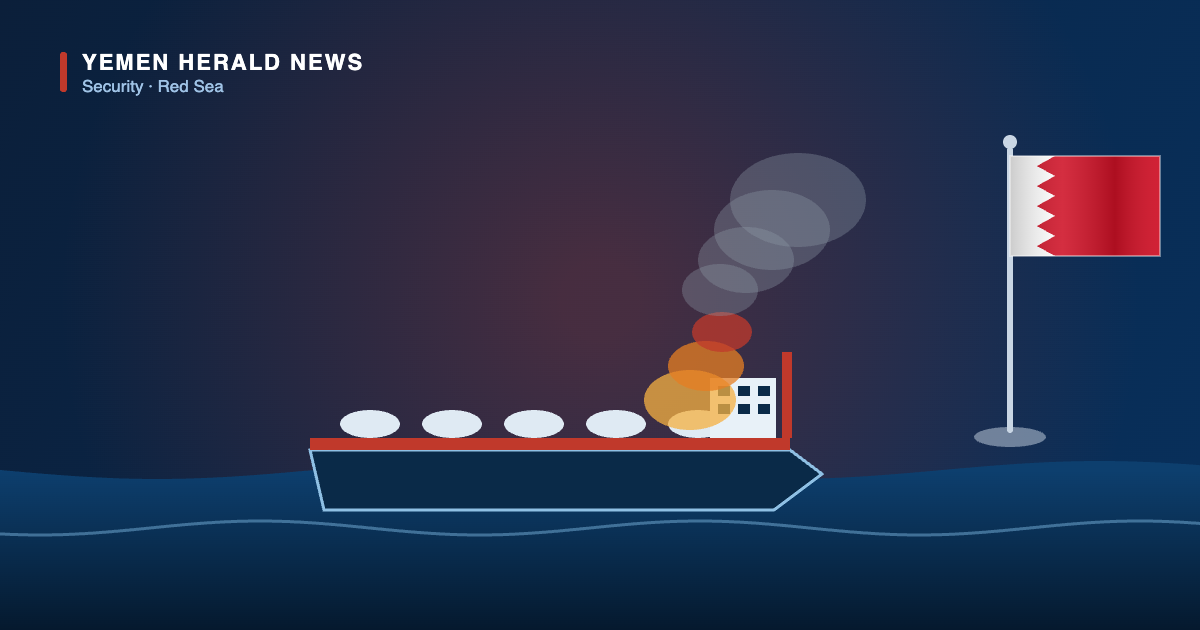
Bahrain has strongly condemned a Houthi attack on a commercial vessel operated by a Saudi company in the Red Sea, describing the assault as a blatant violation of international law and a direct threat to one of the world’s most heavily used shipping corridors. The Bahraini Ministry of Foreign Affairs issued its statement on Thursday, 23 July 2026, a day after Yemen’s Iran-aligned Houthi movement claimed responsibility for striking tankers transiting the waterway.
Saudi Arabia’s General Authority for Transport said the vessel Encelia, operated by a Saudi company, came under direct attack while sailing through the Red Sea, and that the strike started a fire in the ship’s bow. All crew members were safe and no injuries were reported. The United Kingdom Maritime Trade Operations centre said a tanker master had reported being struck by an unidentified projectile, with the crew fighting a blaze on board.
Houthi military spokesman Yahya Saree said the group had targeted two Saudi oil tankers, which he named as the Encelia and the Layla, for what he called a violation of a blockade decision issued by the movement’s armed forces. Saree said the attacks used ballistic and cruise missiles alongside drones and set fires on both ships. Saudi authorities have publicly confirmed damage only to the Encelia; the claimed strike on the Layla has not been independently verified.
In its statement, Bahrain’s foreign ministry said the attack breached international law and the United Nations Convention on the Law of the Sea, and warned that it endangered maritime navigation, international trade and the flow of energy supplies. The ministry expressed full solidarity with Saudi Arabia and backed the measures Riyadh has taken to protect its sovereignty. It urged the UN Security Council to take deterrent steps to safeguard shipping through the Strait of Hormuz, the Bab al-Mandab and other vital waterways, and to hold those behind the attacks accountable.
Kuwait issued a parallel condemnation, calling the strike a flagrant breach of international law and a direct threat to freedom of navigation and global energy supplies. Oman, long a mediator in the Yemen conflict, called instead for de-escalation and a renewed political effort to protect maritime security. Britain’s Foreign Office described the attack as reckless, saying it endangered lives and risked an environmental disaster. German Defence Minister Boris Pistorius said the situation was moving in the wrong direction and that the risk of wider escalation was rising. Algeria also condemned the strike and urged an immediate halt to attacks on international trade.
The attack followed the Houthis’ declaration on 20 July of a maritime blockade against Saudi Arabia, announced after airstrikes on 13 July damaged the runway at the Houthi-controlled airport in Sanaa. The internationally recognised Yemeni government said it struck the runway to stop an Iranian aircraft from landing; the Houthis blamed Saudi Arabia. The group framed the embargo as a reciprocal measure and accused the Saudi leadership of besieging Yemen for nearly twelve years. Riyadh rejects that characterisation, and critics note that the movement turned down a Jordanian proposal to restart flights between Amman and Sanaa.
Hussain al-Bukhaiti, a journalist based in Sanaa, told Al Jazeera that the blockade’s objective is to force Riyadh to lift its restrictions on Houthi-held ports and airports. Saree claimed that close to ten ships had abandoned their routes and turned back since the embargo was declared, a figure outside monitors have not confirmed, though independent trackers have recorded vessels diverting away from the Bab al-Mandab.
The waterway’s geography explains why Gulf capitals reacted so sharply. The Bab al-Mandab, linking the Red Sea to the Gulf of Aden between Yemen and the Horn of Africa, narrows to roughly 29 kilometres and funnels Suez-bound traffic into two channels. About 4.1 million barrels of crude oil and refined products moved through the strait each day in 2024, close to five percent of seaborne oil trade. With the Strait of Hormuz badly disrupted since the United States and Israel began their air campaign against Iran in late February, Saudi Arabia had been shifting barrels toward Red Sea export routes, precisely the corridor the Houthis are now targeting.
The pattern is not new, but its target is. The Houthis disrupted global commerce from late 2023 by attacking ships near the Bab al-Mandab in response to Israel’s war in Gaza, a campaign that wound down after the ceasefire announced in October 2025. The current operation turns the same weapons and tactics away from Israeli-linked shipping and toward vessels tied to Saudi Arabia.
The humanitarian stakes inside Yemen are substantial. The United Nations Office for the Coordination of Humanitarian Affairs estimates that more than 22 million Yemenis will need humanitarian assistance during 2026, with 18.3 million acutely food insecure and roughly 5.2 million internally displaced. Aid agencies have appealed for 2.16 billion dollars to reach 12 million people this year. Because most of Yemen’s food, fuel and relief cargo arrives through Red Sea ports, rising war-risk insurance premiums and diverted sailings translate quickly into higher prices and thinner supplies for civilians.
Whether Bahrain’s appeal produces action at the Security Council is uncertain. Similar demands during the 2023 and 2024 attacks on Red Sea shipping produced resolutions and a naval escort mission but did not stop the strikes. For now, the condemnations from Manama, Kuwait City, London, Berlin and Algiers signal an emerging diplomatic consensus rather than an enforcement plan, and shipowners are drawing their own conclusions.
About the Author