
Former Prime Minister Salem bin Braik Sworn In as Yemen’s Ambassador to Saudi Arabia
 Yemen Herald News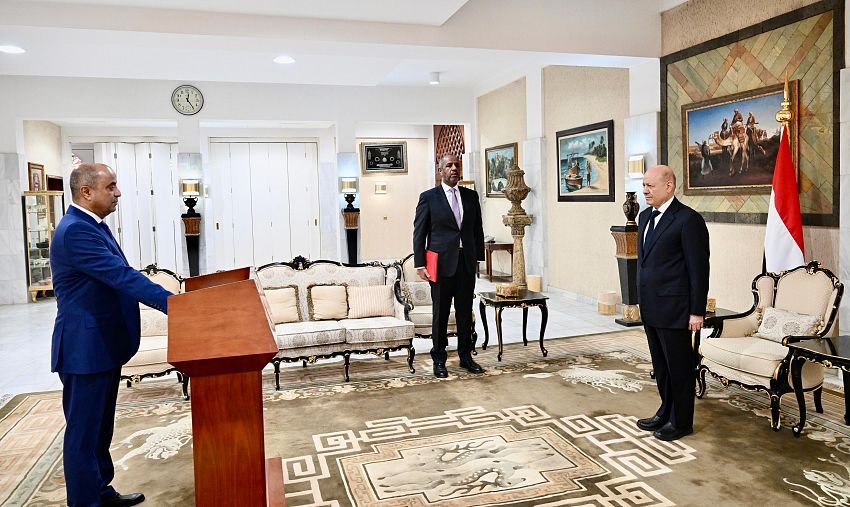
President Rashad al-Alimi, chairman of Yemen’s Presidential Leadership Council, has administered the oath of office to Salem Saleh bin Braik as Yemen’s Ambassador Extraordinary and Plenipotentiary to Saudi Arabia. The ceremony took place at the Yemeni Embassy in Riyadh and sends a former head of government to what is, in practical terms, the most consequential diplomatic posting Yemen has.
Bin Braik is not a routine appointment. He served as Yemen’s prime minister from May 2025 until early 2026, having previously held the finance portfolio, and he was sworn in as premier before al-Alimi in much the same setting. His government was replaced in February 2026 when the Presidential Leadership Council named Shaya Mohsen al-Zindani, until then foreign minister, as prime minister. Sending a recent premier to Riyadh rather than to a ceremonial post signals how much weight the council places on the Saudi file.
Addressing the new ambassador after the oath, al-Alimi urged him to approach the assignment with commitment and diligence, and described the strengthening of relations with Saudi Arabia as a strategic necessity rather than a matter of protocol. He characterised the relationship as rooted in shared history, geography and social ties, and pointed to Riyadh’s role in providing political backing, economic support and humanitarian assistance to the internationally recognised government.
That support is substantial and well documented. Saudi Arabia has led the military coalition backing the Yemeni government since 2015, has hosted the Presidential Leadership Council and successive Yemeni cabinets in Riyadh, and has provided repeated deposits to Yemen’s central bank and fuel grants intended to stabilise the currency and keep electricity generation running. Saudi development programmes have also funded infrastructure and health projects across government-held governorates. The dependence runs deep enough that the health of the Riyadh relationship shapes the Aden government’s fiscal position from month to month.
The president also raised the question of regional security and the protection of international shipping lanes, a subject that has become considerably more urgent in recent weeks. On 20 July the Houthi movement declared a naval blockade of Saudi Arabia, accusing Riyadh of imposing a long-running siege on Yemen. Saudi Arabia has since said it is working to assemble an international coalition to protect Red Sea shipping and has struck what it describes as Houthi military facilities at the port of Hodeidah. The Houthis say the blockade will be lifted if Saudi restrictions on Yemen are lifted. Each side disputes the other’s characterisation, and independent verification remains difficult.
Against that backdrop, an embassy in Riyadh is less a conventional mission than a working channel between a government and its principal backer during an active escalation. Much of the coordination on funding, on coalition military planning and on the government’s own internal disputes has for years run through the Saudi capital rather than through Aden.
Al-Alimi also asked bin Braik to prioritise consular services for the Yemeni community in Saudi Arabia, which is among the largest Yemeni populations abroad. Remittances from workers in the kingdom have long been one of the few reliable sources of hard currency reaching Yemeni households, and periodic changes to residency and labour rules have significant consequences at home. Improving documentation, residency processing and legal assistance is a concrete deliverable the embassy can be measured against.
The appointment comes during a period of visible reorganisation in Yemen’s foreign service. In July the Presidential Leadership Council approved the appointment of Afrah al-Zouba as foreign minister, the first woman to hold the post in Yemen’s history. Al-Zouba spent more than two decades in public administration and development coordination, including work with the World Bank, the International Monetary Fund and the Saudi development and reconstruction programme for Yemen. Placing an experienced administrator at the foreign ministry and a former prime minister in Riyadh suggests an attempt to professionalise a diplomatic apparatus that has been strained by years of exile and fragmentation.
The obstacles are considerable. The government controls only part of the country, its institutions are divided between Aden, Riyadh and various governorates, and its revenue base has been badly eroded since oil exports were halted by attacks on southern export terminals. Al-Alimi returned in his remarks to the restoration of state institutions, which he framed as the precondition for economic recovery and for Yemen resuming a normal role within the Gulf Cooperation Council.
The humanitarian situation gives that ambition its urgency. The United Nations estimates that more than 22 million people in Yemen will require humanitarian assistance and protection during 2026, including 5.2 million internally displaced people. Around 18.3 million people are acutely food insecure and more than 2.2 million children under five are acutely malnourished. Aid agencies have sought $2.16 billion to reach 12 million people this year, and recent appeals have closed well short of their targets.
None of that will be resolved from an embassy building. But the practical business of Yemeni statecraft — securing budget support, coordinating with the coalition, managing the diaspora, and arguing Yemen’s case as the Red Sea confrontation widens — currently runs through Riyadh more than anywhere else. Whether bin Braik’s appointment changes outcomes or simply formalises an existing arrangement will become clear in how the government’s finances and its influence over coalition decision-making fare over the coming months.
About the Author




