Japan announces $8 million emergency grant for Yemen and $2 million for Djibouti
 Yemen Herald News
TOKYO, Japan — Japan announced emergency grant aid of $8 million for Yemen and $2 million for Djibouti on Tuesday, its foreign ministry said.
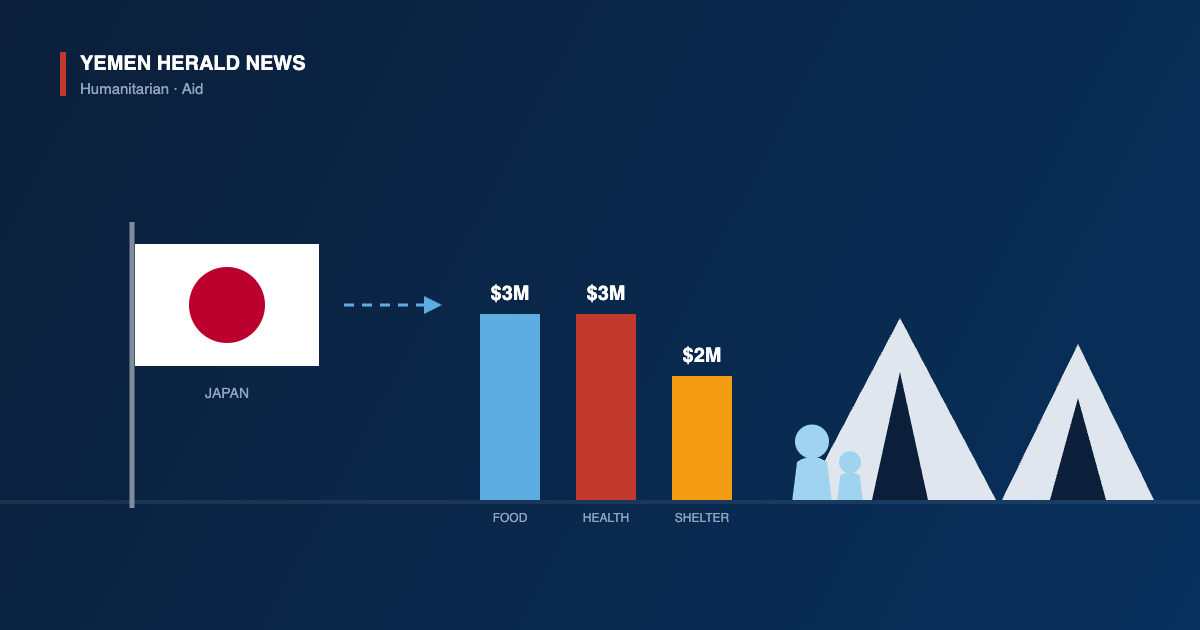
The Yemen money goes to three agencies. The World Food Programme receives $3 million for food. The International Committee of the Red Cross receives $3 million for health, water, sanitation and hygiene. The International Organization for Migration receives $2 million for shelter and non-food items.
The Djibouti money goes to the UN refugee agency, for protection, shelter and non-food items.
The two grants together come to $10 million. The foreign ministry announced them as a single package.
The ministry said it acted because the humanitarian situation in Yemen had deteriorated and its repercussions were reaching neighbouring states.
It tied the decision to shipping as well. Peace and stability in the region, including the Bab el-Mandeb Strait, was “of utmost importance to the entire international community, including Japan, from the perspective of energy security,” the ministry said.
The account of the package rests on the Japanese government’s own announcement, relayed in Yemen by Japan’s embassy. No independent confirmation has been published, and none of the four receiving agencies had issued its own statement on the allocations.
The food money arrives as the World Food Programme reports a funding gap. The agency needs $109 million for its Yemen operation, Al Jazeera reported on 2 October.
Seventy-four percent of households in accessible government-held areas cannot meet basic food needs, according to agency figures released that day. About 10 million people live in those areas.
Matthew Hollingworth, the agency’s assistant executive director, said the escalation “threatens to be absolutely devastating” for food security.
“We are looking at a hunger crisis that is going to grow as it persists,” he said.
Across Yemen, 18.3 million people face severe food insecurity and 2.2 million children under five are acutely malnourished, the agency said.
More than 149,000 people have been displaced inside Yemen since the escalation began, it said. More than 3,700 had crossed to Djibouti by late September.
The Red Cross committee has been running emergency medical deliveries. It sent 22 tonnes of medical supplies to Sanaa on 18 September for distribution to priority hospitals and health facilities.
A mobile surgical team has worked at Marib General Hospital since 23 August, and more than 50 Yemeni Red Crescent ambulances operate on both front lines, the committee said. It described itself as the only international humanitarian organisation present and active in some areas of the country.
Christine Cipolla, who heads the committee’s delegation in Yemen, said the escalation “has overwhelmed hospitals, which are grappling with critical shortages of medical supplies and an influx of war-wounded patients.”
Djibouti recorded about 500 arrivals by 11 September and more than 2,000 by 13 September, Al Jazeera reported. The network reported 3,400 arrivals over a 48-hour period by 15 September.
People crossed in vessels ranging from small dhows to larger ships, according to that reporting. Children faced extreme heat, dehydration and a shortage of safe drinking water. Some families were left on the Yemeni shore by fuel shortages.
Alexandre Coissac heads the International Organization for Migration’s office in Djibouti. Sandrine Dominique Desamours is the UN refugee agency’s representative there.
The crossings followed the Houthi seizure of the Red Sea port of Mocha and an advance toward Bab al-Mandab. Yemen’s government said on 5 October that its forces had taken both Bab al-Mandab and Mocha. The Houthis dispute government accounts of territorial control.
Fighting escalated through September. Al Jazeera reported on 27 September that Yemeni government forces had widened their attacks against the Houthis.
CNN reported on 4 October that Saudi-backed Yemeni forces were attacking Houthi positions near the shipping route through the strait.
Traffic through the strait has fallen. An average of 31 vessels a day crossed in late July, down 50 percent in tonnage terms from the second-quarter average, according to Clarksons Research.
Very large crude carriers averaged one a day that week, down from three a day in the second quarter, the firm’s global head of research, Steve Gordon, said.
The UN humanitarian response plan for Yemen, published in March, puts more than 22 million people in need of assistance and counts 5.2 million internally displaced. It seeks $2.16 billion to reach 12 million people.
Japan announced a separate package for Yemen of about $13.8 million on 17 December 2025. That included $1.18 million for peace-related work.
Of that sum, $960,000 went to the UN Verification and Inspection Mechanism, which inspects commercial cargo bound for Yemeni ports under Security Council Resolution 2216. A further $220,000 went to the Office of the Special Envoy for Yemen.
The balance covered nutrition, health, protection for displaced people and refugees, disaster response, water, reproductive health, prevention of gender-based violence and mine action. It was delivered through the World Food Programme, UNICEF, the UN refugee agency, UNESCO, the UN Population Fund, the Red Cross committee and the UN Development Programme.
Japan has made emergency grants to Yemen before. Its foreign ministry announced Emergency Grant Aid of 11 million dollars on 19 September 2017 for four countries hit by famine, among them Yemen, Somalia, South Sudan and northeast Nigeria. Japan has also funded UNICEF in Yemen, including 5 million dollars to expand nutrition services.
About the Author