Yemen’s Executive Unit counts 23,550 families displaced by the latest escalation
 Yemen Herald News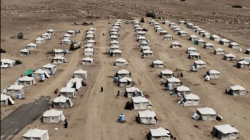
ADEN, Yemen — Yemen’s Executive Unit for the Management of Displaced Persons Camps has recorded 23,550 families displaced by the latest military escalation, the body said.
That is 158,109 people, in a count the Unit ran through Sept. 27.
The Unit’s latest report placed the displacement across ten governorates held by the internationally recognised government. A report on Sept. 22 carrying the same family and individual totals gave the figure for eight.
The account rests on the Executive Unit. No independent confirmation of its count has been published, and every published report of the figures traces back to the Unit.
The Unit’s count differs from the one kept by the International Organization for Migration.
IOM put the number displaced at 145,308 in late September, a rise of about 16,000 over the previous week.
IOM put that figure at about 24,218 households. The Unit’s count of 23,550 families sits close to it, while the two counts of individuals differ by roughly 13,000.
The two bodies measure different periods. IOM counts displacement since insecurity escalated in June, while the Unit counts from the start of the latest escalation.
IOM recorded 15,870 people newly displaced between Sept. 21 and Sept. 28, a rise of 12 percent in a week.
Abdusattor Esoev, IOM’s chief of mission in Yemen, said on Sept. 29 that the agency was counting thousands more people each week who had left everything behind.
Esoev said those families needed shelter, food and protection.
The divergence has drawn official attention. A government coordination meeting in Aden agreed on Sept. 28 to work toward a single set of displacement figures, the state news agency Saba reported.
Deputy Minister of Planning and International Cooperation Nizar Basuhyab chaired that meeting, according to Saba.
The agency had recorded about 46,000 displaced on Sept. 11, more than 104,000 by Sept. 16 and close to 130,000 by Sept. 21.
In a tally covering Sept. 1 to Sept. 18, the Executive Unit reported 21,583 families, or 146,943 people.
Taiz accounted for 11,534 of those families and 80,792 people, the largest share of the total.
Lahj followed with 5,472 families and 38,304 people. Aden recorded 1,622 families and 7,162 people.
Al-Hudaydah recorded 1,471 families and 10,297 people, and Abyan 1,278 families and 8,946 people.
Smaller numbers were logged in Hadramout, with 110 families, Al-Mahrah with 70 and Shabwa with 26.
The Unit said continued fighting, shelling and worsening security were the main drivers of the movement.
It said the displacement was deepening Yemen’s humanitarian crisis and straining conditions for families already living in camps.
The Unit called on United Nations agencies, international and local organisations and donor governments to release resources for emergency assistance. It listed shelter, food, clean water and sanitation among the priority needs.
Fighting on Yemen’s west coast drove much of the movement. Al Jazeera reported in September that Houthi forces and government units were fighting for the Kahboub Mountains in Taiz and Lahj, and that the Houthis had taken Mocha port and Mayyun Island earlier in the month.
IOM said three districts of Taiz had emptied: Maqbanah, Jabal Habashi and Al Ma’afer.
Amy Pope, IOM’s director general, said in September that families were being forced to flee for the second or third time since the start of the conflict, with almost nothing left.
The UN Office for the Coordination of Humanitarian Affairs recorded at least 14 civilians killed or wounded in the first days of September, among them two children.
The World Health Organization recorded 67 deaths and 288 injuries across seven governorates between Aug. 6 and Aug. 24.
By late September the WHO count had risen to 674 killed and close to 3,000 wounded since Aug. 6.
IOM counted 93,864 people newly displaced across Yemen by Sept. 15, with movement recorded in Aden, Al-Hudaydah, Abyan, Taiz and Marib.
The agency also logged movement northward into Ibb.
Some of those displaced left the country. More than 2,400 people crossed into Djibouti over four days in September after the fighting spread along the west coast.
More than 60 percent of those arriving in Djibouti were women, children and elderly people, according to the UN refugee agency.
Sandrine Desamours, UNHCR’s representative in Djibouti, said further support was needed before the response there was overwhelmed.
Tom Fletcher, the UN emergency relief coordinator, released 9 million dollars from the Central Emergency Response Fund for the response in Yemen.
Stephane Dujarric, the UN spokesman, said humanitarian supplies were running low and called on the parties to the fighting to allow aid access.
IOM listed shelter, food, water, household items, health care and protection among the needs of those displaced.
The new movement adds to a caseload recorded before the escalation. The United Nations humanitarian plan for 2026 counted 5.2 million people already displaced inside Yemen.
That plan put the number of people needing aid at more than 22 million, with 18.3 million acutely food insecure.
It recorded more than 2.2 million children under five as acutely malnourished, 516,157 of them severely.
The plan sought 2.16 billion dollars to reach 12 million people.
The United Nations said 60 percent of Yemen’s health facilities were fully operational.
Marib General Hospital suspended maternity services to take trauma cases, according to the same UN account.
The Executive Unit operates under Yemen’s internationally recognised government and reports on camp conditions and displacement movements in the areas it administers.
About the Author