UN envoy Hans Grundberg meets Houthi chief negotiator in Muscat over Yemen escalation
 Yemen Herald News
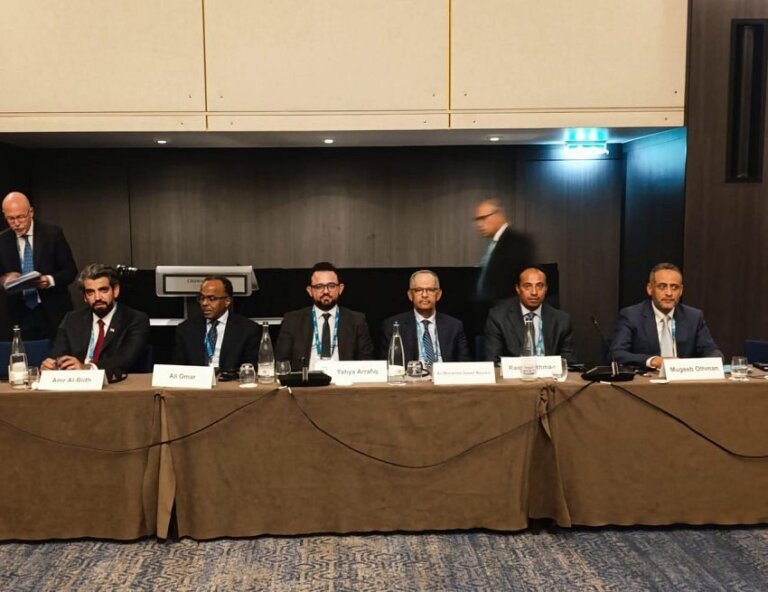
MUSCAT, Oman — UN special envoy Hans Grundberg met the Houthis’ chief negotiator here last weekend, looking for ways to stop Yemen’s escalation from going further.
The envoy met Mohammed Abdul-Salam, who negotiates for the group, The Associated Press reported on Tuesday, 29 September.
Grundberg said he wanted to explore “if there are ways of how to avoid seeing the current escalation go even further,” according to the agency.
The account of the Muscat meeting rests on Grundberg’s own remarks to AP. His office has published no readout of it, the Houthis have issued no statement on it, and Yemen Herald found no confirmation of the meeting independent of what the envoy himself said.
He described the Houthi escalation as “unprecedented” and “dramatic,” AP reported.
Grundberg also held talks in Riyadh with the Saudi government, according to the same account.
“The current situation is going to be challenging to resolve,” he said.
He said the strands of the conflict should be handled apart. “My recommendation at this point is to make sure that you disentangle these conflicts and you address them one by one,” he said.
Fighting has reached Yemen’s Red Sea coast. Grundberg called those “the most sensitive front lines.”
“We’ve seen attacks also on commercial shipping in the Red Sea, and it’s a development that is alarming and that should be a concern for the Security Council,” he said.
The Houthis took the Red Sea city of Mokha on 10 September. Al Jazeera reported the seizure that day, and three Yemeni government sources confirmed it to Reuters.
Al Jazeera’s correspondent, Yousef Mawry, reported that government forces called for reinforcements and tried to hold the city before the port and Mokha itself fell.
The group also took several Red Sea islands early in the month, AP reported. The agency described the advance as the largest land grab in years.
Mokha lies on Yemen’s Red Sea coast, south of Hudaydah.
Bab al-Mandab links the Red Sea to the Gulf of Aden at the southern end of the Red Sea.
Rashad al-Alimi, who chairs the Presidential Leadership Council, said at the time that Bab al-Mandab “cannot become another Strait of Hormuz.” He called the waterway a regional and international matter tied to global trade.
Al-Alimi’s council took power in April 2022 and sits in Aden.
Abdul-Salam said then that navigation in the Red Sea remained safe and uninterrupted. He said the group’s ban on Saudi ships stood.
About 12% of global trade passes through the strait, according to AP.
The Houthis have stepped up cross-border attacks into Saudi Arabia and have targeted oil facilities there, the agency reported. It said they have also blocked Saudi tankers from passing Bab al-Mandab.
The World Health Organization recorded 838 people killed and 3,643 wounded in Yemen between 6 August and 26 September. It put recorded casualties at 4,481 over that period, drawing on returns collected by Yemen’s Health Emergency Operations Center.
UN figures cited by AP put internal displacement at more than 145,000 people. More than 3,000 have crossed to Djibouti.
Oman has hosted the Houthis’ negotiating team through the war. Grundberg’s office said in April that Oman supports dialogue on Yemen and that regional backing matters to the UN mediation effort.
He visited Muscat in April as well, meeting senior Omani officials and Abdul-Salam, according to a statement his office issued on 22 April.
Abdul-Salam held the same role in September 2022, when Grundberg met him in Muscat during efforts to extend that year’s truce, the envoy’s office said at the time.
Grundberg told the Security Council on 13 August that Yemen “faces a more serious risk of return to large-scale conflict than at any point since the 2022 UN-mediated truce.”
He told the council in that briefing that Ansar Allah’s renewed attacks on commercial vessels in the Red Sea and the Gulf of Aden risked deepening Yemen’s entanglement with the wider regional confrontation.
“For four years, and well beyond its formal expiry, the truce kept Yemen’s front lines relatively quiet,” he said in that briefing.
The truce took effect in April 2022 under UN mediation. It was extended twice and formally lapsed that October, though several of its provisions held afterwards.
In the same briefing he pointed to attacks by Ansar Allah in Marib, Hadramawt and Mokha, which he said had caused casualties among military personnel and civilians.
He also said 73 UN personnel had been arbitrarily detained by Ansar Allah, the Houthis’ formal name. Staff from non-governmental organisations, civil society and diplomatic missions had been held as well, he said.
A separate track on conflict-related detainees has been running in Amman. Grundberg’s office said in April that a breakthrough there was needed to bring relief to hundreds of Yemeni families.
The UN humanitarian plan for Yemen published in March counted more than 22 million people in need of assistance. It put 18.3 million as acutely food insecure and 5.2 million as internally displaced.
The plan recorded more than 2.2 million children under five as acutely malnourished, 516,157 of them severely. It sought 2.16 billion dollars to reach 12 million people.
Grundberg took up the post in September 2021, succeeding Martin Griffiths. He is the fourth person to hold it since the UN appointed a special envoy for Yemen in 2012.
About the Author