
Yemen and Japan Explore Deeper Security Cooperation as Interior Minister Meets Japanese Ambassador
 Yemen Herald News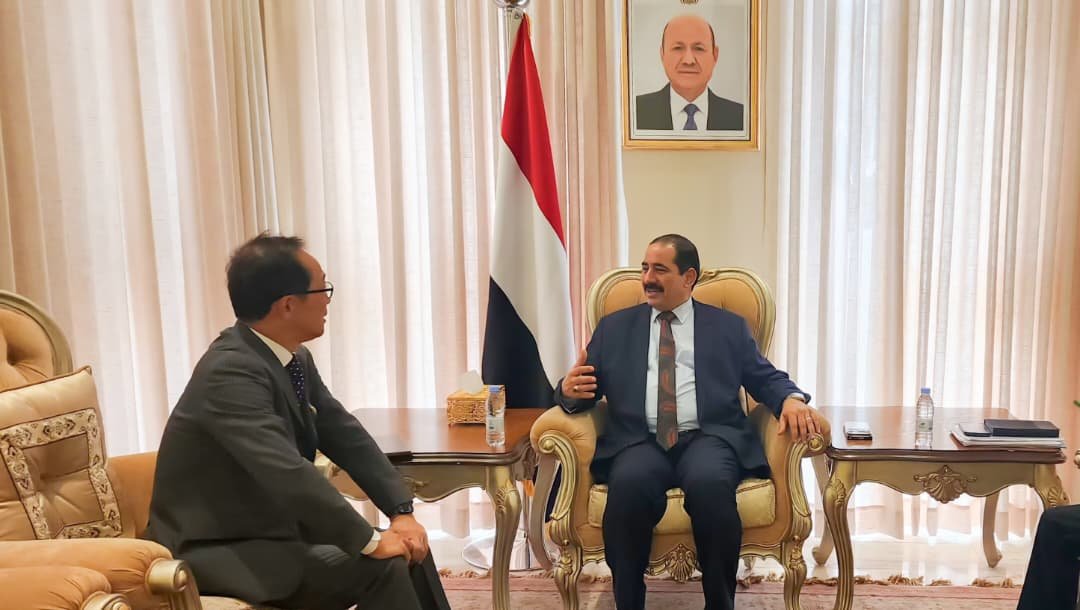
Yemen and Japan have moved to broaden their cooperation on security, with the internationally recognised government seeking expanded Japanese assistance to rebuild policing capacity, secure the country’s long coastline and confront the smuggling networks that have flourished during more than a decade of war. The push was underlined in talks between Yemen’s Minister of Interior, Major General Ibrahim Haidan, and the Japanese Ambassador to Yemen, Yoichi Nakashima, who reaffirmed Tokyo’s commitment to standing by the ministry as it works to restore basic order.
During the discussions, Haidan pressed for deeper Japanese support in a set of specific areas, chief among them forensic expertise, rehabilitation and structured training programmes designed to raise the professional standard of Yemeni security personnel. He framed capacity building as central to the government’s effort to reassert the rule of law, arguing that better investigative tools and modern policing methods are prerequisites for tackling crime in a country whose institutions have been hollowed out by conflict.
A large part of the conversation centred on maritime security. Haidan highlighted the need to strengthen the Coast Guard so that it can more effectively patrol Yemen’s territorial waters, interdict weapons and drug smuggling, and disrupt the organised criminal groups that exploit weak enforcement. Yemen sits alongside the Bab al-Mandab Strait, the narrow chokepoint linking the Red Sea to the Gulf of Aden through which a substantial share of global seaborne trade passes, and instability along its shores carries consequences far beyond the country’s borders.
Ambassador Nakashima reaffirmed Japan’s readiness to help Yemen navigate its overlapping challenges and signalled that Tokyo intends to keep working closely with the Interior Ministry. Japanese engagement has been channelled in part through the Japan International Cooperation Agency, whose development work has accompanied diplomatic support, and Nakashima praised the ministry’s rollout of a biometric identification card project as a meaningful step toward reliable documentation and identity verification, tools that underpin both public administration and security screening.
Japan’s approach to Yemen has consistently emphasised capacity building and humanitarian assistance rather than direct military involvement, positioning Tokyo as a partner focused on institutions, training and reconstruction. That posture allows it to support the recognised government’s security apparatus without becoming entangled in the fighting, and it aligns with a broader international interest in preventing the Red Sea corridor from becoming a permanent zone of disorder. Tokyo has long maintained development and humanitarian ties with Yemen and has repeatedly channelled aid through United Nations agencies during the war.
The backdrop to the meeting is a conflict that has ground on since 2015, when the Houthi movement seized the capital, Sanaa, and pushed the government south, prompting a Saudi-led coalition to intervene. The war has splintered the country into rival areas of control, devastated the economy and produced one of the world’s gravest humanitarian emergencies, with the United Nations estimating that well over half the population depends on some form of aid. Displacement has uprooted millions, and the collapse of services has left large parts of the population exposed to disease and hunger.
Within that landscape, rebuilding a functioning security sector is both urgent and difficult. Smuggling routes that move weapons, fuel and narcotics not only undercut state authority but can also finance armed groups, feeding a cycle of instability. By investing in forensic capability, training and coastal enforcement, the government hopes to weaken those networks and reassure Yemenis and international partners alike that a measure of order can be restored even before a comprehensive political settlement is reached.
The emphasis on the Coast Guard is particularly timely given persistent concern over maritime security in the region. Attacks on commercial shipping and the militarisation of the Red Sea in recent years have sharpened international attention on who controls Yemen’s waters and how effectively they are policed. A better-equipped and better-trained Yemeni Coast Guard would serve national interests while contributing to the wider goal of keeping one of the world’s busiest trade arteries open and secure for the many economies that depend on it.
For Yemen’s government, cooperation of this kind also carries a political message. Partnerships built around training, forensics and institution building offer a template for foreign engagement that strengthens the state without deepening the country’s dependence on any single military actor. Officials have repeatedly sought this type of assistance, and the meeting with Nakashima reflected a continued effort to convert diplomatic goodwill into concrete programmes on the ground.
Yemen’s internationally recognised authority is led by the Presidential Leadership Council, established in 2022 to unify anti-Houthi factions and coordinate governance from the interim capital, Aden. Strengthening the Interior Ministry is part of the council’s wider bid to show it can deliver security, and outreach to partners such as Japan is central to that effort.
Neither side announced specific new agreements, funding figures or timelines, and the talks are best understood as part of an ongoing dialogue rather than a single decisive breakthrough. Even so, the tone was constructive. With Japan reaffirming its support and Yemen articulating clear priorities, the exchange pointed to a durable, low-profile partnership that could yield gradual gains in policing and maritime enforcement. In a country where stability has proved elusive, incremental progress on security is widely seen as a necessary foundation for any eventual recovery and for easing the humanitarian crisis that continues to affect millions of Yemenis.
About the Author




