Yemen’s ambassador to Japan discusses parliamentary cooperation in Tokyo talks
 Yemen Herald News
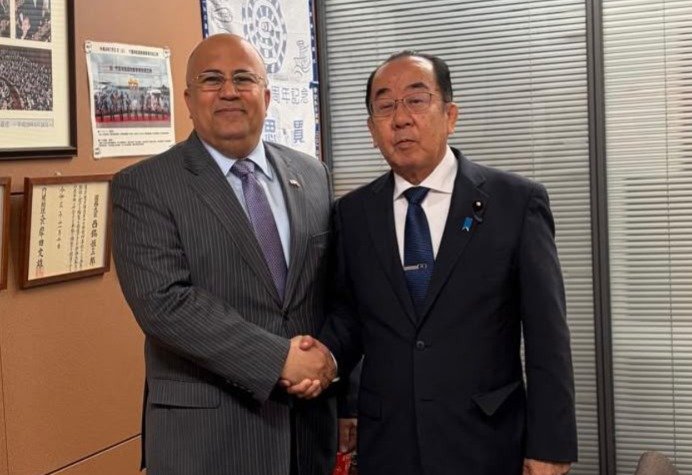
TOKYO, Japan — Yemen’s ambassador to Japan discussed ways to strengthen parliamentary cooperation with the head of the Japan-Yemen Parliamentary Friendship League on Thursday, the state news agency Saba reported.
Ambassador Adel al-Sunaini met Kosaburo Nishime in Tokyo, according to the agency.
Nishime is a member of Japan’s House of Representatives. He chairs the parliamentary friendship group linking the two legislatures.
Saba rendered the lawmaker’s name as Kosaburo Nishimi. The House of Representatives lists him as Kosaburo Nishime, and that spelling is used here.
Al-Sunaini briefed Nishime on developments in Yemen and the wider region, Saba said. He set out government efforts to restore state institutions and to secure international shipping.
The ambassador raised what he called escalation by the Iran-backed Houthi militia. He cited the siege of Taiz, attacks on civilian facilities and threats to shipping lanes, according to the agency.
He warned of consequences for security in the Red Sea and the Bab al-Mandab Strait, and for global trade and energy supplies.
The group rejects that characterisation. It did not publish a response to the ambassador’s remarks.
Al-Sunaini asked for wider international support, Saba reported. He said the government needed help to rebuild institutions, extend control over cities, ports and coastlines, and protect maritime routes.
He praised Japan’s backing for the Presidential Leadership Council and for Yemen’s unity and stability. He also thanked Tokyo for development and humanitarian aid.
Nishime restated his commitment to bilateral relations and to Japanese support for Yemen, the agency said. He stressed maritime security and the safety of shipping routes.
He said work toward peace and stability in Yemen and the region should continue, according to Saba.
The account of the meeting rests on the Yemeni state news agency. No independent confirmation of it has been published.
Nishime has sat in the Diet since 2003. He represents Okinawa’s fourth district for the Liberal Democratic Party, and served as minister of reconstruction from October 2021 to August 2022.
Japan’s foreign ministry gives the ambassador’s full name as Adel Ali Ahmed Alsunaini.
The meeting follows a separate round of talks in Tokyo earlier this month. Al-Sunaini met Keiichi Iwamoto of the Japanese foreign ministry on Oct. 16, Saba reported at the time.
Japan announced an emergency grant for Yemen on Oct. 6. Its foreign ministry said it had decided on $10 million, of which $8 million was allocated to Yemen and $2 million to Djibouti.
The money is going through the World Food Programme, the Red Cross, the International Organization for Migration and the UN refugee agency, the ministry said.
It covers food, health, water and sanitation, shelter, non-food items and protection.
Tokyo has set out its position on the war before. Parliamentary Vice-Minister for Foreign Affairs Yohei Onishi received al-Sunaini on Dec. 16, 2025, Japan’s foreign ministry said.
Onishi said Japan would keep supporting dialogue among Yemenis and subsequent efforts to build a new state, according to the ministry’s account.
He also stressed freedom of navigation and maritime safety in the Red Sea, and said Japan intended to take measures toward that end.
The United Nations humanitarian plan published in March put more than 22 million people in Yemen in need of assistance. It recorded 18.3 million as acutely food insecure.
More than 2.2 million children under five were acutely malnourished, the plan said, 516,157 of them severely.
It counted 5.2 million people displaced inside the country. The appeal sought $2.16 billion to reach 12 million people.
Taiz has drawn particular attention in recent weeks. The World Food Programme said this month it could no longer reach 600,000 people in the city as flour stocks ran down.
Humanitarian workers said wheat and flour stocks in Taiz could run out in less than three weeks, and that food prices had risen by about half. Gasoline prices have tripled and cooking gas is almost unavailable.
The World Health Organization recorded more than 8,000 suspected cholera cases in Yemen since the start of the year. About a quarter of them came in the past four weeks.
UN spokesman Stephane Dujarric said the United Nations and its partners had provided emergency assistance to about 148,000 people since the beginning of August.
The World Food Programme estimates it needs $268 million to sustain its operations through 2027.
The talks took place during an escalation in the war. A missile attack hit a military camp in Shabwa on Oct. 19.
Government officials and medical sources initially reported at least 18 people killed and more than 30 wounded, according to news agencies. The local authority in Shabwa later put the toll at 53 killed and 200 wounded.
The dead were security recruits in training. A spokesperson for government forces said three ballistic missiles struck the al-Alam camp.
The Houthis claimed the attack. Their spokesman said sites with a Saudi-backed military presence were legitimate targets.
Rashad al-Alimi, who chairs the Presidential Leadership Council, called the attack a terrorist act and promised a firm response.
The group has also stepped up attacks on Saudi Arabia, including on Riyadh’s international airport and on the state oil company Aramco. Saudi authorities warned residents of the capital of a hostile aerial threat on Oct. 19.
Fighting had eased after a truce in 2022. It resumed this year, and government forces began a counteroffensive, the Dawn of Yemen operation, to retake Houthi-held areas.
Nishime was first elected to the Okinawa Prefectural Assembly in 1988.
About the Author